
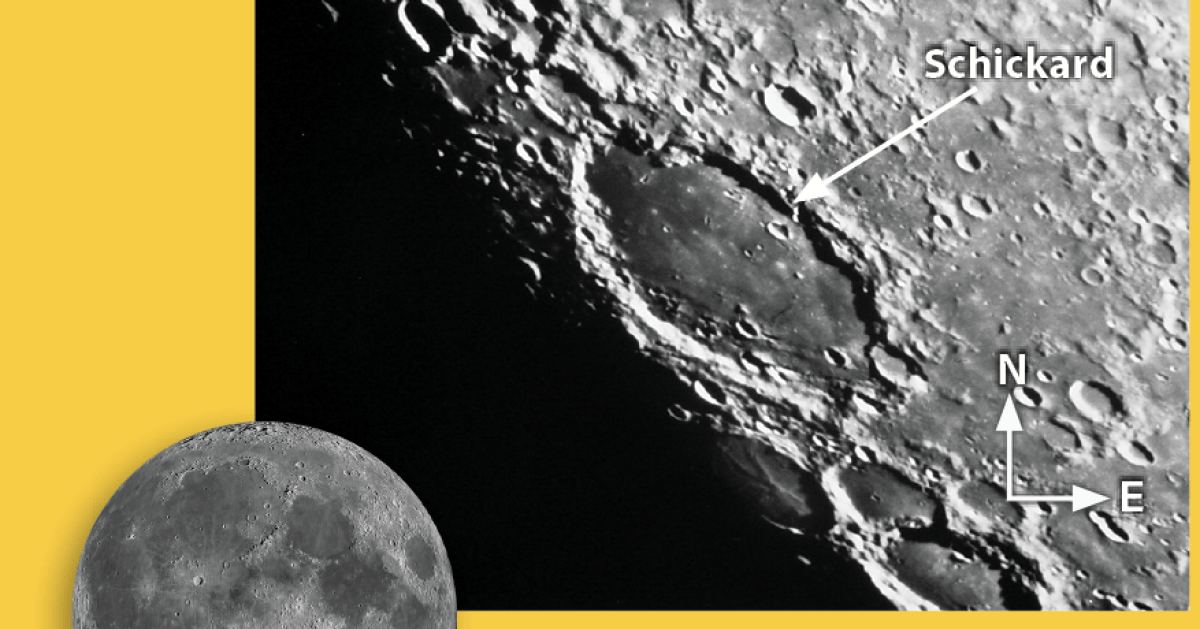
This broad impact crater in the lunar southwest is now lit by sunlight as the Moon’s phase approaches Full. | Published: November 22, 2026 Looking for a sky event this week? Check out our full Sky This Week column. November 21: Mercury far west of the Sun With the Moon not far from Full, its western limb is now coming into view as the Sun rises across the lunar landscape. The large, flat-floored crater Schickard is prominent in the southwest, near the small, circular Mare Humorum. Because the nearly Full Moon is so bright, you may want to use a Moon filter before you turn your telescope toward our satellite tonight for a closer look. Zoom in on Schickard to discover that its dark floor isn’t perfectly smooth, but pockmarked by smaller craters that came after the initial, larger crater’s formation. Its outer walls are shallow and beaten down, also showing off their age. Look closely at Schickard’s western wall to see how it has slumped, particularly compared to the eastern side of the crater rim. Also compare the texture of the southwestern portion of the crater floor, which appears quite rough, to the rest of the crater, which is smoother. The difference arises because most of the crater was flooded by lava, which didn’t quite reach its southwestern regions. Stretching about 130 miles (210 kilometers) across, Schickard is roughly 4 billion years old and was formed by a giant impact. Because it sits so near the limb of the Moon, it often looks oblong from our vantage point on Earth — but from above, orbiters have shown it is really quite circular in shape. Sunrise: 6:53 A.M.Sunset: 4:39 P.M.Moonrise: 2:59 P.M.Moonset: 4:34 A.M.Moon Phase: Waxing gibbous (97%)*Times for sunrise, sunset, moonrise, and moonset are given in local time from 40° N 90° W. The Moon’s illumination is given at 10 P.M. local time from the same location. Alison Klesman is senior editor of Astronomy magazine. She holds a Ph.D. in astronomy and has studied a variety of topics, from minor planets to supermassive black holes.
The Sky Today on Sunday, November 22: Flat-floored lunar crater Schickard
Full Article
Original Source
Read the full article at Astronomy →KhanList aggregates and links to publicly available news content. We do not host full articles from third-party sources. Always verify important information with original sources.