
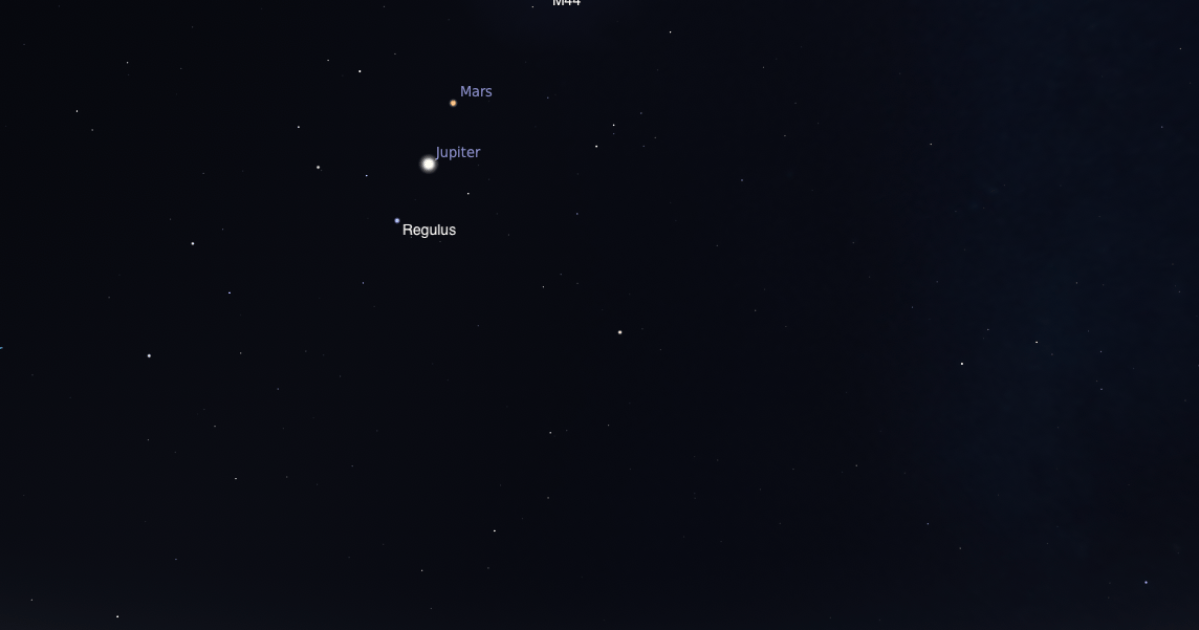
Our satellite stands in Cancer the Crab, not far from M44 and ready to approach western Leo to pass the planets there. | Published: November 1, 2026 As November opens, the Moon floats in Cancer, not far from the Beehive Cluster (M44). To their east, Jupiter and Mars dominate Leo, with Jupiter halfway between Mars and Regulus, the Lion’s alpha star. Credit: Stellarium/USGS/Celestia/Clementine Looking for a sky event this week? Check out our full Sky This Week column. October 31: Glimpse the ghostly Phantom Galaxy Daylight saving time ends at 2 A.M. local daylight time this morning, when clocks fall back one hour to 1 A.M. local standard time. Early this morning, the waning gibbous Moon is in Cancer, just west of the naked-eye Beehive Cluster (M44). The cluster might be hard to catch today without optical aid due to the nearby light of our satellite, but should show up nicely in binoculars or even your telescope’s finder scope. Its stars are spread so widely — across nearly 100’ of sky — that observing them through a telescope at higher magnification only shows the cluster’s central regions. East of the Moon, Mars and Jupiter shine brightly in western Leo, to the upper right of the bright star Regulus. Brighter Jupiter should be particularly easy to spot, located halfway between the Red Planet and the blue-white star. The Moon will reach Last Quarter phase this afternoon at 3:28 P.M. EST. Sunrise: 6:29 A.M.Sunset: 4:57 P.M.Moonrise: 11:23 P.M.Moonset: 1:11 P.M.Moon Phase: Waning crescent (47%)*Times for sunrise, sunset, moonrise, and moonset are given in local time from 40° N 90° W. The Moon’s illumination is given at 10 P.M. local time from the same location. By 5 A.M. local time on November 2, western Leo is more than 50° high in the southeast. The Moon lies just to Mars’ upper right, roughly 1.5° southwest of the Red Planet’s position and 6.3° west-northwest of Jupiter. The gas giant is by far the brightest light here, shining at magnitude –2.0. This morning it lies halfway between the Moon and Regulus to its lower left (east), Leo’s alpha star and the base of the Sickle asterism. The Moon is sliding east along the ecliptic this week; on November 2, it lies less than 2° from Mars in the early-morning sky. Credit: Stellarium/USGS/Celestia/Clementine This view offers a great opportunity to see just how far the Moon travels through our sky in a day. By tomorrow morning at the same time, Luna will have moved some 14° to the east, passing close to Regulus and standing southeast of the star in the early-morning sky at the same time. Make sure to check out the view tomorrow for comparison. Alison Klesman is senior editor of Astronomy magazine. She holds a Ph.D. in astronomy and has studied a variety of topics, from minor planets to supermassive black holes.
The Sky Today on Sunday, November 1: The Moon in Cancer
Full Article
Original Source
Read the full article at Astronomy →KhanList aggregates and links to publicly available news content. We do not host full articles from third-party sources. Always verify important information with original sources.