
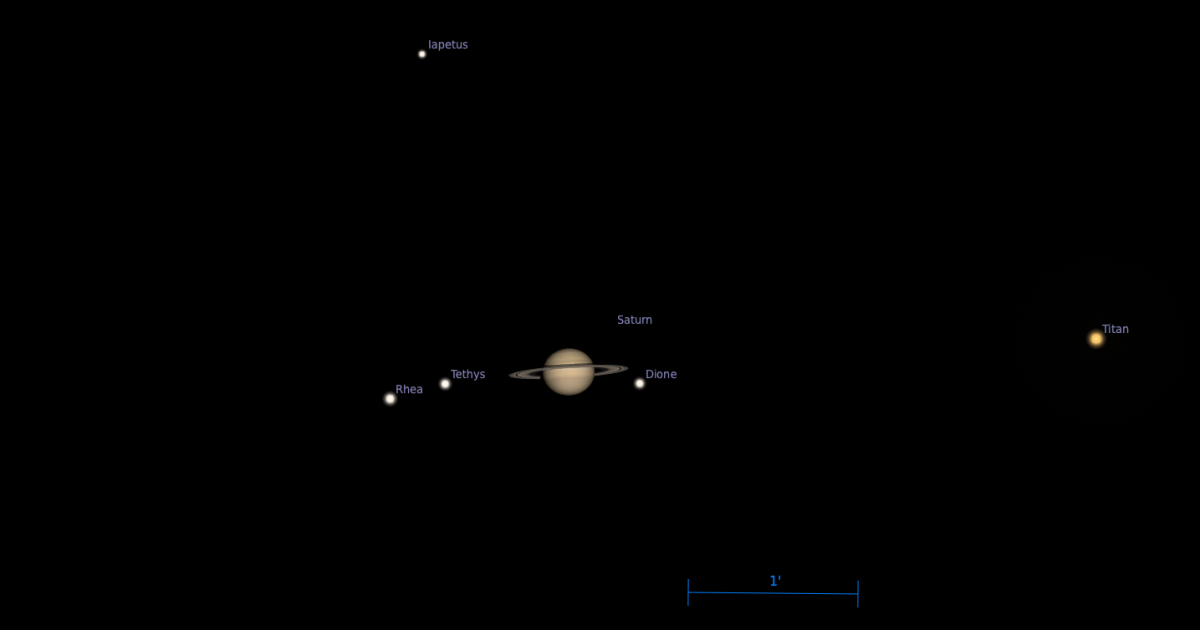
The two-toned moon Iapetus sits near the ringed world for the next several nights, making it easier to locate. | Published: November 28, 2026 Iapetus sits close to Saturn at the end of November, approaching inferior conjunction on the 30th. You’ve got a few days to catch it as it slides north of the ringed world. Note that only moons brighter than about magnitude 11 are shown here. Credit: Stellarium/Oleg Pluton Looking for a sky event this week? Check out our full Sky This Week column. November 27: Catch Comet Hartley-IRAS Saturn remains a bright naked-eye object all evening, setting around 2 A.M. local time. Around 8 P.M., you’ll find it high in the south, to the left of the Circlet of Pisces and above the body of Cetus the Whale. Tonight and for the next few nights, Saturn’s strange, two-faced moon Iapetus is skimming north of the planet, making it easier to find. Now glowing at 11th magnitude, it is heading west toward a late December western elongation, when it will shine about a magnitude brighter but sit far from Saturn. Once you’ve got Saturn in your scope, look about 2’ northeast to land on Iapetus. Over the next few nights, it will move westward, reaching inferior conjunction and standing due north of the ringed world by the 30th. If you can catch 11th-magnitude Iapetus, you’ll also see four brighter moons: 10th-magnitude Dione, Rhea, and Tethys closer to Saturn; and mid-8th-magnitude Titan, about 3’ to Saturn’s west. The latter is the planet’s largest and brightest moon, easy to spot in any size scope and often even binoculars. If you keep returning each night to track Iapetus, also keep an eye on Titan, which is moving eastward toward the planet and will pass south of Saturn on December 2. Dione, Rhea, and Tethys have smaller orbits and shorter periods, so they move visibly over the course of several hours, frequently swapping places and passing in front of or behind Saturn. For example, Dione disappears behind Saturn’s southwestern limb in an occultation around 12:20 A.M. EST on the 29th (still late on the 28th in time zones farther west). Sunrise: 7:00 A.M.Sunset: 4:36 P.M.Moonrise: 9:10 P.M.Moonset: 11:09 A.M.Moon Phase: Waning gibbous (73%)*Times for sunrise, sunset, moonrise, and moonset are given in local time from 40° N 90° W. The Moon’s illumination is given at 10 P.M. local time from the same location. Have you ever seen your shadow by planetlight? Venus reaches greatest brilliancy at 2 P.M. EST on November 29, shining at magnitude –4.9. Rising nearly three and a half hours before the Sun, Venus will be so bright that it could potentially cast a shadow if you’re in a location with particularly dark skies (Bortle 1 or 2). Venus reaches greatest brilliancy on the 29th, blazing as a morning star high in the southeast an hour before sunrise. Check out Mercury closer to the horizon as well — our views of this planet won’t last much longer. Credit: Stellarium Even without perfect viewing conditions, this morning star can’t be missed. By an hour before sunrise, Venus is roughly 25° high in the southeast, blazing just to the lower left of Spica, the brightest star in Virgo. Far to Venus’ lower left, closer to the ground, Mercury stands nearly 5° above the horizon, shining at magnitude –0.7. Compare the two planets through a telescope. Venus is a 27%-lit crescent, but its disk stretches 40” across. Mercury, by comparison, is much smaller, just 6” across, but its phase is 82%. Now through the first week of December is the best time to catch the solar system’s smallest planet, as it remains bright but appears to sink toward the horizon day by day. By the 5th, Mercury will be less than 2° high an hour before sunrise, making viewing challenging both because of potential obstacles on the horizon as well as the more turbulent layer of air near the ground. Alison Klesman is senior editor of Astronomy magazine. She holds a Ph.D. in astronomy and has studied a variety of topics, from minor planets to supermassive black holes.
The Sky Today on Saturday, November 28: Iapetus near Saturn
Full Article
Original Source
Read the full article at Astronomy →KhanList aggregates and links to publicly available news content. We do not host full articles from third-party sources. Always verify important information with original sources.