
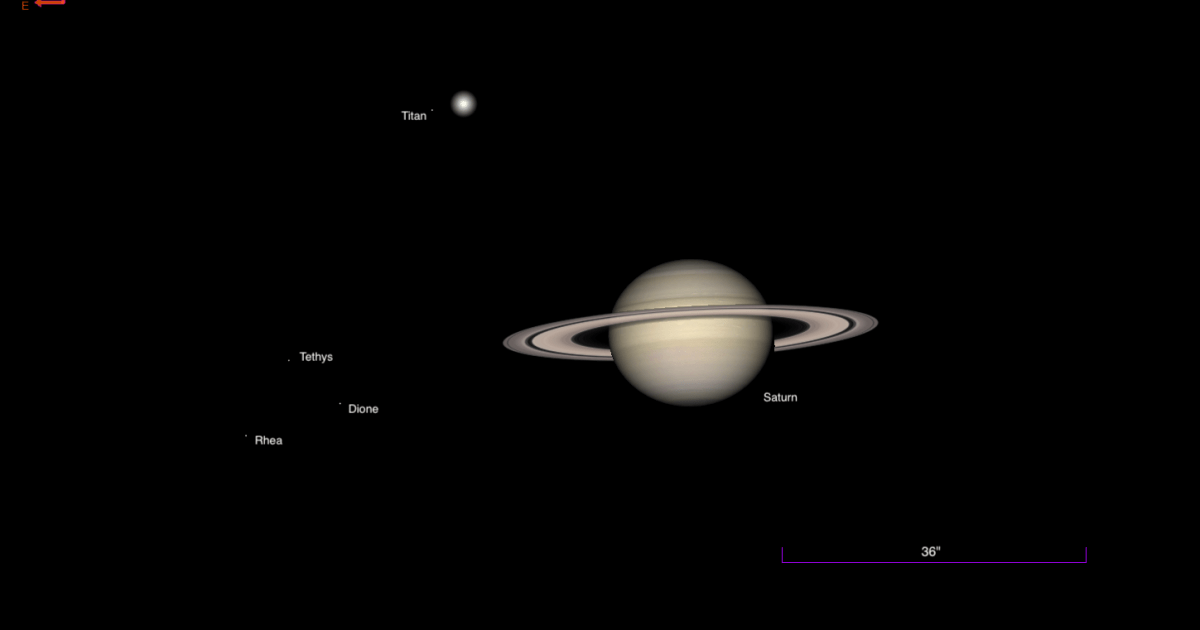
A field star appears to pass through the Saturn system as the planet moves across our sky overnight tonight. | Published: September 21, 2026 An interloper “enters” the saturnian system overnight on September 21/22, as Titan passes close to a field star around midnight CDT. Note that only objects brighter than 11th magnitude are shown. Credit: Alison Klesman (via TheSkyX) Looking for a sky event this week? Check out our full Sky This Week column. September 20: Juno’s movement Rising around 7:30 P.M. local daylight time, Saturn reaches an altitude above 40° in the southeast by local midnight. Visible to the naked eye, it is the brightest point of light in this region of the sky, sitting near the border of southern Pisces and northern Cetus. The ringed planet always looks magnificent in a telescope, and tonight there’s an added bonus: its brightest moon, Titan, stands just northeast of the planet. It passes due north of Saturn during the daylight hours of the 22nd in the U.S. and will sit northwest of the planet in tomorrow night’s sky. Around midnight Central time, the view is a bit crowded: to Saturn’s east lie mid-8th-magnitude Titan (northeast) as well as 10th-magnitude Tethys, Dione, and Rhea (all east and southeast). But don’t be fooled — there’s another mid-10th-magnitude point of light just northeast of Saturn, close to Titan. This is a field star Saturn is passing as the planet moves across our sky. Although the star is very near Titan, the moon is about a magnitude brighter, allowing you to distinguish the two. Brighter Titan will move some 2″ south of the star at 1:17 a.m. EDT on the 22nd (still late on the 21st for the Mountain and Pacific time zones). It’s a unique sight to see, so try to catch it if you’re able. After that, Saturn and its moons will pull away from the star toward the southwest in the early hours of the 22nd. Sunrise: 6:47 A.M.Sunset: 6:59 P.M.Moonrise: 4:37 P.M.Moonset: 1:18 A.M.Moon Phase: Waxing gibbous (79%)*Times for sunrise, sunset, moonrise, and moonset are given in local time from 40° N 90° W. The Moon’s illumination is given at 10 P.M. local time from the same location. Alison Klesman is senior editor of Astronomy magazine. She holds a Ph.D. in astronomy and has studied a variety of topics, from minor planets to supermassive black holes.
The Sky Today on Monday, September 21: Saturn passes a field star
Full Article
Original Source
Read the full article at Astronomy →KhanList aggregates and links to publicly available news content. We do not host full articles from third-party sources. Always verify important information with original sources.