
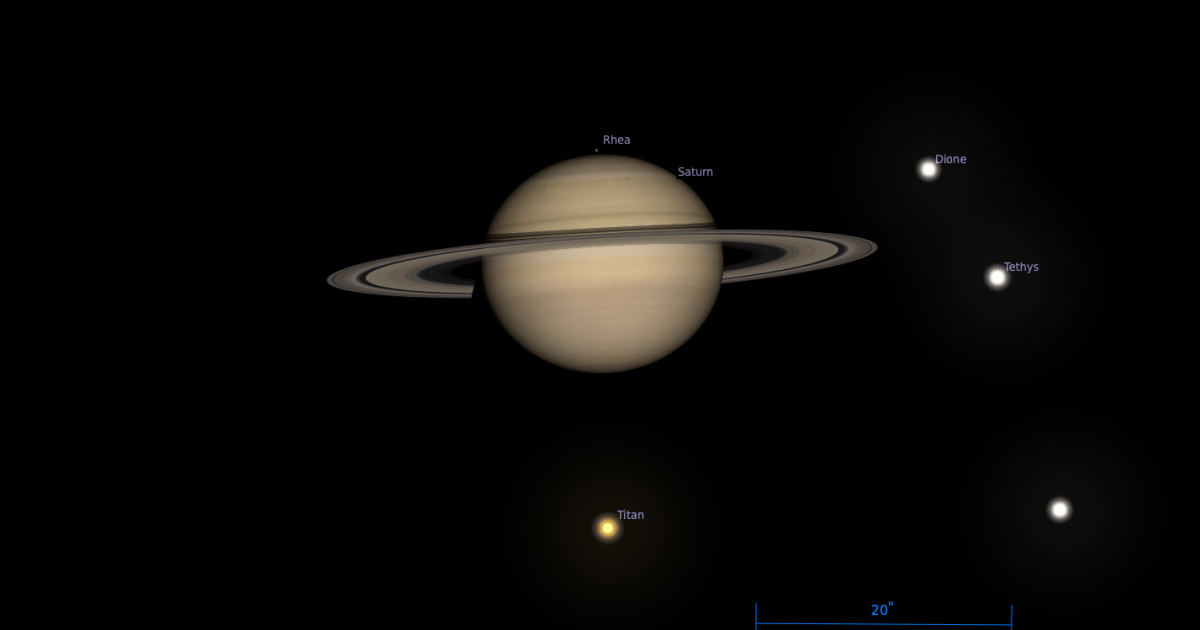
While the bright moon Titan sits close to Saturn to the south, fainter moon Rhea skims the planet’s north pole tonight. | Published: November 16, 2026 Bright Titan sits south of Saturn on the 16th, while fainter Rhea skims just north of the planet’s pole. Credit: Stellarium/Oleg Pluton Looking for a sky event this week? Check out our full Sky This Week column. November 15: Mars and Jupiter in conjunction It’s a great night to catch Saturn’s largest and brightest moon, Titan, as it skims south of the planet. Two hours after sunset, Saturn is roughly 40° high in the southeast, outshining all the other stars in this region of the sky. It lies to the lower left of the Circlet of Pisces and to the upper left of the bright star Fomalhaut in Piscis Austrinus. Zoom in on Saturn with a telescope to first catch sight of its ring system, stretching 43” from end to end and tilted 8° to our line of sight. Currently we are seeing Saturn’s southern side, including the entirety of the planet’s southern hemisphere. The gas giant’s disk now measures 19” across. Titan is difficult to miss, shining at mid-8th magnitude just south of the ringed planet. Don’t be fooled by a fainter 10th-magnitude field star, which lies just to Titan’s west. The three next-brightest moons, also 10th magnitude, are Tethys, Dione, and Rhea. They lie closer to the planet. Tethys sits about 40” west of Saturn’s center shortly before 8 P.M. EST, while Dione is just west of the limb and Rhea just east of the planet. Dione and Rhea are moving westward, and Rhea will skim just north of Saturn’s pole along the way, standing due north of the planet around 10:40 P.M. EST. Tethys is moving east, and will disappear behind the planet’s southwestern limb in an occultation around 2:35 A.M. EST on the 16th (still late on the 15th along the Pacific Coast). Sunrise: 6:46 A.M.Sunset: 4:43 P.M.Moonrise: 12:32 P.M.Moonset: 11:00 P.M.Moon Phase: Waxing crescent (47%)*Times for sunrise, sunset, moonrise, and moonset are given in local time from 40° N 90° W. The Moon’s illumination is given at 10 P.M. local time from the same location. Alison Klesman is senior editor of Astronomy magazine. She holds a Ph.D. in astronomy and has studied a variety of topics, from minor planets to supermassive black holes.
The Sky Today on Monday, November 16: Titan south, Rhea north
Full Article
Original Source
Read the full article at Astronomy →KhanList aggregates and links to publicly available news content. We do not host full articles from third-party sources. Always verify important information with original sources.