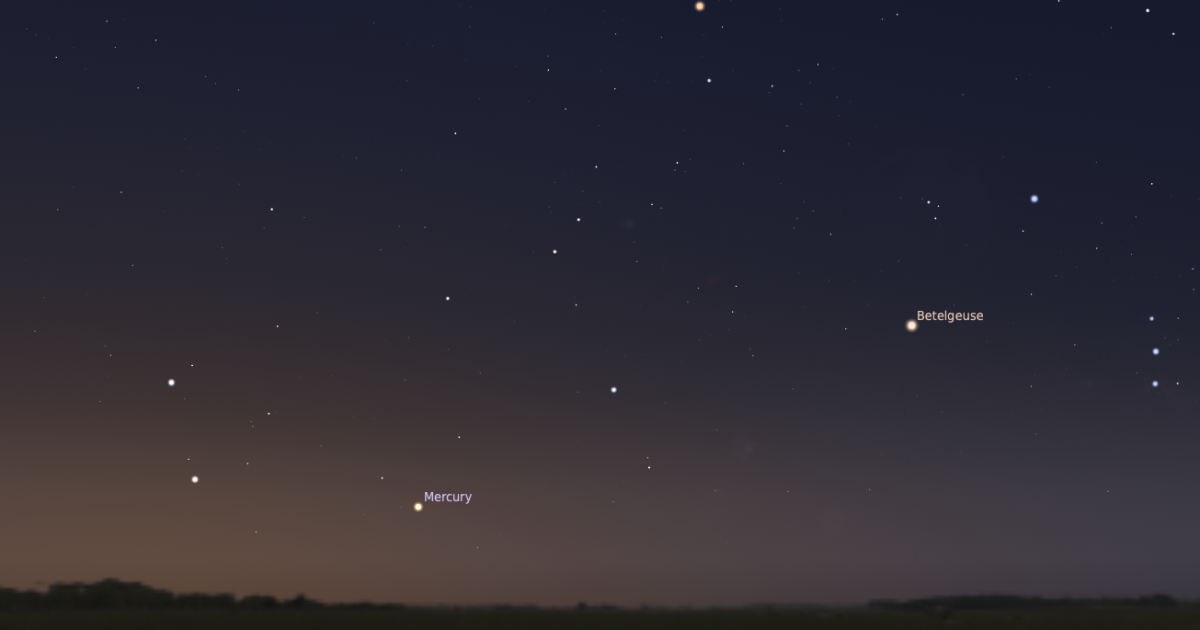
Mercury is rising earlier and growing brighter in the predawn sky. You may have good luck spotting it this morning in the east. | Published: July 31, 2026 Mercury has now brightened to magnitude 0.5 and should be relatively easy to spot in the east before sunrise. You might even catch it standing in line with two fainter stars in Gemini if you look early enough. Credit: Stellarium Looking for a sky event this week? Check out our full Sky This Week column. July 30: Meteors may shine Mercury has now brightened to magnitude 0.5 in the early-morning sky and should be even easier to see than it was earlier in the week. It is now just a few days from greatest western elongation. If you’re already up trying to catch the brightest Southern Delta Aquariid meteors, turn your gaze eastward about an hour before sunrise (roughly 5 A.M. local daylight time) to look for Mercury, now roughly 4° above the eastern horizon. The small planet should be bright enough to spot easily if your horizon is clear. You may even notice that it stands directly in line with two faint stars, Delta (δ) and Lambda (λ) Geminorum, although these two pinpricks of light will quickly disappear in the encroaching twilight. If you’re able, try to take a closer peek at the planet with a telescope, as long as you’re mindful of the time and put your instrument away well before sunrise. Under magnification, Mercury’s disk spans 8” on the sky and shows off a slim crescent with 33% of its surface illuminated. Because Mercury has no significant atmosphere, you’re seeing all the way down directly to its cratered surface when you look at it. Sunrise: 5:58 A.M.Sunset: 8:14 P.M.Moonrise: 9:25 P.M.Moonset: 7:54 A.M.Moon Phase: Waning gibbous (94%)*Times for sunrise, sunset, moonrise, and moonset are given in local time from 40° N 90° W. The Moon’s illumination is given at 10 P.M. local time from the same location. Alison Klesman is senior editor of Astronomy magazine. She holds a Ph.D. in astronomy and has studied a variety of topics, from minor planets to supermassive black holes.
The Sky Today on Friday, July 31: Mercury brightening
Full Article
Original Source
Read the full article at Astronomy →KhanList aggregates and links to publicly available news content. We do not host full articles from third-party sources. Always verify important information with original sources.