
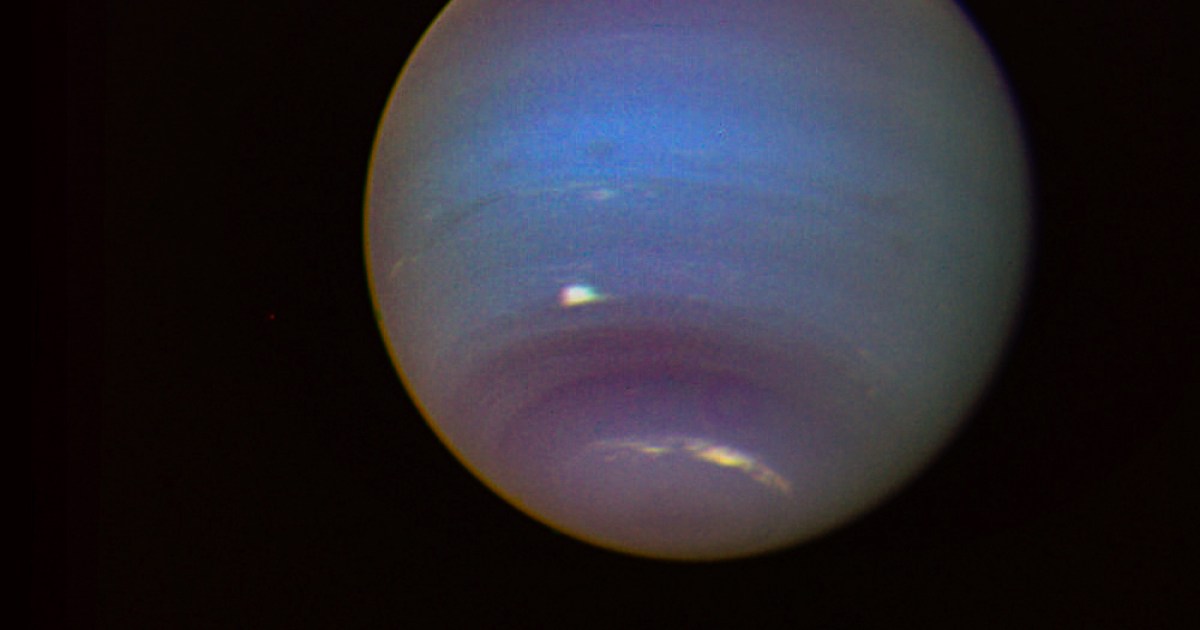
Friday, September 25Mercury passes 1.0° north of Spica at 9 P.M. EDT. You can find more details on how to observe them shortly after sunset in last week’s column, as today we’re focusing on another event. Neptune reaches opposition this evening at 10 P.M. EDT, placing the planet at its best for viewing. However, with the nearly Full Moon (more than 99% lit and appearing Full to the naked eye) nearby, catching the ice giant may be a bit challenging — but certainly doable. You’ll find Neptune in southern Pisces, rising around sunset and setting around sunrise. It’s highest in the middle of the night, in the hours around local midnight. By midnight, Neptune is nearly 50° high in the south, to the left of the bright Moon and to the lower right of naked-eye Saturn. Neptune is not visible without optical aid, so the easiest way to find it will be to use binoculars or a telescope (ideally the latter, thanks to the bright Moon) to look about 7° to the left (east) of our satellite. Alternatively, you can use Saturn as your guidepost, and find Neptune 9° west-southwest of the ringed planet. Even at its best, Neptune’s disk is tiny — 2” across — and will look more like a “flat” or circular bluish-gray star than a full-fledged planet. The ice giant is now 2.68 billion miles (4.32 billion kilometers) from Earth, which is why it looks so small. In reality, Neptune is the fourth-largest planet in the solar system, behind Jupiter, Saturn, and Uranus. It is also the farthest major planet from the Sun; beyond it is the icy Kuiper Belt, to which Pluto belongs. Neptune will be at its best for a while, so if you’re having trouble spotting it with the bright Moon nearby, just wait a couple of days for our satellite to move out of the area and try again.Sunrise: 6:50 A.M.Sunset: 6:52 P.M.Moonrise: 6:17 P.M.Moonset: 5:39 A.M.Moon Phase: Full*Times for sunrise, sunset, moonrise, and moonset are given in local time from 40° N 90° W. The Moon’s illumination is given at 10 P.M. local time from the same location. Saturday, September 26Full Moon occurs at 12:49 P.M. EDT. The Moon then passes 5° north of Neptune at 3 PM EDT. Rising around sunset and setting around sunrise, the September Full Moon is traditionally called the Corn Moon, as it occurs at a time when corn is harvested. However, this year the Corn Moon is also the Harvest Moon, the name given to the Full Moon that takes place closest to the autumnal equinox, which was September 22. The Harvest Moon name supersedes the Corn Moon moniker. On the days around the Harvest Moon, our satellite appears to rise and set at roughly the same time, with shorter-than-average intervals between one moonrise and the next. It also appears roughly Full for more than one day — this year, the Moon is more than 99% illuminated on the evenings of both September 25 and 26, and the phase shrinks only a few percent by the 27th. This is due to the tilt of the Moon’s orbit relative to Earth’s equator, as well as the position of the Sun (and Moon) in our sky around the autumnal equinox. This is often called the Harvest Moon effect. The Full Moon is easy for anyone to enjoy, whether observing with unaided eyes or with optics. In fact, naked-eye observing can be easier and more comfortable during Full Moon, as lots of light streaming in your eyepiece can be a bit uncomfortable. If you do want to check out our satellite under magnification, consider using a Moon filter or even putting on a pair of sunglasses before observing. Increasing your magnification can help, too, as higher magnification means you’re looking at a smaller area of the lunar surface, which reduces glare. Sunrise: 6:51 A.M.Sunset: 6:50 P.M.Moonrise: 6:40 P.M.Moonset: 6:46 A.M.Moon Phase: Full Four of Saturn’s moons should be easily visible the night of the 27th. Titan especially will start a ways away from the planet but move closer to Saturn each night until it passes due south of the ringed world early on the 30th. Note this chart shows the position of the moons at 10 P.M. CDT; the inner three satellites may appear in different positions at different times. Credit: Stellarium/Oleg Pluton Sunday, September 27The Moon now passes 7° north of Saturn at 8 A.M. EDT. The ringed planet currently glows at magnitude 0.3, as bright as it will get this year. It will reach opposition in just another week. By evening, the Moon has pulled a bit farther away — around 10 P.M. CDT, our satellite is more than 13° northeast of Saturn. The ringed planet is the brightest point of light in the eastern sky at that time, located near the border of Cetus and Pisces (within the bounds of the former). Through a telescope, Saturn’s disk spans 20”, while its rings are more than twice that width, stretching 44” from end to end. Look for mid-8th-magnitude Titan, Saturn’s largest and brightest moon, now about 2.6’ west of the planet’s center. Over the next few days, Titan’s orbit will bring it closer to Saturn, and the moon will pass south of the planet early on the 30th. Don’t be fooled by an interloping field star just to Saturn’s southwest tonight, although fortunately the 11th-magnitude star is much fainter than Titan — as well as Saturn’s next three brightest moons, 10th-magnitude Tethys, Rhea, and Dione, all orbiting closer to Saturn and its rings. A couple of brighter field stars shine a little farther away, to Saturn’s north and east as well, all farther out than its moons. Sunrise: 6:52 A.M.Sunset: 6:49 P.M.Moonrise: 7:05 P.M.Moonset: 7:55 A.M.Moon Phase: Waning gibbous (97%) Monday, September 28Although the Moon still dominates much of the night, bright deep-sky objects far from our satellite’s location remain well within reach. A few hours after sunset, M39 in Cygnus is some 80° high in the north, perfect for viewing with any optics you’ve got on hand. M39 is an open cluster of young stars located about 9.2° northeast of Deneb, the Swan’s bright alpha star and one of the three points in the famous Summer Triangle asterism. Spanning roughly the size of the Full Moon, M39 is best viewed under lower magnification, such as with small binoculars or a beginner telescope. This is what makes it such a great target, especially for those just learning to use their equipment to find distant objects in the sky. In all, the cluster contains roughly 30 stars and shines around 5th magnitude — capable of being seen with the naked eye, albeit not on a night with the Moon shedding bright light across the sky. This open cluster is quite close to us, with an estimated distance of less than 1,000 light-years. Its members are between 230 million and 300 million years old. Sunrise: 6:53 A.M.Sunset: 6:47 P.M.Moonrise: 7:34 P.M.Moonset: 9:08 A.M.Moon Phase: Waning gibbous (93%) Tuesday, September 29Jupiter’s largest moon, Ganymede, transits the gas giant’s disk this morning. Some part of the event, which lasts more than three hours in total, is visible for all U.S. observers. Jupiter is currently in Leo, rising around 3 A.M. local daylight time. The bright planet shines at magnitude –1.9, outshining 1st-magnitude Regulus, the Lion’s brightest star, which lies to Jupiter’s east and follows it up into the eastern sky. Through a telescope, the gas giant’s disk spans 33”. For those in the eastern half of the U.S., the planet is flanked by two moons on each side as it rises: Callisto and Ganymede on the east, and Io and Europa on the west. Ganymede is closing in on the eastern limb and its transit begins at 5:24 A.M. EDT. It continues across the disk as the hours pass and the sky brightens, until those in the western portion of the country see Ganymede finally exit the disk at 6:02 A.M. PDT. But Ganymede isn’t the only moon to watch: Not long before Ganymede reaches a halfway point across the disk, Io winks out of view on Jupiter’s western side as it passes into the planet’s long, dark shadow around 5:45 A.M. CDT (just before or around sunrise on the East Coast). It is occulted by the planet about an hour later, and won’t reappear until after sunrise on the West Coast. Speaking of sizable satellites, Saturn’s largest moon, Titan, sits just to the planet’s southwest today, and to its southeast tomorrow night. With the bright satellite so close to the ringed world, it’s a great chance to easily view both together. Sunrise: 6:54 A.M.Sunset: 6:45 P.M.Moonrise: 8:09 P.M.Moonset: 10:22 A.M.Moon Phase: Waning gibbous (86%) Look for asteroid Nausikaa at opposition on September 30, within a diamond of slightly brighter field stars in the constellation Pisces. Credit: Alison Klesman (via TheSkyX) Wednesday, September 30Asteroid 192 Nausikaa reaches opposition at 6 P.M. EDT in the constellation Pisces, just north of Saturn and Neptune’s position on the sky. About 62 miles (100 kilometers) wide, Nausikaa is a rough-edged, slightly oblong rocky body in the inner region of the main belt. It now shines at magnitude 8.5, within reach of binoculars or any telescope. The nearest bright star is 3rd-magnitude Algenib (Gamma [γ] Pegasi), which is just over 6.5° north of the asteroid. Tonight, Nausikaa sits within a diamond formed by four background stars of varying brightness, from about 5th to 8th magnitude. It is moving westward, shifting very slightly with respect to this pattern over time. Because it is at opposition, Nausikaa is visible all night, standing highest (in the south) around midnight. The best time to observe it will be earlier in the evening before or shortly after moonrise, although even after rising, the gibbous Moon shouldn’t diminish the view too significantly. The Moon passes 5° north of Uranus in Taurus at midnight EDT tonight. Sunrise: 6:55 A.M.Sunset: 6:44 P.M.Moonrise: 8:52 P.M.Moonset: 11:39 A.M.Moon Phase: Waning gibbous (77%) Thursday, October 1The Moon reaches perigee, the closest point to Earth in its orbit, at 4:52 P.M. EDT. At that time, our satellite will sit 229,494 miles (369,335 km) away. There’s time before the Moon rises this evening to get in some deep-sky observing — plus, our two-for-one targets tonight are bright enough that even once our satellite creeps above the horizon, it won’t ruin your view. By about 9 P.M. local daylight time, the entirety of Perseus the Hero is above the horizon for most U.S. observers. In Perseus’ far upper (northwestern) corner, you’ll find the famous Double Cluster: two bright open clusters only half a degree apart. Together, the pair spans roughly 1.5°, with each individual cluster stretching about the diameter of the Full Moon. Lying about 7,000 light-years away, these clusters are NGC 869 (west) and NGC 884 (east). They are sometimes called h and Chi (χ) Persei, respectively. On a clear, dark night, you can see the pair with the naked eye, both shining at 4th magnitude just 4.3° west-northwest of slightly brighter (magnitude 3.8) Miram (Eta [η] Persei). They are some of the most distant star clusters visible without optical aid. When you do opt to magnify them, binoculars or any small scope is all you’ll need. Wide-field views will show both at once, while zooming in will let you look at each cluster individually. Both show numerous hot (blue) young stars, but a generous smattering of cooler, older (red) stars appears across the view as well. Age studies show they were not born at exactly the same time: NGC 869 is roughly 5.6 million years old, while NGC 884 is just over half its age, around 3.2 million years old. Sunrise: 6:56 A.M.Sunset: 6:42 P.M.Moonrise: 9:46 P.M.Moonset: 12:51 P.M.Moon Phase: Waning gibbous (66%) Venus and Mercury hang low in the western sky shortly after sunset on October 2, the same day Venus comes to a standstill against the background stars of Virgo. You’ll need a clear western horizon to see the planets before they set. Credit: Stellarium Friday, October 2The brilliant planet Venus stands stationary against the background stars of Virgo at 10 A.M. EDT. Together with Mercury, Venus is visible for a short time in the western sky after sunset, but you’ll want a clear horizon to make sure you catch them. Just 20 minutes after sunset, Venus is only 2° high; Mercury is about 4° high, located to Venus’ upper right. Venus is by far the brighter of the pair, blazing at magnitude –4.8 — its brilliance should help you find it, even close to the horizon. Mercury is several magnitudes fainter, but still quite bright at magnitude –0.1. You might need binoculars to help you pick it out of the slowly darkening sky, so once you find Venus, scan around for Mercury’s position based on the chart above. Make sure not to begin using binoculars or a telescope until the Sun has fully set from your location. Venus sets about 30 minutes after the Sun, and Mercury is gone 15 minutes after that. Today’s standstill brings Venus’ prograde (eastward) motion to an end. After today, Venus will be in retrograde, appearing to move westward against the background stars. While tonight it sits in the southeastern corner of Virgo, near that constellation’s border with Libra, Venus’ retrograde motion will carry it away from Libra and back into Virgo after this date. Sunrise: 6:57 A.M.Sunset: 6:40 P.M.Moonrise: 10:50 P.M.Moonset: 1:56 P.M.Moon Phase: Waning gibbous (55%) Alison Klesman is senior editor of Astronomy magazine. She holds a Ph.D. in astronomy and has studied a variety of topics, from minor planets to supermassive black holes.
The Sky This Week from September 25 to October 2: Neptune at opposition
Full Article
Original Source
Read the full article at Astronomy →KhanList aggregates and links to publicly available news content. We do not host full articles from third-party sources. Always verify important information with original sources.