
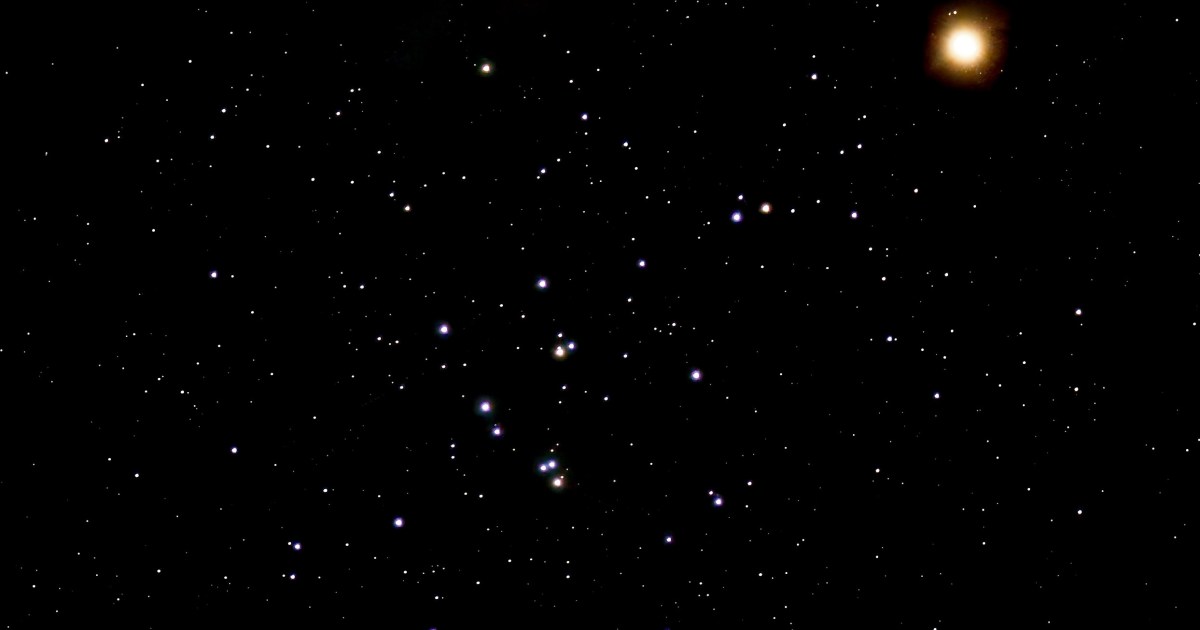
Friday, October 9A few hours after sunset, turn toward the north to find the familiar W shape of Cassiopeia on its side, looking more like the number 3. To the upper left of this numeral is the target we’re aiming for tonight: open cluster M52. This young grouping of stars covers almost a quarter of a degree on the sky and is quite bright at magnitude 7.3. It’s easy to capture with binoculars or any small scope, making it a great target for beginners and advanced observers alike. You’ll find it located 6° northwest of magnitude 2.3 Caph (Beta [β] Cassiopeiae). If you draw a line between similarly bright Shedar (Alpha [α] Cas) and Caph, follow it in the same direction for about the same distance again and you’ll land on M52. Through binoculars or your telescope’s finder, M52 looks like a hazy patch of light. Under higher magnification, its individual stars appear. Many observers see the cluster’s stars as arrayed in a roughly fan-shaped pattern.Sunrise: 7:04 A.M.Sunset: 6:29 P.M.Moonrise: 6:00 A.M.Moonset: 5:49 P.M.Moon Phase: New*Times for sunrise, sunset, moonrise, and moonset are given in local time from 40° N 90° W. The Moon’s illumination is given at 10 P.M. local time from the same location. Saturday, October 10New Moon occurs at 11:50 A.M. EDT. With extra-dark skies, you’ve got a chance to spot the zodiacal light in the early-morning hours, reaching up from the eastern horizon before dawn. This faint glow is generated by sunlight glinting off dust that has accumulated along the plane of the solar system, shed by countless comets as they are heated when they near the Sun. You’ll want to look well before twilight, when the sky is darkest, and do so from a location with as little light pollution as possible. The zodiacal light will stretch up above the eastern horizon, from Leo into Cancer and into Gemini. The pyramid-shaped glow follows the ecliptic, which you can trace out using the bright planets Jupiter (in Leo) and Mars (in Cancer) in the sky. October is a great time to view the zodiacal light because the ecliptic is nearly perpendicular to the horizon. And with no Moon in the morning sky, you’ve got several days now to give observing this ethereal glow a try. Sunrise: 7:06 A.M. Sunset: 6:28 P.M. Moonrise: 7:07 A.M. Moonset: 6:12 P.M. Moon Phase: New Sunday, October 11Early risers can catch a stunning sight this morning as magnitude 1.1 Mars makes its way through the Beehive Cluster (M44) in central Cancer. Rising around 1 A.M. local daylight time, Mars is already 30° high in the east by 4 A.M. If you’re observing from a particularly dark site, you may be able to see the Beehive’s stars without optical aid — they shine collectively at magnitude 3.7, well within naked-eye range. This nearby open cluster is also quite large, spanning nearly 100’ on the sky, and appears as a fuzzy glow without optical aid. It has been known since antiquity and has carried several names, including Praesepe, which is Latin for manger. Pull out binoculars or any size telescope, and you’ll get a clearer view of the Red Planet floating amid a gaggle of pinprick white and blue stars. Within 10 minutes or so, you’ll be able to note the bright, orange-hued planet’s motion through the cluster, as Mars appears to track across the sky while the more distant stars appear fixed. Make a few sketches or snap a couple of photos over the course of just an hour, and you’ll definitely see the difference. Closer to the horizon, bright Jupiter leads the constellation Leo into the sky, standing near the border the Lion shares with the Crab. Take a wide-field nightscape photograph, and you’ll be able to catch both planets in the predawn sky. The Moon passes 3° north of Venus at 11 P.M. EDT, although neither is above the horizon at that time. The pair sets just minutes after sunset, meaning you likely won’t be able to catch Venus at all. You can, however, spot the crescent Moon setting in the west at the same time the Sun is disappearing from view as well. Sunrise: 7:07 A.M. Sunset: 6:26 P.M. Moonrise: 8:13 A.M. Moonset: 6:38 P.M. Moon Phase: Waxing crescent (2%) Although Mercury is only briefly visible in the evenings, try on Oct. 12, when it is near the delicate crescent Moon. Credit: Astronomy: Roen Kelly Monday, October 12Mercury reaches its greatest eastern elongation from the Sun at 6 A.M. EDT today, standing 25° from our star. The Moon then passes 2° south of Mercury at 4 P.M. EDT. Both are now in Libra. By evening, our satellite sits to the lower left of bright Mercury, and both are visible for a short time in the west after sunset. Mercury shines at magnitude 0.0 and should pop out quickly in the twilight — which is fortunate, as it’s just 4.5° high 20 minutes after sunset. Look for it some 3.5° to the upper right (north) of the delicate waxing crescent Moon, now some 6% lit. You might have good luck spotting the planet in binoculars or a finder scope before you can see it with your eyes — just make sure not to pull out any optical aid until at least several minutes after the Sun has disappeared below the horizon. Through a telescope, Mercury spans 7” and appears 60% lit. The planet sets shortly after 7 P.M. local daylight time. Sunrise: 7:08 A.M. Sunset: 6:25 P.M. Moonrise: 9:20 A.M. Moonset: 7:08 P.M. Moon Phase: Waxing crescent (6%) While Vesta is not immediately near any bright stars, you can use Theta and Eta Ceti to its south to orient your view. Credit: Astronomy: Roen Kelly Tuesday, October 13Asteroid 4 Vesta reaches opposition at 2 A.M. EDT. Shining at magnitude 6.5, it’s an easy catch, even under somewhat light-polluted skies. While at opposition, objects are visible all night long. The best time to observe Vesta is after 10 P.M. local daylight time, when it has risen to 30° above the southeastern horizon. It’s located in northern Cetus the Whale, just 4.9° north of magnitude 3.6 Theta (θ) Ceti. There aren’t many similarly bright stars nearby — check out the chart above to help you peg Vesta’s position with respect to Theta as well as similarly bright (magnitude 3.5) Eta (η) Ceti. The large main-belt world isn’t moving quickly, but if you take a photo or make a sketch, come back tomorrow to the same spot in the sky and do it again to see which point of light has moved. Even if you don’t see Vesta move, however, you might spot something else — sunlight briefly glinting off a geostationary satellite as it passes through your field of view. This can brighten such objects to 2nd magnitude for a few minutes, and because geostationary satellites don’t appear to move relative to the background stars, this time it is the field stars that will appear to drift past, while the brighter satellite sits still. You might just catch one by chance! Sunrise: 7:09 A.M. Sunset: 6:23 P.M. Moonrise: 10:25 A.M. Moonset: 7:42 P.M. Moon Phase: Waxing crescent (12%) At 5:35 A.M. CDT, Io and Callisto are just minutes away from a mutual event in which Io occults Callisto, passing in front of the larger moon. Ganymede (not shown) lies west of Jupiter. Credit: Stellarium/James Hastings-Trew/NASA Cassini/Oleg Pluton/John van Vliet/PDS (CC-BY-SA) Wednesday, October 14Observers in the U.S. Midwest and farther west have a great opportunity this morning to watch one Galilean moon pass in front of another. Io crosses in front of Callisto, occulting it from our point of view between about 5:39 A.M. and 5:44 A.M. CDT. This occurs in bright twilight along the East Coast, making the observation challenging. If you do want to try from this time zone, make sure to put away your optics at least several minutes before sunrise from your location, which might differ from the time given for our standard location below. Around the time of the event, Jupiter is some 36° high in the east in the Midwest, to the upper right of the bright star Regulus in Leo. The gas giant is unmissable, shining brightly at magnitude –1.9. Zoom in with a telescope around 5:30 A.M. CDT and you’ll see Ganymede alone to Jupiter’s west, with Europa close to the planet on the eastern side, followed by Callisto just west of Io (farthest from the planet). Keep your eye on those last two moons, as they will close in and appear to merge for visual observers. If you’re an experienced astrophotographer, try capturing the event on camera and see what detail you can get! For evening observers or those without large scopes, the Moon passes 0.4° south of Antares at 5 P.M. EDT. Look for the pair in the southwestern sky after sunset, where they linger for roughly two hours after the Sun disappears beneath the horizon. The Moon now sits just to the lower left of the red giant star Antares and passes close to 3rd-magnitude Tau (τ) Scorpii as well. No telescope is required to enjoy this view. Sunrise: 7:10 A.M. Sunset: 6:21 P.M. Moonrise: 11:28 A.M. Moonset: 8:23 P.M. Moon Phase: Waxing crescent (19%) Thursday, October 15An hour after sunset this evening, you’ll find the waxing crescent Moon low in the southwest, hanging above the back of Scorpius and just off the spout of Sagittarius’ Teapot. Zoom in with a telescope on Mare Fecunditatis, the large dark splotch that lies just below the much rounder Mare Crisium. In Mare Fecunditatis’ western region, look for a pair of small craters with a signature white “tail” spreading westward — this is the doublet Messier, named for the famous French comet hunter Charles Messier, whose name persists on his Messier Catalog of deep-sky objects. Of the two, Messier is the easternmost crater, while Messier A lies just west of it. The pair was created by the same event, as a comet nucleus or asteroid came in at a glancing angle, skipping off the surface like a rock skipping on water and coming down to create a second crater. Astronomers believe Messier was the initial impact, while the skip created Messier A, just 4 miles (6 kilometers) away. Take some time to study this intriguing pair, including comparing and contrasting their shape and depth. They’re definitely fraternal twins, not identical ones! Sunrise: 7:11 A.M. Sunset: 6:20 P.M. Moonrise: 12:25 P.M. Moonset: 9:11 P.M. Moon Phase: Waxing crescent (30%) Friday, October 16Pluto stands stationary in Capricornus at 7 A.M. EDT. The dim, distant dwarf planet now shines at a mere magnitude 15.2. If you want to try for it, you’ll need a very large scope and clear, dark skies. It’s located in southwestern Capricornus, about 5.2° northwest of Psi (ψ) Capricorni. Your best bet is using a go-to function, as star-hopping to such a faint world can be challenging. The nearby Moon will unfortunately make the search a bit more difficult, so you may want to wait a week or two for our satellite to pass fully by. The Moon reaches apogee, the farthest point from Earth in its orbit, at 6:56 P.M. EDT. At that time, our satellite will sit 251,434 miles (404,644 km) away. Late this evening for much of the U.S., Saturn’s small moon Tethys transits the ringed planet’s disk along with its shadow. It’s the best-timed such event all month for U.S. observers, beginning shortly after midnight EDT (so, early on the 17th in the Eastern time zone, and late on the 16th for all other U.S. time zones). Around midnight EDT, magnitude 0.3 Saturn is high in the south, outshining any of the stars in this region. Through a telescope, you’ll easily spot Titan, Saturn’s largest and brightest moon, roughly 1’ southeast of the ringed planet. At this time, 10th-magnitude Tethys lies just northeast of the planet’s eastern limb. Similarly bright Dione is east of the planet, just north of Titan, while Rhea is west of Saturn. The tiny, dim moon Enceladus is transiting with its shadow, but will be extremely difficult to track and require photography or high-speed video capture to catch. Watch as Tethys approaches the planet, beginning to transit around 12:17 A.M. EDT Oct. 17 (still Oct. 16 farther west). Its shadow appears just after 12:30 A.M. EDT. Again, you will likely require photography to catch the transit and shadow transit, given that Tethys is so small and faint compared to Saturn’s disk. The moon continues to make its way across the disk until the early-morning hours of the 17th; both moon and shadow slip away from Saturn’s western limb around 2:25 A.M. EDT. Sunrise: 7:12 A.M. Sunset: 6:19 P.M. Moonrise: 1:16 P.M. Moonset: 10:05 P.M. Moon Phase: Waxing crescent (36%) Alison Klesman is senior editor of Astronomy magazine. She holds a Ph.D. in astronomy and has studied a variety of topics, from minor planets to supermassive black holes.
The Sky This Week from October 9 to 16: Mars passes through the Beehive
Full Article
Original Source
Read the full article at Astronomy →KhanList aggregates and links to publicly available news content. We do not host full articles from third-party sources. Always verify important information with original sources.