
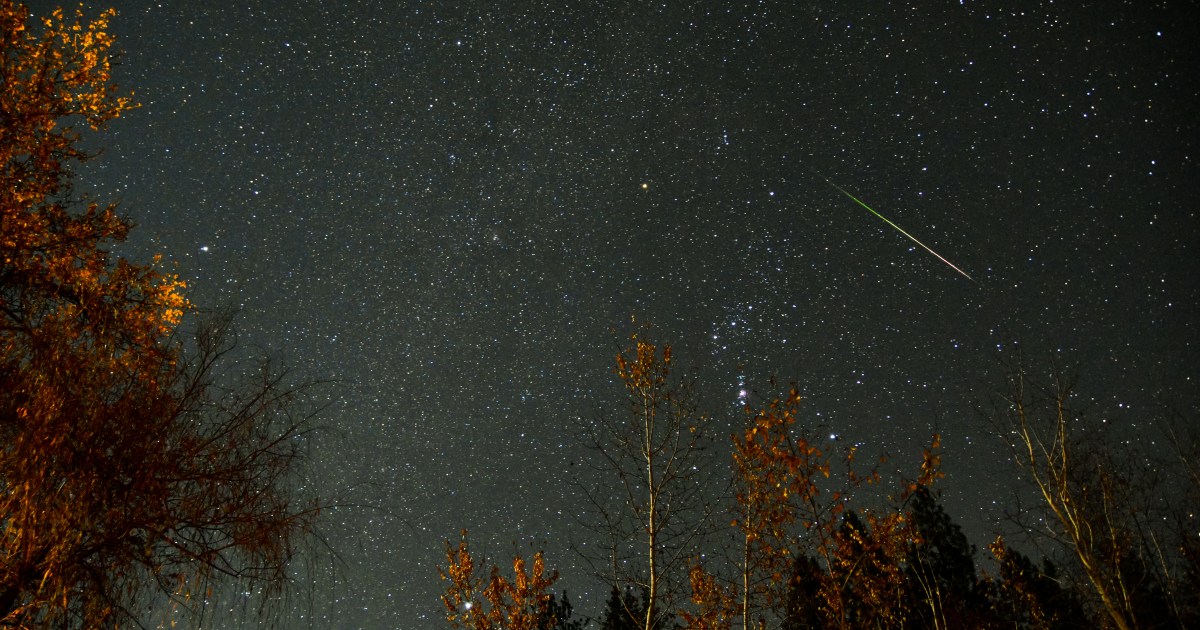
Friday, November 20The Moon reaches apogee, the farthest point from Earth in its orbit, at 12:50 P.M. EST. At that time, our satellite will be 252,040 miles (405,619 kilometers) from Earth. Already 60° high in the east by 8 P.M. local time is M33, the Pinwheel Galaxy in Triangulum. This lovely spiral glows at 6th magnitude and is technically visible from a dark site with sharp eyes — just wait until after moonset if you want to give it a try. You’ll find it in far western Triangulum, about 4.3° west-northwest of 3rd-magnitude Alpha (α) Trianguli. Any telescope will show M33, but larger ones are better because its considerable size — some 70’ across along its longer axis — spreads its light out and makes its surface brightness quite low. Instruments 10 inches or larger will show some detail along the spiral arms, including brighter knots of star formation. Located some 2.7 million light-years away, M33 is the third-largest galaxy in our Local Group, after Andromeda and our own Milky Way. This cosmic neighbor is a classic spiral with no central bar and a round, bright nucleus wrapped by its dusty arms. Oriented more closely to face-on than Andromeda, M33 is a popular target for visual observers as well as astrophotographers. Sunrise: 6:43 A.M. Sunset: 4:45 P.M. Moonrise: 10:54 A.M. Moonset: 7:55 P.M. Moon Phase: Waxing crescent (21%) *Times for sunrise, sunset, moonrise, and moonset are given in local time from 40° N 90° W. The Moon’s illumination is given at 10 P.M. local time from the same location. Saturday, November 14Following inferior conjunction early this month, Mercury has reappeared in the morning sky. Now magnitude 0.3, you can find the small planet some 5° above the eastern horizon an hour before sunrise. It lies to the lower left of brighter Venus (magnitude –4.8), which sits alongside Virgo’s luminary Spica, about 12° to Mercury’s west. This morning, Mercury is less than 1° south of 4th-magnitude Kappa (κ) Virginis, which should be visible until the sky brightens enough to wash out the star. You can capture both in the same field of view in either binoculars or a telescope. Mercury now appears as a 32%-lit disk that is 8” across. Compare that with Venus, which features a narrower phase just 13% lit but stretches 51” by comparison. The brighter planet lies just 1.4° northwest of Spica, the brightest star in Virgo. Both Spica and Kappa can act as guideposts to help you spot Venus’ and Mercury’s motion, respectively, over the next few days. Mercury is moving east and will pull away from Kappa to the lower left. Venus, which just recently reached a stationary point, is also moving east, but will swing slightly northeast (to the upper left) of Spica for a few days before tracking more directly east. Mars passes 1.2° north of Jupiter at 10 P.M. EST — we’ll focus on this pair in the early-morning sky tomorrow. Sunrise: 6:44 A.M. Sunset: 4:44 P.M. Moonrise: 11:33 A.M. Moonset: 8:56 P.M. Moon Phase: Waxing crescent (29%) Io and Europa pass each other as the former heads for a transit and the latter pulls away from their parent planet Jupiter following an occultation early on November 15. Credit: Alison Klesman (via TheSkyX) Sunday, November 15Jupiter and Mars are approaching opposition in February next year. They are now rising late in the evening and dominate the early-morning sky. By 3 A.M. local time, the two planets are 40° high in the east. Mars sits just to the upper left (north) of Jupiter, having passed 1.2° due north of the gas giant late last night, shortly before rising. Both planets sit to the upper right (west) of Regulus, the brightest star in Leo the Lion. In addition to spotting the pair of planets together in a telescope, you’ll want to zoom in on Jupiter in particular, as its Galilean moons are showing off this morning. Around 3 A.M. EST, Callisto stands alone west of the planet, with Io (closest) and Ganymede to the east. Twenty-two minutes later (at 3:22 A.M. EST), Io’s shadow appears at the eastern limb and begins to transit. Just over an hour later, with Io closing in on the same limb, Europa pops into view as it reappears from an occultation at 4:27 A.M. EST. It is just south of Io, which passes due north of Europa at 4:34 A.M. EST. Io then begins a transit two minutes later, slowly following its shadow. Io’s shadow reaches the western limb and disappears at 5:38 A.M. EST, while the moon takes a little over an hour to reach the same point, ending its transit at 5:52 A.M. CST (now daylight in the Eastern time zone). Sunrise: 6:45 A.M. Sunset: 4:43 P.M. Moonrise: 12:05 P.M. Moonset: 9:58 P.M. Moon Phase: Waxing crescent (38%) Bright Titan sits south of Saturn on the 16th, while fainter Rhea skims just north of the planet’s pole. Credit: Stellarium/Oleg Pluton Monday, November 16It’s a great night to catch Saturn’s largest and brightest moon, Titan, as it skims south of the planet. Two hours after sunset, Saturn is roughly 40° high in the southeast, outshining all the other stars in this region of the sky. It lies to the lower left of the Circlet of Pisces and to the upper left of the bright star Fomalhaut in Piscis Austrinus. Zoom in on Saturn with a telescope to first catch sight of its ring system, stretching 43” from end to end and tilted 8° to our line of sight. Currently we are seeing Saturn’s southern side, including the entirety of the planet’s southern hemisphere. The gas giant’s disk now measures 19” across. Titan is difficult to miss, shining at mid-8th magnitude just south of the ringed planet. Don’t be fooled by a fainter 10th-magnitude field star, which lies just to Titan’s west. The three next-brightest moons, also 10th magnitude, are Tethys, Dione, and Rhea. They lie closer to the planet. Tethys sits about 40” west of Saturn’s center shortly before 8 P.M. EST, while Dione is just west of the limb and Rhea just east of the planet. Dione and Rhea are moving westward, and Rhea will skim just north of Saturn’s pole along the way, standing due north of the planet around 10:40 P.M. EST. Tethys is moving east, and will disappear behind the planet’s southwestern limb in an occultation around 2:35 A.M. EST on the 16th (still late on the 15th along the Pacific Coast). Sunrise: 6:46 A.M. Sunset: 4:43 P.M. Moonrise: 12:32 P.M. Moonset: 11:00 P.M. Moon Phase: Waxing crescent (47%) Tuesday, November 17First Quarter Moon occurs at 6:48 A.M. EST, floating among the stars of Aquarius. Early this evening brighter targets are best, as the Moon doesn’t set until late. Ready for viewing as the winter constellations start to dominate earlier each day is the Pleiades, an open cluster cataloged as M45. Known since antiquity and readily visible to the naked eye, the Pleiades contains several bright stars arranged in a tiny dipperlike shape. Located in northwestern Taurus, the cluster is sometimes mistaken for the Little Dipper, although that asterism is much larger and lies in the northern sky, anchored at the end of its handle by Polaris, the North Star. The Pleiades shines with a collective magnitude of 1.6 and spans roughly 110’ — a huge swath of sky. It lies above the sideways V-shape of Taurus’ face as the Bull rises in the east this evening, and is already 30° high by 7:30 P.M. local time. How many stars can you make out with the naked eye? Most observers see six or seven. Once you’ve taken in the cluster without any optical aid, zoom in with binoculars or a finder scope. (Any higher magnification and you won’t see most of the cluster at once, but instead be limited to a smaller portion.) Many more stars will now pop into your field of view. If you do opt for high magnification, look for a faint grayish haze around the stars — this is nearby dust reflecting the stars’ light, and requires clear, dark conditions to make out. The Leonid meteor shower peaks tonight, with the best meteor viewing overnight into the early-morning hours of November 18, as the Moon sets around midnight and the radiant rises higher. Check out tomorrow’s entry for more detail. Sunrise: 6:47 A.M. Sunset: 4:42 P.M. Moonrise: 12:56 P.M. Moonset: — Moon Phase: Waxing gibbous (57%) The Leonids’ peak comes just days after a conjunction of Jupiter and Mars, also in Leo. Visible as well will be Venus, near Spica in Virgo. Credit: Astronomy: Roen Kelly Wednesday, November 18The peak of the Leonid meteor shower, caused by the dusty debris of Comet 55P/Tempel-Tuttle, is best seen early this morning after the Moon has set and the shower’s radiant rises high in the hours before dawn. Two hours before sunrise, Leo is high in the southeast, with bright Jupiter and Mars joining the curved shape of the Sickle asterism. The Leonids’ radiant is located just inside the cuved blade’s inner edge, near 3rd-magnitude Zeta (ζ) Leonis to the upper left (north) of Mars and Jupiter. The two planets appear roughly side by side in the sky around this time, with ruddy Mars at left and more golden-yellow Jupiter at right. Regulus sits just to their lower left. To catch the most meteors, you’ll actually want to look a little ways away from Leo, about 40° to 60° to the left or right of the constellation. This is where meteors with the longest trains will also occur. Although this shower isn’t particularly strong, you can expect to see roughly a half-dozen or more Leonid meteors per hour. The Leonid shower produces some of the fastest-moving meteors we experience all year, streaking through the sky at some 44 miles (70 kilometers) per hour. Sunrise: 6:49 A.M. Sunset: 4:41 P.M. Moonrise: 1:19 P.M. Moonset: 12:03 A.M. Moon Phase: Waxing gibbous (67%) Thursday, November 19The solar system is a dynamic place. Let’s return to the predawn sky today to check out the inner planets’ progress relative to the stars of Virgo. An hour before sunrise, both Mercury and Venus are again well above the eastern horizon, with the stars around them still visible before twilight brightens too much. Compared with earlier in the week, Venus now sits to the upper left of Spica, rather than directly above it. Venus will pass 1.8° due north of Spica later today at 6 P.M. EST. Now moving steadily east, it will track along the ecliptic, slowly headed for Libra. Mercury has already reached the Balance, sitting within its domain and to the far lower left of Kappa (κ) Virginis, as opposed to the pair’s close proximity a few days ago. Pull out your telescope to see how the planets’ appearances have changed, too. Mercury is now 55% lit and 7” across, while Venus is 18% lit and has shrunk more noticeably, now 47” across. Sunrise: 6:50 A.M. Sunset: 4:40 P.M. Moonrise: 1:41 P.M. Moonset: 1:07 A.M. Moon Phase: Waxing gibbous (76%) Friday, November 20The Moon passes 5° north of Neptune at 8 A.M. EST; 12 hours later, our satellite passes 7° north of Saturn at 8 P.M. EST. The trio is visible in the southeastern sky two hours after sunset, forming a triangle with the Moon to the upper left of Saturn, and Neptune to Saturn’s right. Only the Moon and Saturn are visible to the naked eye, while Neptune will require optical aid. From the gibbous Moon, drop down first to check out Saturn through a telescope, including its lovely ring system and brightest moon, Titan. Saturn is the brightest object in this part of the sky after the Moon, so you don’t have to worry about misidentifying it. After passing south of the ringed world earlier this week, Titan now sits about 3.2’ to Saturn’s west, in line with the rings. Fainter moons Tethys, Rhea, and Dione may be visible clustered closer to the planet, but the bright moonlight might also make them challenging for visual observation. From Saturn, scan 6.6° west-southwest to land on Neptune. If you have a go-to scope, it may take you right to the outermost planet, which glows at magnitude 7.7 and offers up a tiny, 2”-wide disk. It may look like a “flat,” bluish-gray star, rather than a bright pinprick of white light. Look for a large parallelogram of 4th- and 5th-magnitude stars just over 9° to Saturn’s southwest if you need a closer stepping stone. The star at the northeastern point of that shape is 5th-magnitude 29 Piscium, and it lies about 2.6° southwest of Neptune. Mercury reaches greatest western elongation (20°) at 7 P.M. EST. We’ll check out the planet in the predawn sky in next week’s column. Sunrise: 6:51 A.M. Sunset: 4:40 P.M. Moonrise: 2:04 P.M. Moonset: 2:12 A.M. Moon Phase: Waxing gibbous (84%) Alison Klesman is senior editor of Astronomy magazine. She holds a Ph.D. in astronomy and has studied a variety of topics, from minor planets to supermassive black holes.
The Sky This Week from November 13 to 20: The Leonids peak
Full Article
Original Source
Read the full article at Astronomy →KhanList aggregates and links to publicly available news content. We do not host full articles from third-party sources. Always verify important information with original sources.