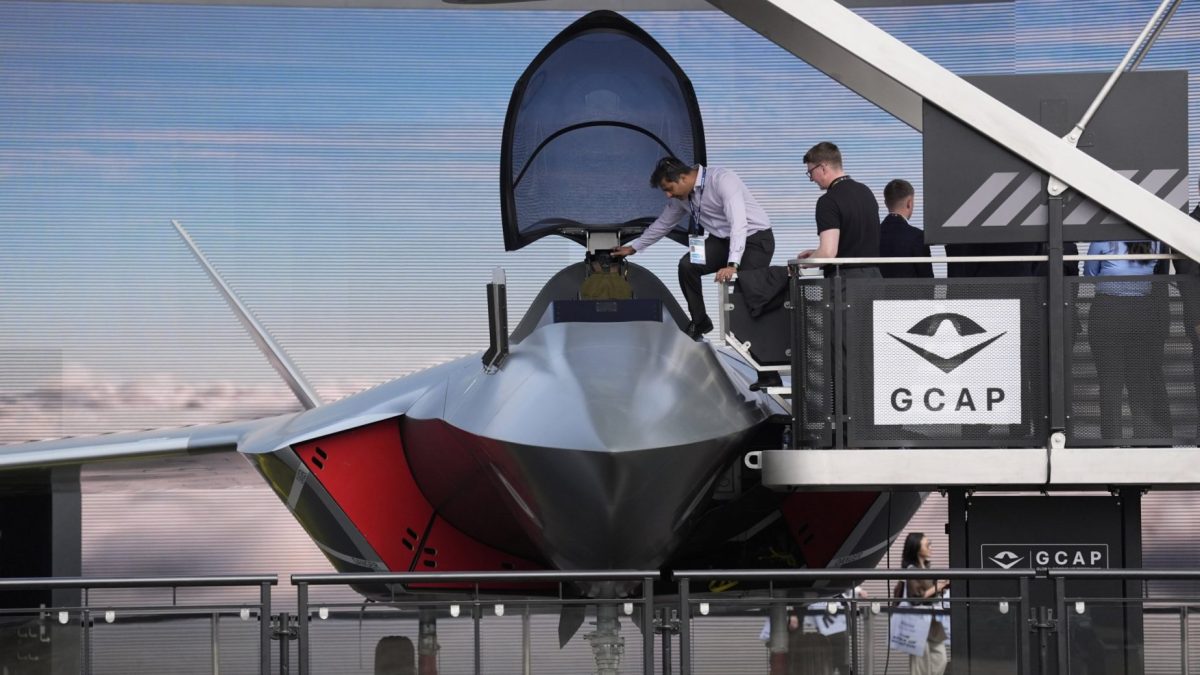
Britain may soon have a new fighter jet to envy, or at least that’s the plan. The UK’s partnership with Japan and Italy to build a sixth-generation military plane is the most ambitious feature of an otherwise cautious national defence strategy. It also has the potential to restore our standing as a military power capable of standing up to Russia and China. A mock-up of the as yet unnamed platform was on display at Farnborough Air Show this week, offering a preview of what will become Britain’s first crewed supersonic aircraft in 40 years. Shorts The UK’s delayed and divisive Defence Investment Plan, announced last month, committed more than £8bn to the Global Combat Air Programme (GCAP) over the next four years, with a £4.6bn development contract awarded to Edgewing, the venture behind the aircraft. Construction of a demonstrator model is said to be 75 per cent complete, and if smooth progress continues, the first test flights will take place by the end of next year. The aircraft is set to enter service by 2035. The programme is a serious pull for British influence. This is a great-power – as opposed to superpower – project by design. Three capable states are pooling money and sovereignty to hold a top-tier capability none could sustain alone. The US and China, the world’s two superpowers, have the only other sixth-generation combat aircraft programmes, and theirs are closed to partnerships. The new fighter is a third larger than the Typhoons that make up the bulk of the Royal Air Force, with large internal weapons bays. That makes it well suited to long-range combat missions of the kind we have seen against Iran, where US aircraft have struck targets more than a thousand miles away and sustained operations for days. As global tensions rachet up, an aircraft that can take off from a British base to patrol Nato’s eastern border with Russia, and return without requiring a vulnerable chain of tankers, would close a gap the RAF has lived with for decades. The GCAP fighter will have an advanced, integrated suite of sensors and data systems (Photo: Carl Court/Getty) The new model surpasses the Typhoon’s stealth profile, but what sets it apart is on the inside. Its sensing system replaces the separate radars and sensors of older jets with one integrated suite built to process enormous amounts of data. Its radar can jam and deceive hostile networks to neutralise enemy threats, not only detect them. The system is also designed to have the potential to act as a command platform for collaborating drones – which would give it a distinct advantage, in both capabilities and numbers, over traditional combat aircraft. Feeding those systems takes an engine that Rolls-Royce, with Japan’s IHI and Italy’s Avio Aero, calls a flying power station. None of this comes cheap. Tens of billions more will be required for development, with unit costs for the finished plane likely to exceed the £80m price tag for a US-made F-35. Fighter fit for modern warfare The two major current conflicts scarring and shaping the world show the value of the sixth-generation fighter. In Ukraine, after more than four years of conflict, neither side has secured control of the air. Both armies field dense, overlapping ground-based air defences that have made the sky too dangerous for non-stealth jets. Both air forces are limited to supporting roles. The gruelling, drone-dominated ground-based warfare is a warning of what the future holds for any military unable to achieve air superiority. The US-Israeli campaigns against Iran have offered an opposite example, with stealth aircraft capable of long-range precision fire used to seriously degrade a dense air-defence network. The ability to penetrate and dismantle such a network is the hardest thing a fighter must do, and succeeding in this is what turns a contested air space into a usable one. The RAF has endured a period of relative decline, amid decades of underinvestment. It fields fewer than 160 combat jets: around 110 fourth-generation Eurofighter Typhoons and 47 fifth-generation F-35s. Typhoons are capable but not stealthy, and are set to leave service from 2040. GCAP is meant to replace them. The threat by then will be greater. China already operates two families of fifth-generation stealth fighters, and is testing two sixth-generation prototypes for service around 2035. Russia fields more modern air defences at home than the export systems it provided to Iran. Ukrainian forces fire at Russian positions near Kostiantynivka, Donetsk. Ground-based air defences have made the sky too dangerous for non-stealth jets (Photo: Iryna Rybakova/93rd Mechanized Brigade via AP) By the middle of the next decade, British pilots may have to contend with a new level of sophistication from enemy aircraft and air defences. Questions will persist. The strategic case for GCAP has strengthened in the past month. The parallel Franco-German-Spanish programme, FCAS, collapsed in June after nine years without a prototype. This came after a variety of disputes ranging from capability to workshare and costs. That leaves GCAP as the only fully-funded sixth-generation fighter programme in Europe, with Germany increasingly seen as a potential partner. Canada has joined the programme as an observer nation, and Britain now has a list of countries that could become potential customers or partners, including Saudi Arabia. It has the opportunity to become the centre of a coalition spanning the Atlantic and Pacific, linking European and Indo-Pacific security. This is a far cry from the current reality. And with a healthy mix of fourth, fifth and sixth- generation aircraft, the UK will be well placed to help defend Nato airspace and credibly threaten enemy territory. Having built and funded the programme, the task is to see it through on schedule.
The sixth-generation fighter jet that can defend the UK against Putin
Full Article
Original Source
Read the full article at Inews →KhanList aggregates and links to publicly available news content. We do not host full articles from third-party sources. Always verify important information with original sources.