
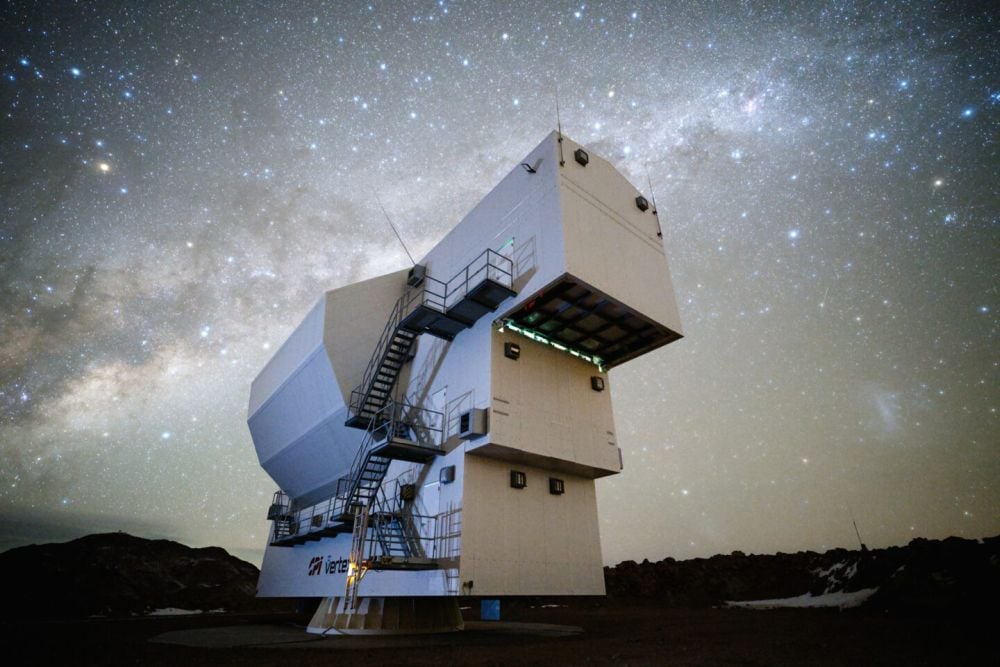
The Simons Observatory in the Atacama Desert has begun its mission to survey the Cosmic Microwave Background. Its goal is to detect undeniable evidence of the Big Bang and cosmic inflation. Can this unique survey succeed where others have failed? We live in an age of large astronomical surveys, enabled by powerful computers and data handling methods. While powerful telescopes still perform detailed observations of individual targets, and always will, wide surveys have a power all their own. The ESA's Gaia mission, for example, has completed its survey of billions of stars and generated a massive amount of foundational data that researchers will draw on for decades to come. There are automated surveys for transients like supernovae and asteroids, radio-sky surveys to spot objects obscured by thick dust, and massive surveys just getting started like the Vera Rubin Observatory's Legacy Survey of Space and Time (LSST) and the Nancy Grace Roman Space Telescope's three core surveys. But another Simons Observatory's survey hasn't garnered the same attention that some of the other have. The Simons Observatory (SO) consists of four telescopes working together: three small 0.5 meter aperture 'scopes in its Small Aperture Telescope (SAT) and one large 6-meter one in its Large Aperture Telescope (LAT). The unusual configuration gives the SO the best chance to observe tiny details in the Universe's first observable light, the Cosmic Microwave Background (CMB). This image of the Cosmic Microwave Background is from the Simons Observatory, the newest and most powerful observatory to study the CMB. It's unique arrangement of three small and one large telescope increases its resolution by an order of magnitude over its predecessor, the Planck satellite. The Simons Observatory's main goal is to find the elusive evidence from the epoch of inflation, and thereby confirming the Big Bang model of cosmology. Image Credit: Simons Observatory. The stuff of the Universe was too opaque for light to travel through it at first. Photons were effectively scattered by the hot, dense plasma that permeated the Universe. Eventually conditions changed. The Universe expanded, the plasma cooled, and photons could travel. This was the recombination epoch and it occurred about 380,000 years after the Big Bang. Note that the name is historical and reflected our earlier understanding of the Universe. It wasn't actually a recombination, it was the first time that electrons and protons combined to form neutral hydrogen, and that's what made the cosmos transparent. Its name should probably be changed to the combination epoch. But regardless of its name, the cosmic microwave background is the relic radiation from the Universe's first light, and it holds clues to the Universe, especially to the Big Bang theory of cosmology. Other efforts have been made to map the CMB. NASA's Wilkinson Microwave Anisotropy Probe (WMAP) and the ESA's Planck satellite both made the effort from orbit. Currently, the South Pole Telescope (SPT) and related facilities are doing the same. The SPT made an important discovery. It detected for the first time what's called the B-mode polarization of the CMB. The B-mode is important because it was created by primordial gravitational waves generated during the epoch of inflation, the first moments of the Universe's inflation. So finding the B-mode was important evidence for the Big Bang theory. The South Pole Telescope at the Amundsen–Scott South Pole Station, Antarctica. The SPT is a 10-meter telescope that is credited with the first detection of the Cosmic Microwave Background's B-mode polarization. Image Credit: By Amble - Own work, CC BY-SA 3.0, https://commons.wikimedia.org/wiki/Special:Redirect/page/9057466 But there was a problem. Gravitational lensing can also create B-mode polarization, and it has nothing to do with the Big Bang or inflation. It's difficult to tell which source created the B-mode polarization the SPT detected. So its initial detection was put in doubt. This is where the Simons Observatory comes into the picture. It's been calibrating its instruments for two years and is now getting down to business. “To have all the observatory motors humming, gears turning and data flowing makes me joyful, but even more exciting is the prospect of what we could find in its big new deep and detailed maps,” says Simons Observatory Co-Director Suzanne Staggs of Princeton University. This time-lapse shows the Simons Observatory's Large Area Telescope scanning the sky in August 2026. Credit: David Boettger The observatory's four telescopes collectively have tens of thousands of microwave detectors, almost 98,000 of them. That's 16 times more than one of its predecessors, the Atacama Cosmology Telescope. They're not only mapping the CMB the same way that WMAP and the Planck satellite did. They're also searching for the tiny fluctuations in the CMB, the B-mode polarizations that can confirm the Big Bang and cosmic inflation. If detected, the SO can determine if these are true artifacts of primordial gravitational waves, or artifacts of the polluting gravitational lensing that confounded the SPT. It'll take years of observations before that can be achieved, but the SO's first observations are already showing the observatory's power. Its sensitivity is meant to be an order of magnitude highter than its predecessor, the Planck satellite. “The images that we’ve made with just a few months of data are already deeper and less noisy than Planck’s, which were collected over years,” says Simons Observatory Spokesperson Jo Dunkley of Princeton University. That's significant, because the Planck outperformed its predecessor, WMAP, and is considered the benchmark for CMB observations. So the SO is already establishing a new benchmark for observations. The SO's unique four telescope design is already showing its value. The large, 6-meter telescope is able to observe more of the sky in higher resolution than other CMB telescopes. Every couple of days, it scans half of the available sky. “It is incredibly satisfying to see the early maps, knowing that our initial data places us at the forefront of the field — and that we are poised to go much further,” says Jeffrey McMahon, observatory testing lead at the University of Chicago. The SO isn't isolated and alone in its work. All of these CMB surveys and observatories will work together in the end. For example, the SPT and other facilities at its site are mapping gravitational lenses that can interfere with the detection of B-modes from primordial gravitational waves in the epoch of inflation. Those templates can be used to help remove their pollution from CMB surveys. So it's all hands on deck. This cut-away schematic shows the Large Area Telescope's Receiver with one of its optical tubes highlighted. Note the pulse tube coolers and the dilution refrigerator. They keep the telescope at the cryogenic temperatures necessary for microwave observations. Image Credit: Simons Observatory/Nicholas Galitzki et al. 2018. Conference Proceedings. The SO is an observer of polarized light, and that means that while its primary goal is searching for B-mode polarization, its maps have other things to reveal, too. “There are a number of large surveys adding to our understanding of the universe,” Staggs says. “Our idea is that we can combine our data with theirs to further our discoveries.” This is especially true of other wide surveys like the Rubin Observatory's Legacy Survey of Space and Time. The pair will create a potent combination for detecting transients across multiple wavelengths. “The instrument is now sensitive enough that we can see small changes in transients in only a few days, whereas ACT took months,” Devlin says. “This enables us to observe entirely new classes of objects.” Its science observations have barely begun, and it's already giant stellar flares and asteroids in the Milky Way, and activity around a supermassive black holes outside of our galaxy. But detecting that elusive evidence from the epoch of inflation is the SO's holy grail, and if it finds it, it will be a collective finding in the mass data the observatory will produce. Like other survey telescopes, the data will be released in large sequential data releases. “We’ll be providing everything to the community through a data management tool, which we hope to have completed for the first data release,” Devlin says. The initial success of its first science operations is a hopeful indication that it can finally find the evidence of cosmic inflation, the B-mode polarization from primordial gravitational waves in the CMB. “Essentially, right out of the box, just turning on the instrument, we’re making beautiful crisp images of the Milky Way,” Staggs says. Those images are uncovering new observations of the galaxy's magnetic fields, and understanding them is critical to understanding star formation and how the galaxy evolves. “This moment marks a major milestone in our effort to understand these big questions about the universe,” Devlin says. “I think there’s going to be so many scientific discoveries coming out in the next few years, it’ll be hard to keep up.” The SO's performance will improve when another three small telescopes are added in 2027. That will also double the Small Area Telescope's number of individual detectors to 48,160 detectors. The original five-year survey has been extended, too. "Combined with a planned extension of the survey duration to 2035, this expansion will significantly enhance SO's search for a B-mode signal in the polarisation of the cosmic microwave background, a potential signature of gravitational waves produced in the very early Universe," explain the authors of a 2026 paper in the Journal of Cosmology and Astroparticle Physics.
The Simons Observatory is Online and Surveying the Cosmic Microwave Background
Full Article
Original Source
Read the full article at Universetoday →KhanList aggregates and links to publicly available news content. We do not host full articles from third-party sources. Always verify important information with original sources.