
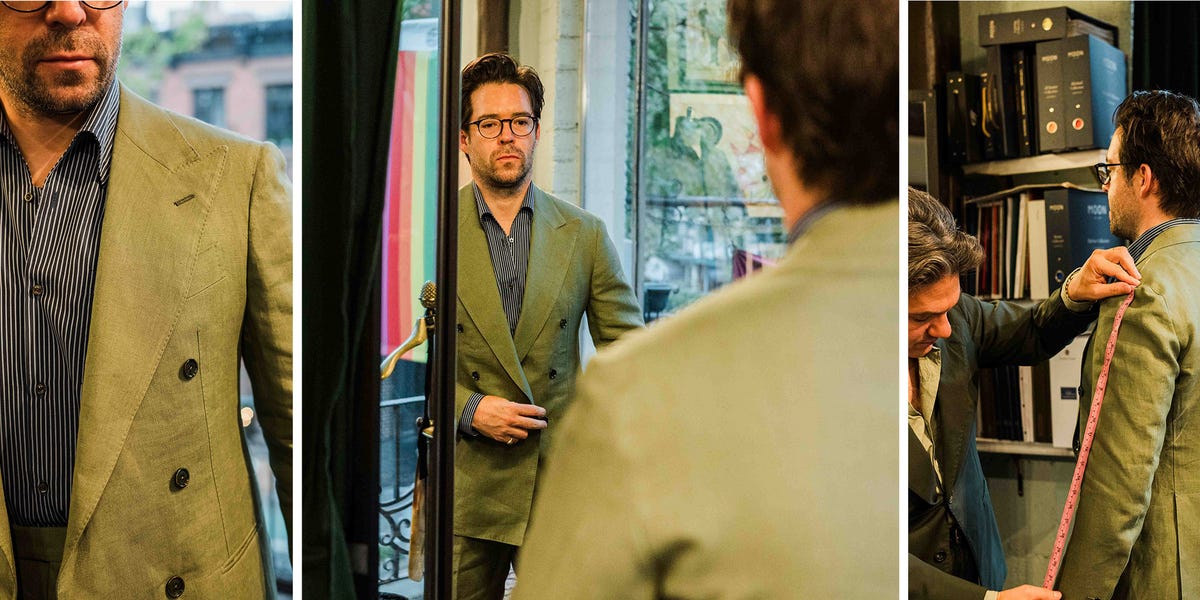
Chase Winfrey5 min read“I think you've lost weight,” Jake Mueser says, wrapping the tape around my chest.I haven't. And he knows that. But this is how you sell a suit.It's a balmy Wednesday afternoon in May, on the second floor of his atelier on Christopher Street, which is as close as downtown gets to Savile Row: antique triptych mirror, a patchwork of Persian rugs, floor-to-ceiling shelves of books. He pulls out options: pale gray, cream linen, a heavier taupe he thinks might work into September. Then he holds up the olive linen and says nothing. That is more or less the end of the debate. Today, he is measuring me for a summer commission. Double-breasted. A day suit that can stay for dinner.Jake grew up in New Hampshire, went to punk shows in Boston in the late ’90s, and eventually landed at FIT, where he studied stagewear design and apprenticed under Stella Zotis, who dressed Debbie Harry, Joan Jett, Sebastian Bach—anyone who needed to make an entrance. Jake's first label leaned theatrical, in that tradition. Then he pivoted hard into classic menswear.Less noise. More signal.Chase WinfreyThe author being measured by Jake Mueser.I've known him for a while. Our friend Cody Pruitt—previously owner of Libertine, the undeniably sexiest French bistro in the West Village, and now proprietor of Chateau Royale and Capitaine—introduced us some years back. There is a large overlap between men who care about tailoring and men in hospitality. Both tribes come alive in the evening, when dressing up matters more. When you find someone who speaks that language and has taste, you keep them close."Embrace the asymmetry," Jake says, pointing out an imperceptible difference in the heights of my shoulders that I had never once noticed and will now think about every morning for the rest of my life. He says it the way a doctor delivers mildly bad news, not unkindly, but with the quiet assuredness of someone who has seen this before.Chase WinfreyWhen you find someone who speaks that language and has taste, you keep them close."Savile Row is all about perfection. It is armor, more padding, more structure, a built-up chest. An arbitrary approximation of the masculine ideal. It is not real." He shows me the unstructured shoulder in his own jacket. "This is Christopher Street. We do what I call 'soft tailoring.' The suit should hang on the body, rather than building the body into something else. Comfort and confidence tie together. A man never wants to look like he's trying too hard."“Like Serge Gainsbourg," I suggest, as if this follows logically.But it does to me. A few nights earlier, on the night of Libertine's final service, Cody and I had a lively conversation about Serge, whose smoldering portrait graced the opposite wall. Not the most conventionally attractive man. Objectively, the opposite. And yet no one who has ever encountered him, in person, on film, across half a century of photographs, could say he did not possess a gravity of presence.Chase WinfreyMueser and the author chatting outside the J.Mueser shop on Christopher Street.The cigarette hanging from his lip by some miracle of surface tension, defying physics and decorum both. The eyelids at half-mast, not quite deigning to open for whatever the world was currently offering. The stubble not grown but simply permitted. The collar open one button beyond propriety, two beyond apology."Serge was unstructured," Jake says. "No padding, no canvas. Just the man hanging on his own frame."A man wholly uninterested in your approval, which is of course the only way to get it. Coming from a tailor raised on punk rock, this is less a paradox than a philosophy.Chase Winfrey“Comfort and confidence tie together,” Mueser says. “A man never wants to look like he’s trying too hard.”"I have a colleague," Jake says, running his tape from my ankle to somewhere requiring mutual trust, "who doesn't follow movies or modern culture at all. When a celebrity comes into the store, he'll say afterward, ‘That guy was so cool.’ And I'll say, ‘Yeah, he's in the movies.’ He never recognizes them. He just feels the presence. So what is that? Aura?""Aura," I agree. A useful word precisely because it explains nothing. Something that survives the removal of all context. Every generation finds its own name for this: charisma, magnetism, presence, it. Strip away beauty and status, and a lucky few still have it."The clothes are not irrelevant," I offer."But they are not the source," Jake insists.This is Jake's philosophy at its purest: not trying too hard is the highest form of trying. Which makes it all the more ironic that he has chosen to express that philosophy through the suit, the establishment's most reliable costume."I see the irony," he says, but he’s distracted. Something about my suit is bothering him. He excuses himself, crosses the street, and returns a few minutes later carrying a soft summer wool. It is, at this point, like the final slide of an eye exam. One or two, two or one. I can’t tell the difference. Meanwhile, the optometrist has already decided and is just being polite. Jake picks the wool."The suit is the opposite of punk rock in the cliché sense," he continues. "There are punks, and then there are the suits. But look at Paul Weller and The Jam, or Nick Cave and the Bad Seeds. They wore tailored clothes and it never looked conservative. It looked cool. A lot of those guys came out of punk and matured into something more interesting. The suit was part of that."The Beatles, The Stones, Oasis: after the first big record deal, Savile Row. Not surrender. Subversion.Jenny Holzer said it best: Use what is dominant in a culture to change it quickly. And there are few symbols in Western culture more dominant than the suit.Chase WinfreyA closer look at the author’s suit."Once you understand the vocabulary," Jake says, "you can play with it. You decide where to push and where to stay classic." He runs a finger along a pocket flap."A standard flap might be an inch and three quarters. Maybe we make it two and a quarter. Small things. They give a suit attitude without announcing it. I like suits where you don't notice everything from across the street. Someone gets closer and says, ‘Wait, what is that?’ A good suit reveals itself slowly."This is the detail that rewards proximity. From across the room, it reads as a suit. Up close, it becomes a conversation: the weight of the cloth, the drape, the shoulder that sits just so. Style as a private language in a public room.I look at myself in the mirror. Chalk marks. Pinned fabric. A body awaiting revision. This is where the clothes finally meet the man. The suit can impose an ideal, or accept what it’s given. It can announce itself, or reveal itself slowly. In the wrong hands, it is costume. In the right ones, fluency."The navy blazer can be the most boring thing in the world," Jake says, lifting one from a nearby hanger. He shrugs off his jacket, puts it on, and smiles."Same jacket. Different man."
The Sheer Joy of Getting a Suit Made Just for You
Full Article
Original Source
Read the full article at Esquire →KhanList aggregates and links to publicly available news content. We do not host full articles from third-party sources. Always verify important information with original sources.