
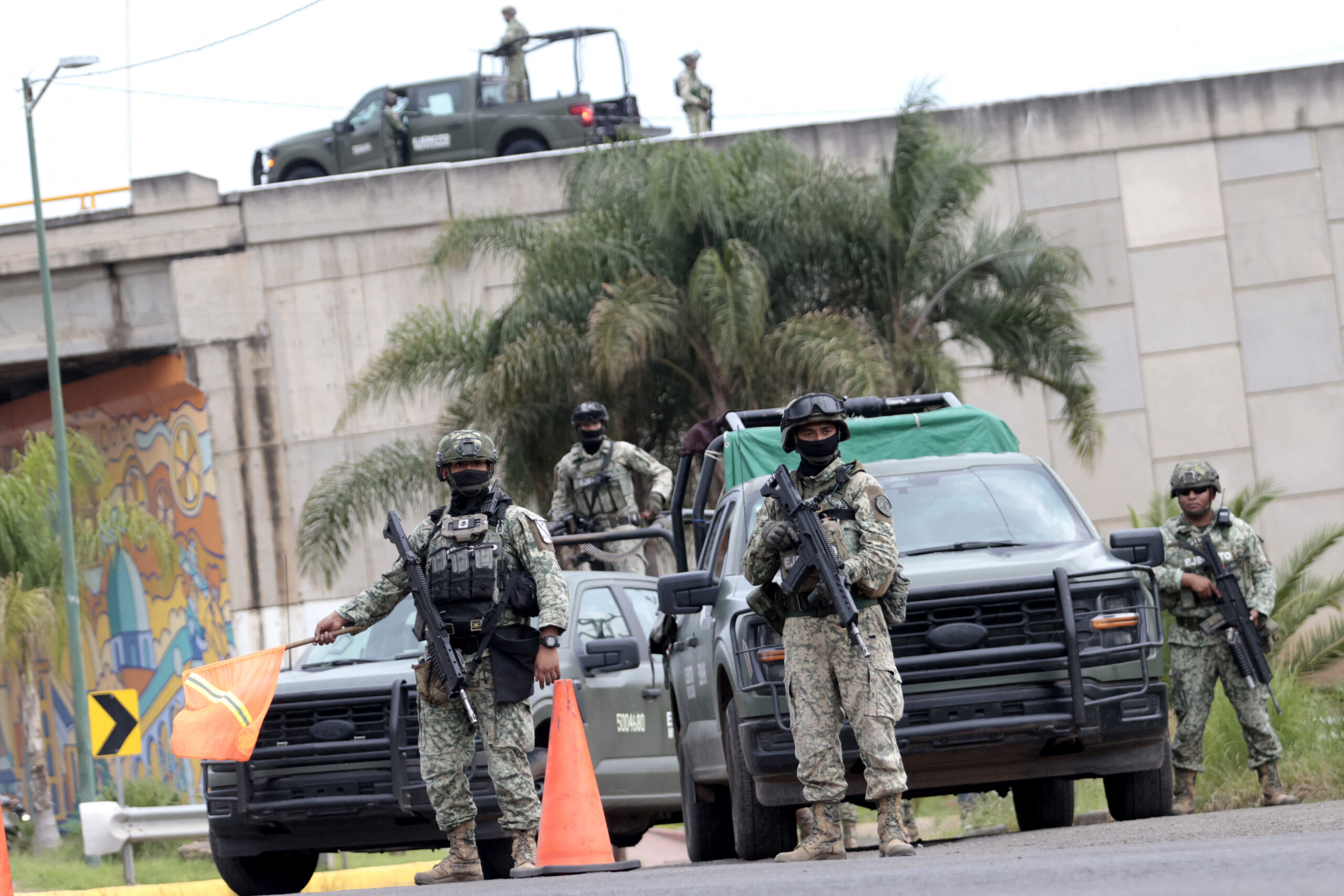
Foreign Affairs American businesses are funding violent cartels south of the border. Photo by ULISES RUIZ / AFP via Getty Images The U.S. attorney for the Western District of Texas did not mince words: Nothing crosses into or out of Mexico without the approval and payment to Mexican drug cartels. American businesses that engage in any cross-border trade bear a significant amount of responsibility to do so without benefiting those cartels and without threatening our national security. The statement came last July in the context of a bribery case brought by the Department of Justice against the Scoular Company, a Nebraska-based agricultural trading firm with billions in annual revenue. The Justice Department used the Foreign Corrupt Practices Act (FCPA) to prosecute a scheme in which Scoular authorized more than $400,000 in bribes to Mexican officials between 2015 and 2019. The payments enabled the company to avoid approximately $6.5 million in inspection fees and transportation costs associated with agricultural shipments entering Mexico. Mexican customs brokers were the intermediaries in arranging the corrupt transactions. Customs brokers are private agents, not government officials. Importers and exporters contract with them to manage the complicated cross-border shipping process. Licensed by their respective governments, customs brokers prepare paperwork and advise on compliance with the rules governing international freight transportation. Indeed, customs brokers are indispensable in moving the more than $870 billion in merchandise traded annually between the United States and Mexico. Many brokerage firms coordinate shipments on both sides of the border, working through separately licensed Mexican and American brokers to manage customs clearance with both Mexican authorities and U.S. Customs and Border Protection. They also provide professional advice and services involving transportation, storage, and security. When it comes to moving cargo south of the border, Mexican customs brokers are key actors in managing the criminal cartel wild cards. In the Scoular case, the brokers involved seemed remarkably bold—or sloppy. According to the Justice Department, these agents asked Scoular to authorize payments of approximately $2,000 to $3,000 per train to the Mexican officials responsible for inspecting rail shipments. Disguised as legitimate reinspection fees, these were in fact bribes. Over several years, Scoular authorized over $400,000 in corrupt payments before the scheme was exposed. The company subsequently agreed to pay more than $10 million in criminal penalties and forfeiture. The most disturbing aspect of the case was the U.S. government’s contention that some of the bribery proceeds ultimately benefited cartel associates. Federal prosecutors, however, said the American company representatives were not aware that their bribes were ending up in the hands of Mexican organized crime, and it wasn’t publicly established how the money passed from corrupt Mexican officials or intermediaries to cartel-associated individuals. Nevertheless, the case demonstrates how American corporations can be unaware—perhaps willfully so—that their legitimate commercial transactions are fueling corruption and organized criminality. Consider another federal prosecution announced in May 2025. The Department of Justice charged executives of Sport LA, a Los Angeles freight-forwarding company, with operating an international smuggling scheme involving billions of dollars of merchandise shipped into Mexico. According to the indictment, the defendants used fraudulent customs documents, shell companies, and bribes to Mexican officials. More significantly, prosecutors alleged that the operation paid kickbacks directly to Mexican drug cartels, including the Jalisco New Generation Cartel, to facilitate its activities. The defendants were also accused of laundering the proceeds through Mexican shell companies and American bank accounts. These allegations have yet to be proven in court, but the indictment describes a commercial shipping operation in which cartel payments allegedly formed part of the business arrangement itself—made-in-the-USA corruption finding partners in Mexico. The American trade lobby would say both the Scoular and Sport LA cases are routine, and show why we have a DOJ to investigate and prosecute these matters—no big deal. But the truth is that these cases illustrate the vast complex of corruption and criminality that has a stranglehold on the Mexican state, and that growing legal commerce between our countries inadvertently feeds that beast. Since the negotiation of NAFTA in the early 1990s, one of the assumptions underpinning hemispheric trade has been that growing wealth would help Mexico modernize its government institutions, defeat widespread corruption, and ultimately begin winning the war against its powerful criminal cartels. But despite the wishful thinking of the American trade lobby and the international business community, this has not in fact occurred. The troubling reality is that Mexico’s homegrown corruption and powerful criminal cartels prosper by taking a cut of legal commercial activity—and that commerce is overwhelmingly tied to the country's northern neighbor. And patriotic Mexicans who seek to change this have few tools to do so. They are losing their battle. It is no secret that Mexico has assigned major responsibilities for maritime ports and land-border customs security to its armed forces. This was a desperate decision taken by former President Andrés Manuel López Obrador and continued by current President Claudia Sheinbaum. This policy is a recognition that Mexican civilian government authorities have lost control amid corruption and criminal penetration of their country's international trade infrastructure. The situation in these ports should be understood as the proverbial canary in the coal mine. Mexican customs brokers are hardly the only intermediaries involved, but the Scoular case illustrates the deeply interwoven nature of the problem. Most Americans understand how cartels make money from smuggling illicit drugs into the United States. But U.S. policymakers should also be aware of the vast profits these gangs make from extortion, protection payments, fuel theft, and other criminal activities that are embedded in legitimate commerce. The cartels rarely send gunmen to rob banks. They do not want to kill the golden goose. Instead, they see their future as continuing to take a small cut of growing business, which in Mexico means international trade, now approaching a trillion dollars a year. Through normal business practices inside Mexico, American and multinational companies pay substantial costs associated with freight transportation, storage, insurance, and security. These are all part of countless opaque and mundane business transactions, mostly handled for multinational companies through Mexican intermediaries. The payoffs to criminal actors remain commercially affordable because Mexico offers other massive advantages in labor costs, taxation, and environmental compliance. Major U.S. investors in Mexico, such as General Motors, Walmart, and Constellation Brands—the brewers of delicious Mexican beer—do not publicly disclose how much they spend on private security to ensure their products move safely through a country in which cartels exercise control or influence over as much as a third of national territory. Much of that territory includes trucking routes and railroad lines that run up to the U.S. border. To its credit, the Trump administration announced in February 2025 that it would prioritize investigations involving cartels and transnational criminal organizations. In June, the DOJ issued revised FCPA enforcement guidelines specifically addressing corruption connected to cartel operations. But FCPA enforcement can only go so far. One significant issue with the statute is that it is designed principally to punish Americans who bribe foreign officials. But that is only a small part of the looming corruption and criminality iceberg threatening the U.S. homeland out of Mexico. Subscribe Today Get daily emails in your inbox The central point is that neither DOJ investigators nor State Department officials on the ground can unravel the countless legitimate arrangements in Mexico that also mask corrupt activities in which payments from American corporations are routinely siphoned off to criminal enterprises. Earlier this month, the office of the U.S. Trade Representative (USTR) announced that it was seeking public comment in advance of the 2027 joint review of the United States–Mexico–Canada Agreement. It is time for USTR to grapple with the reality that robust cross-border trade is not simply growing Mexico’s legitimate economy. It is also making Mexico’s corruption problem worse. And it is making the Western Hemisphere’s most powerful cartels stronger, more entrenched, and more dangerous. In considering next steps with Mexico, it is useful to recall that USTR once told us that robust U.S. trade would modernize, reform, and democratize Communist China. That is why Washington needs a real Mexico trade plan now.
The Seedy Underbelly of U.S. Trade With Mexico
Full Article
Original Source
Read the full article at Theamericanconservative →KhanList aggregates and links to publicly available news content. We do not host full articles from third-party sources. Always verify important information with original sources.