
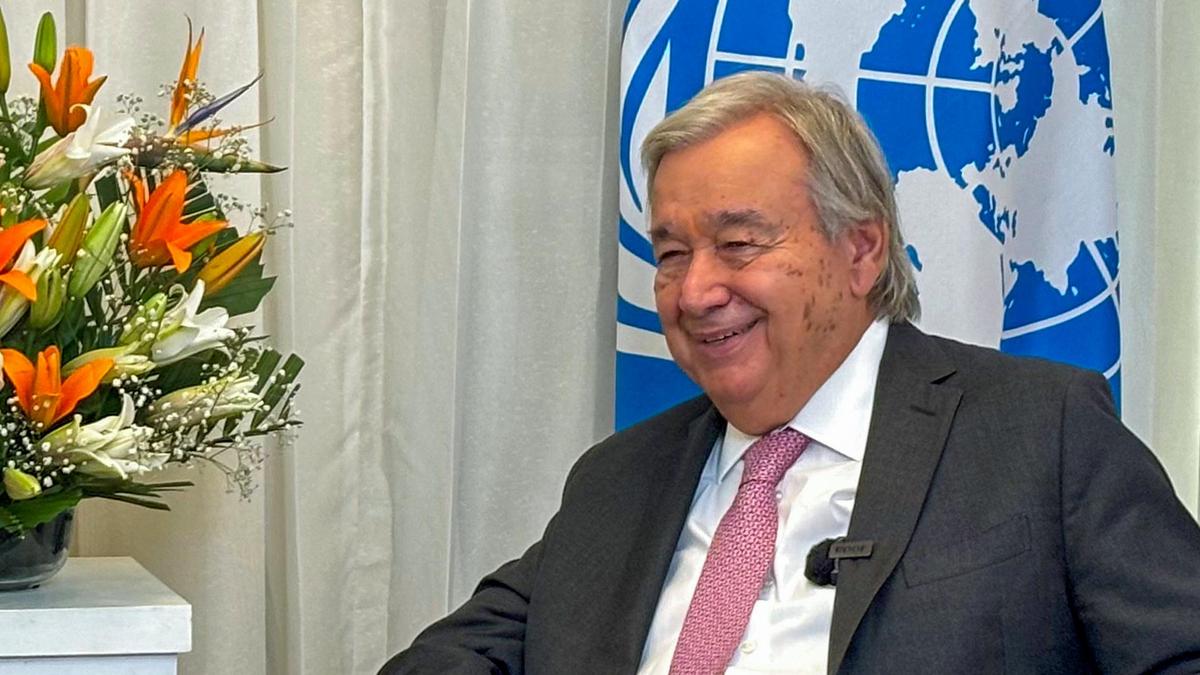
The Security Council is paralysed, and global superpowers haven’t recognized there are limits to their power says UN Secretary-General Antonio Guterres, in his most scathing comments about the culture of “impunity” and divisiveness that besets global leadership. In an exclusive interview to The Hindu on the sidelines of the 18th BRICS summit, the UNSG, who demits office at the end of the year, weighed in on a number of issues, including UN reform, the election for his successor, the latest developments in the West Asia war, Israel’s war in Gaza, India’s efforts in the Russia-Ukraine war, and the latest controversy of a new UN resolution on the world map. In a speech last year, you said that the promise of never again for genocide is dangerously close to being broken. 80 years Since World War II and the UN’s creation, do you think the United Nations is no longer able to fulfil the role it was created for? Well, first of all, let’s be very clear. The United Nations has guaranteed that we would not have a third world war. We have many conflicts around the world, but we have not two superpowers fighting each other directly. And this is largely because of the work of the United Nations has done during these 18 years. The problem is that we now have a strong geopolitical divide. On one hand, we have superpowers that have not yet recognised that their power has limits and get into adventures that produce terrible results. The division between these superpowers creates a situation of impunity for mid-sized powers to start wars, not respecting any rules, with a total sense of impunity. With the Security Council that is paralysed because of the divisions that exist at the level, especially of the superpowers, this has created a world that became very, very dangerous. I do want to get to the role of the superpowers in all of this, but on news now that groups in Yemen have captured the Bab el-Mandeb strait. Can the United Nations help with the situation? We have been trying to help as much as possible in relation to guaranteeing something that is fundamental, which is the freedom of navigation. The rights and freedoms of navigation that must be respected in the Black Sea, in the Strait of Hormuz, in the Bab el-Mandeb. That is essential. No tolls, no permission to some and the refusal to others. Freedom of navigation is a basic principle we are defending. On top of that, United Nations has been involved in creating mechanisms and proposing those mechanisms in order to allow for these blockades to at least have exceptions in relation to food and fertilisers. We did it with the Black Sea Grain Initiative [in the Russia-Ukraine conflict]. We have made an offer in relation to fertilisers for the Strait of Hormuz that Iran has not accepted. We are also interested in discussing, both for the Ukrainians and for the Russians, the possibility of exporting food, fertilisers and energy in the Black Sea. This would require, again, political will. Leaders and high officials from Iran, UAE and Saudi Arabia are here at the BRICS Summit. Are you going to take the opportunity to get that political will going? I’ve been talking to all of them. But the question is, when the superpowers are divided, there is no respect. Everybody believes that everybody can do whatever they want, and what we see is mid-sized powers getting involved in different conflicts. Look at Sudan. How many countries are involved in the conflict in Sudan? It would be enough to have a conflict between Sudanese, but then lots of other countries get involved because there is a sense of impunity. As the superpowers are divided, the Security Council is paralysed. There is no way to put order in the world. So, we badly need to overcome this divide. Superpowers must also understand that their powers have limits. I mean, if you look at what happened in Ukraine, Russia’s attacked Ukraine four-and-a-half years ago, and it goes on and on. Even the U.S. with Iran, we see the difficulties that U.S. is facing. I think it’s time for superpowers to understand the limits of their power, and that will help the world become more peaceful. India has declared it stands ready to offer its services for peace efforts in Ukraine. Did you discuss that with Prime Minister Modi? We discussed both the war in Ukraine and the situation in the Gulf with a common, clear perspective — that we need peace and at the same time we need, even if peace will not be immediately in place, we need absolute freedom of navigation. That is an area where we are totally in agreement. I’m very appreciative of the efforts of mediation that India has had — the contacts, the permanent contacts with the parties to the conflicts in order to create conditions to allow for trust to be reestablished. One of the biggest problems is that there is a total lack of trust and even a reasonable agreement is not made because each party thinks that the other will not implement the agreement. The existence of true mediators, messengers of peace, of bridge-builders is extremely important and no country is better placed than India. At BRICS they are discussing the future of global governance. Is it time for a reformed UN or is it time to push for a completely overhauled multilateral system? Well, we have been pushing a lot for fundamental reforms, and the question is a question of power. We still have a number of institutions, multilateral institutions, economic governance mechanisms that correspond to the situation of the world in 1945. It is obvious that we need a deep reform in the UN, especially in the Security Council. We are doing a lot of reforms in the operational aspects of the UN, but the central question is a question of power. This Security Council does not correspond anymore to the world of today. It creates a problem of legitimacy, and it creates a problem of effectiveness. The Bretton Woods system doesn’t correspond to the reality of the emerging economies that are underrepresented in an obvious way, both in the World Bank and the IMF and in several other institutions. So, we need to readjust the power systems and the mechanisms of governance in the world to the reality of today’s world instead of the reality of 1945. This is a hard battle. What I have been recommending is more than a simple reform. It is really an overhaul. Even so, it’s incremental. The question is if the UN is broken, does it need to be fixed or replaced? But the UN is not broken. I mean, look at all the humanitarian action that is done in the world. Even with less resources, even with the cuts that were made, no UN institution has collapsed. and they are going on working and supporting people in the most dangerous places in the world. Look at peacekeeping, still active in the most dangerous locations. Look at the support the UN has been providing to the reforms in international financial architecture. Our involvement in artificial intelligence — the first international scientific independent panel on artificial intelligence was created in the UN. The first global dialogue on artificial intelligence was created in the UN, very much in line with the initiative that India has taken. I mean, many things demonstrate that the UN is full of vitality and is able to inclusively reform its own ways of work, its own structures. But there is, as I said, a central question, and the central question is the question of power. Power relations in this world are distorted, and that makes the Security Council — the central entity for the preservation and peace and security in the world — completely non-operational. The UN has now adopted a resolution to reform the Map the world uses to be more representational of size. Has India raised concerns over the map online at the UN website that draws parts of Indian territory disputed with Pakistan and China separately? There is no such a thing as a “UN map with borders”. The resolution that was approved in the General Assembly is not a map. It is a resolution that, and I think quite correctly, says that there are distortions in the landmasses that correspond [to real sizes] and also to power relations in the past. Those distortions should be corrected. However, the UN has not published any map with borders, and it’s not for the UN to define those borders. So, there’s nothing to do with the border or disputed territories between two countries. There is a map on the UN’s website that represents what was seen as the new map. That’s not an [official] UN map. It is the contribution of an NGO. That map is indicative, but there is not at all any definition by the UN of what borders should be. Of course, it also raises one of the challenges you have dealt with as UN Secretary General, and that is the India-Pakistan conflict. When you had come to India in 2018, your first visit, you had spoken hopefully of trying to help or you had offered your good offices to help with the India-Pakistan situation to mediate if required. Was there a time in which you did actually mediate between the two sides? The U.S. claims it did. Well, I don’t know if the U.S. mediated or not. I’m not a mediator. Let’s be clear. I respect the two countries. I discuss issues with the leaders of the countries. I hope that it will be possible for the two countries to come together, but the UN is not directly involved in any mediation process. In any case, to mediate, you need the agreement of both parties. That isn’t the case here. We aren’t just seeing superpowers carry out wars. But superpowers now offering alternatives to the UN- like the U.S. Board of Peace, and China’s Global Governance Initiative. Do you think the Board of Peace is an alternative thing? It’s what the U.S. is presenting it as. Even the U.S. has always said that this is not to replace the UN, and in the global governance initiative in China, it’s clear that the UN should be at the center of the global governance. But these are unilateral initiatives that take the place of what the UN system itself is doing. Those initiatives are not correcting anything that the UN is doing and the Board of Peace, let’s be clear, is a proposal that is trying to solve the question of Gaza. Let’s be clear it is not something to replace the UN. The UN is present all over the world and I still believe that the UN is an indispensable instrument in order to minimise the enormous existential risks that we face. The risk of inequality, the risk of climate, and the risk of unregulated artificial intelligence. Another threat to the UN comes from Israel — it has not just exited many UN institutions and declared you personally PNG, not given you a visa. So many UN officials have been killed. I didn’t ask for any visa. If there is something that is clear, it is that the UN, and I’m responsible largely for that, has had a very clear position always. Be it in the Russian conflict, be it in the Israel-Palestine conflict, the UN has always been a reference point in defence of the charter, in defence of international law, in defence of international humanitarian law. It is not our fault that unfortunately several countries around the world, and sometimes some of the most responsible, have apparently decided that international law must not be respected, and that the law of the force must prevail over the force of the law. Do you think Israel’s war in Gaza qualifies as the “never again”, the genocide that you spoke about in that speech that I referred to? Genocide is a legal definition that belongs to the courts and in principle to the International Criminal Court. What we say is that what is happening in Gaza is absolutely outrageous. It’s absolutely unacceptable. It’s a dramatic violation of all principles under international law. But, we are not giving a legal definition of that. It’s so horrible that it doesn’t even need to be qualified as such. Do you wish it would be qualified? This is not our matter. We are not qualifying in legal terms what happens in different circumstances. What we are describing is a reality that is a reality in which the Palestinian people have suffered dramatically after what was also something condemned clearly — the barbarous attacks by Hamas on October 7 (2023). So, what happens when the next country decides that it too can keep UN officials out, keep the Secretary-General out, carry out these kind of killings — 70,000 dead, 20,000 of them children? The UN does not have the power to stop it, and that is the problem that I mentioned in the beginning. We have a power relations situation in which you have a number of superpowers that are divided. That creates a situation in which countries like Israel or Iran, or any other think that they can do whatever they want. There is no instrument in the international community to guarantee that those violations of international law are effectively punished. There is a UN Secretary-General election this year. Do you think you need another term just to resolve these issues? No, I absolutely need not to have another term. There are many women candidates for your position. Do you hope to be succeeded by the first woman UN Secretary-General? Well, I don’t interfere with the campaign, but I think it’s absolutely natural that in the UN, like in any other country, women have access to the highest position. And I think it’s a matter of gender equality and gender parity. During these last 10 years, we reached full parity, women and men, at 170 positions of leadership in the UN, with 55% of women in the resident coordinators of the UN in the different countries of the world. We will get to the 50% in relation to the international stuff of the UN all over the world. This was a true revolution to ensure that the power relations are changed to guarantee that women really have the role that they should have. If an organisation is led by women and men at the same level, the problems of bias against women in governance, in the way that organisations operate, will disappear. The actual definition of a glass ceiling is that you have women in all these positions, but not at the top- would you like to see a woman as Secretary-General I would be very happy with that. Given the challenges that we have just discussed and there are so many more, wars, pandemics, climate disasters, including what we just saw in Nepal, what do you think was your biggest achievement and what do you think was your biggest failure? It is for others to decide what my achievements or failures are. I think that what I’m happier with is with the fact that we were able to navigate during these 10 years, with full respect for the principles of the UN. We never had double standards. The worst failure has been the failure to make countries understand, and especially those countries that have the instruments of power, that we absolutely need to seriously reform the global governance institutions, Security Council. system and others. I thought you were going to say — the fight against climate change, lack of commitments for the Green Climate Fund That is not the failure of the UN. The UN has been in the front line of fighting for climate action. That is the failure of member states that go on putting their short-term interests before what is an existential share to humankind. The UN is what the member states want the UN to be. Member states should not use the UN as an excuse for what they are not able to do or are unwilling to do. Have you given a thought to what next? What will you do after you step down as UN Secretary-General? I have absolutely no idea. I’ve been working hard to make sure that I do what I have to do until the 31st of December. Afterwards, we will see.
The Security Council is paralysed, but the UN is not broken, says UNSG Guterres
Full Article
Original Source
Read the full article at Thehindu →KhanList aggregates and links to publicly available news content. We do not host full articles from third-party sources. Always verify important information with original sources.