
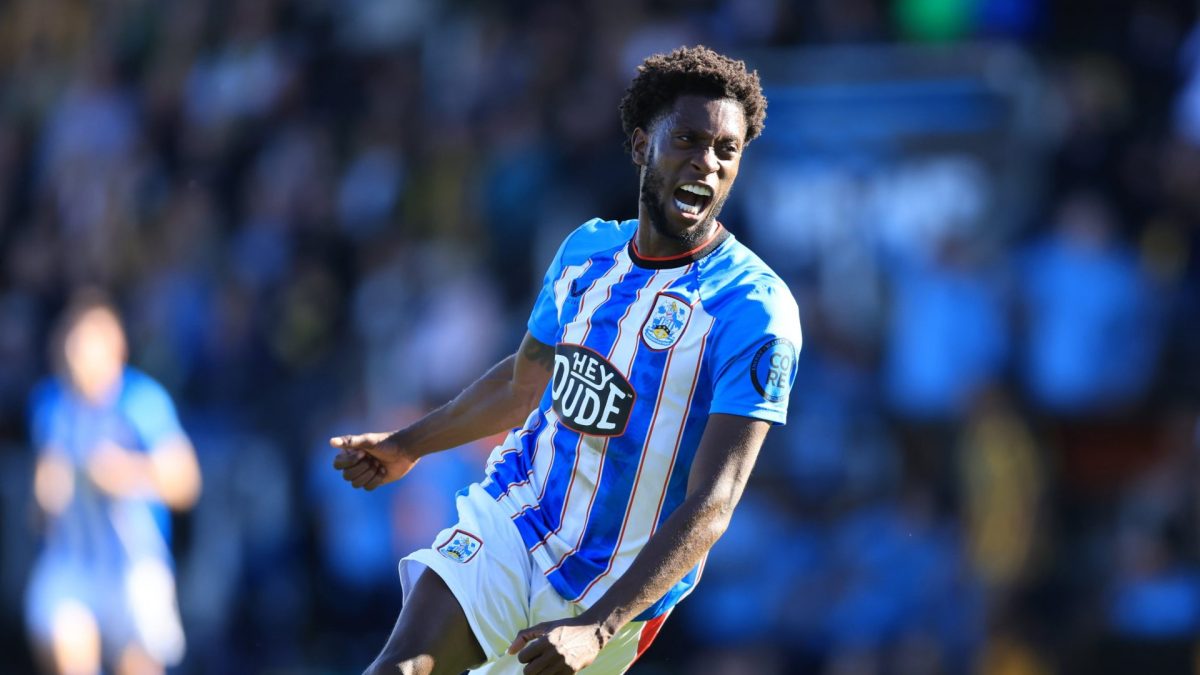
After 81 minutes in the Accu Stadium, Derensili Sanches Fernandes was withdrawn in the aftermath of Huddersfield Town’s fourth goal, another win secured. As he walked around the back of the goal, supporters rushed towards the front of the stand to touch the winger’s hand. There was something distinctly comical about adults joining children in the pursuit, as if they were clamoring to see their favourite character at Disney World. If Sanches Fernandes’ arrival from the Dutch Eredivisie was a coup, the form since has been ludicrous – nine goal contributions in as many league games. On this night, he assisted the fourth goal in a 4-1 win over Peterborough United but his fingerprints were over the entire performance because he’s the out ball for most attacks. Football managers talk an awful lot about maximising their advantages. You can distill the whole business to one mighty difficult pursuit: making good momentum last as long as possible and ending the inevitable dips as quickly as you can. Do that with individual players and the performance of the team will reflect it in glorious symbiosis. Doesn’t that sound so easy. The question I want to answer is how that actually works in practice? Using interviews with Sanches Fernandes and head coach Martin Drury, I want to know how a football club – and a footballer – work specifically to keep an in-form player at the top of their game? Praise vs motivation We’re all aware of the difficult balance of man management: motivation, complacency, praise and criticism. Every player’s personality is different and they shift over time and depending on a dozen external factors. Coaching teams must quickly understand what makes each player tick. It is the most complicated and most important element of the job.The starting point, as Drury says, is honesty. “The best thing you ever do for players is to tell them the truth,” he tells The i Paper. “So when someone’s doing something good, I think they should be championed. And when they’re not doing something right, I don’t think you should shy away from letting them know.” Sanches Fernandes says that he feels the love from Drury. There is an embrace when he finally gets around the touchline to the bench. Twenty minutes after the game, in the back of the tunnel, Drury comes out of a side room, sees his winger and gives him another bear hug and a complimentary word in the ear. Cue beaming smile from his special talent. “It’s really important that staff recognise when players are improving,” says Drury. “But I think it’s even more important that players recognise themselves improving. That can be really magical, because they see the route to getting even better and they become sponges for information.” Sanches Fernandes is in that zone now. He has been excellent so far this season, but his first words to me do not dwell upon how well he’s doing but the improvements that he must make next. “I know clearly what has to happen,” he says. “I have to learn that even when I get tired, the final pass or shot is better. I should have been involved in at least two more goals [against Peterborough United]. When I’m tired, I have to know that I can still produce.” Think like an underdog Sanches Fernandes says that he isn’t particularly superstitious. He doesn’t have a specific mental routine or use visualisation techniques as others might do. But there is a mindset that he believes makes good form more likely to persist: “Think like an underdog”. In the Dutch league, where defenders were physical with him (and League One is no different) he told himself that he was the underdog even in situations where he knew that he was the better player. Doing that subconsciously fueled his defensive work and making runs even when he wouldn’t get the ball. You play as if you have something to prove in every action. “Doing that also creates a picture where you aren’t seeing the game for how it is, but how it could play out,” he says. “You’re trying to get something over the opponent. Then when something changes behind you, you can adapt really quickly.” Coaching but never over-coaching Sanches Fernandes, like many creative attacking players, is an instinct footballer. There is a muscle memory to his movement, accumulated over his entire development. If there is any overriding philosophy, he explains it succinctly: “I just want to attack and just go as quickly as possible. If I see a gap open up, I just play it. When I see it, I give it. And if I can shoot I will always shoot.” That sounds so ludicrously simple that you wonder how coaches adapt his game. It’s one of the more unrecognised elements of training elite footballers: knowing when not to coach is as important as when to coach. When an instinct player is thriving, why would you ever complicate that? “It’s a really important point,” Drury says. “Some players have just got that level of ability that they can turn it on and off when they decide to and, actually, sometimes you just have to respect that level. You have to work out a different way to connect with them. “Derens has got a hell of a lot of talent and our job as a coaching staff is to make sure we get the ball to him and put him in situations he enjoys, he thrives in, he relishes. He loves competition. He really enjoys being in duels and looking at his opponent and how he wants to get the better of them. “As you rightly say, we have to get that balance around how we coach so as not to uncoach some of the things that they’re already doing themselves. Of course there are always things that we can refine, but you have to have a soft and different touch with those types of players.” Recovery is king The Dutchman has started every league game in Huddersfield’s rise to top of the table (Photo: PA) “The physicality here didn’t surprise me because I knew what to expect,” says Sanches Fernandes with a weary smile 30 minutes after full-time. “But now I’m definitely feeling it.” When Huddersfield Town signed Sanches Fernandes, they knew that he was prepared for physical demand. The winger is keen to point out that Excelsior, his previous club, were hard trainers and that made adapting to League One football easier. There is a resilience to Sanches Fernandes that belies his frame. He has also never played more than 35 matches in a domestic campaign and has already reached 13 this season. There are certain things you can do: Sanches Fernandes has been substituted in five of the last six league games and left out of the squad for both EFL Trophy fixtures. But the player and club both understand the importance of recovery work and rest. Drury is in regular communication with medical staff about training workloads. Talent speaks loud but any player’s voice is amplified by feeling able to perform at their peak. In the case of a fast winger who acts as his team’s most regular outlet and creative force, it becomes everything. Freedom = unpredictability Practically, the easiest tactical way to keep an attacking player in form is to maintain their unpredictability. In the age of data and video analysis, there are no surprises. It becomes a game of cat and mouse: opposition coaches move to mitigate Sanches Fernandes’ impact; he and Huddersfield work to maintain it by shifting the sand. Here again, relying on the player’s instinct is useful. Sanches Fernandes nominally starts on the right wing, but he has clear licence to drift from that role: dropping deeper, staying high, moving infield, taking his man on the outside and inside. “It’s something I practiced a lot a couple of years into my career,” Sanches Fernandes says. “When I first started, I tended to stick out on the wing and I got a little predictable. The defender knew my next move. “If I’m given a slightly more free role, I can take on my man on the outside. But then he also knows that I can move to the middle and create space. Or sometimes even go onto the left and create an overload out there. Even if I still end up going down the right wing, there’s doubt in the mind of the defender.” The whole package It’s pretty obvious that happy people make happy footballers. You probably do your job better if you feel good about yourself, feel valued, have a settled home situation and see your friends and family often. The same is true of people who have to make split-second decisions under intense pressure under great physical strain, weirdly. Sanches Fernandes has a new flat. His family come over from the Netherlands every week and were present for the weekend home game against Wigan Athletic (when he scored again, of course). He now has a friendship group within the club. Staff checked in far more often in his early weeks. But Huddersfield Town also made it easier in another, emphatically practical way. Last season, Excelsior played 26 Eredivisie matches with Sanches Fernandes on the right wing and Ilias Bronkhorst at right-back. Sanches Fernandes was signed by Town on 21 July. Eighteen days earlier, they had signed Bronkhorst on a free transfer. Read more Barnsley: The youngest team in England are a sign of a broken club Special report: I found the best thing about English football at AFC Rushden & Diamonds It’s fairly unusual, but made complete sense given that the club were in the market for a right-back anyway. Not only did each player have a familiar, friendly face around the new place of work, they also had to do far less acclimatisation on the pitch because they knew each other’s game so well. Don’t you love it when a plan comes together? On Saturday, Huddersfield beat Wigan to go top of League One. Their two scorers were Sanches Fernandes and Bronkhorst. “I can’t pay any more respect to Ilias and Derens in terms of what they have done together,” Drury says. “Coming to a new country, with a new group of players. The way they have both started the season is just absolutely crazy and it’s happened more quickly than I anticipated.”
The secrets behind Huddersfield Town’s flying ‘underdog’
Full Article
Original Source
Read the full article at Inews →KhanList aggregates and links to publicly available news content. We do not host full articles from third-party sources. Always verify important information with original sources.