
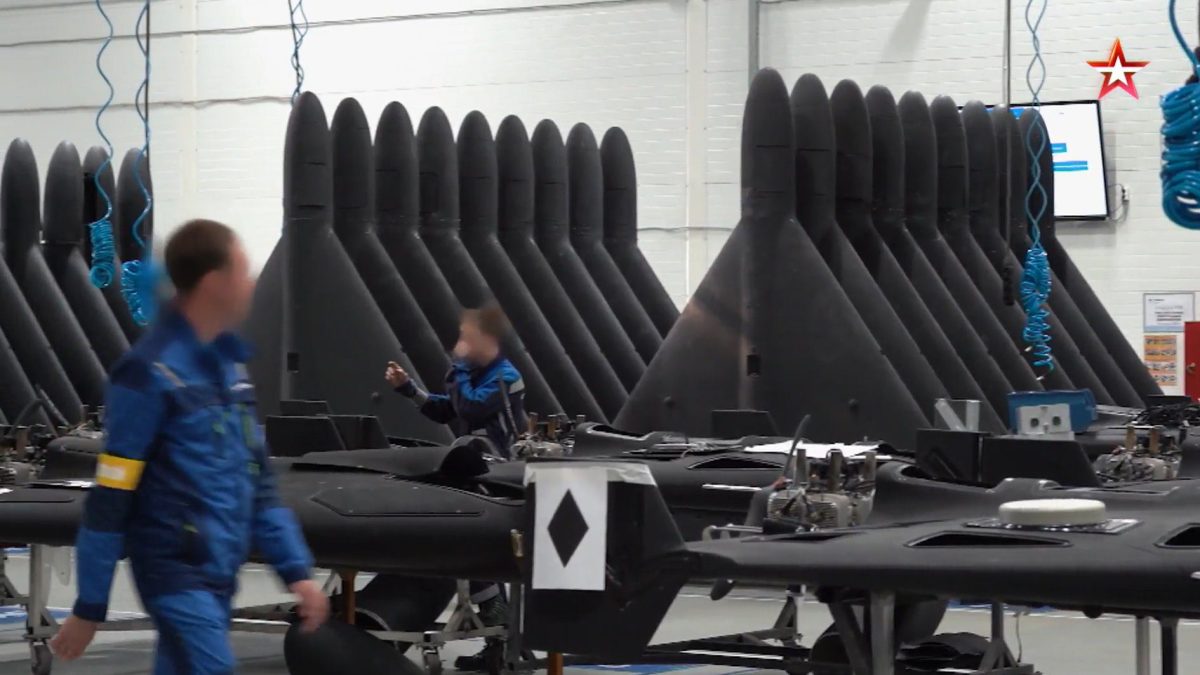
When Ukraine hit an oil refinery hundreds of miles inside Russia this week, Moscow was incensed. The drone strike on the Taneco refinery in Nizhnekamsk was just the latest sign of Kyiv’s ability to shatter Vladimir Putin’s illusion of safety and bring home the reality of his war to ordinary Russians. Local officials said 13 people, including a child, had been killed, making it one of the deadliest attacks on a Russian city since 2022. Nizhnekamsk lies in the Republic of Tatarstan, a top oil producer and refining hub that helps fund Putin’s war machine, and is therefore a major target for Kyiv’s long-range drones. Shorts Barely an hour’s drive north of the city lies a sprawling, high-security zone that is vital for another reason: its role in the production of suicide drones. In 2022, Russia teamed up with Iran to establish a factory in the Alabuga Special Economic Zone (SEZ) in Yelabuga, producing the notorious Shahed-131 and Shahed-136. Situated relatively close to the Caspian Sea, the zone is ideally located for Iran to send vital components and advisers, while rail links allow China to transport dual-use technology straight to the factory. Today, the factory produces Geran drones – Moscow’s low-cost Shaheds upgraded with anti-electronic warfare technology – and Gerbera decoys. It reportedly produces 170 to 190 every day, which Russia rains on Ukrainian cities near-nightly, killing and injuring scores of civilians. “If left operational, the Tatarstan drone factory will churn out thousands of drones that will further saturate Ukrainian air defences,” said Luke Coffey and Can Kasapoğlu, senior fellows at the Hudson Institute in Washington, DC. Satellite imagery revealed rapid expansion at the drone factory early this year, a study by the Center for Strategic and International Studies (CSIS) think-tank in Washington, DC found. Analysis points to “a sustained and deliberate expansion of infrastructure and supporting facilities consistent with the rapid scaling up of UAV [uncrewed aerial vehicles] and UCAV [uncrewed combat aerial vehicles] production”, the CSIS said. “It is reasonable to assert that Yelabuga has evolved into one of Russia’s leading centres for tactical and potentially operational-level UAV development and production.” New construction of facilities was documented in the south of the zone only last month, according to a Ukrainian open-source intelligence group. Since 2021, the drone factory complex expanded from two buildings to around 116, plus 67 housing units for 20,000 workers, including forced labour and children studying at a nearby technical college. Timur Nailevich Shagivaleev, Alabuga’s director general, has been sanctioned by the US for exploiting underage students to assemble drones. Ukraine claimed last year that North Korea, which has sent soldiers and ballistic missiles to support Russia’s war, planned to send 12,000 workers to assemble drones in Yelabuga. The threat posed by this factory makes it a key target for Kyiv. While early in the war, Yelabuga was too far to hit, Kyiv’s rapid advances in weapons technology have brought it into range. Ukraine targeted the factory in 2024 and 2025, a major feat considering the distances. However, those strikes inflicted only limited damage, for several reasons, Coffey told The i Paper. “First, the area is well defended because the Russians know it is a high-priority Ukrainian target. Second, many of the newer facilities constructed since 2022 are hardened and were built with the possibility of airstrikes in mind.” While Kyiv has extended the range of its drones and missiles, Coffey said: “At present, it is unlikely that Ukraine possesses the necessary weapons in sufficient numbers to cause significant and sustained damage directly to the factories.” The Yelabuga drone factory has been rapidly scaled up in recent years (Photo: Screengrab from Zvezda TV) Marc De Vore, senior lecturer at the University of St Andrews’s school of international relations and associate fellow at Chatham House, said that drones at Yelabuga are produced using low-tech “individual fibreglass moulds, which is very person-intensive but it means that there are not any really big machine tools to hit”. Hitting the sprawling, well-defended site with a drone would “put a hole in the ceiling and knock out a bit of the facility, but there is no key bottleneck piece of industrial machinery that you can hit that would take it out”, De Vore said. “It doesn’t present any great opportunities to achieve a really large amount of disruption with a few hits. To really disrupt production you would have to hit it quite regularly.” Such a campaign would require a powerful warhead, Coffey added, but Kyiv could target nearby energy and electrical infrastructure used by the factories. “Any disruption to this regional energy network could impact factory operations. Additionally, labourers may not report to work if the facility were to face a significant threat,” Coffey and Kasapoğlu said. “While destruction of the facility is not possible, even a partial disruption would represent a symbolic victory for Ukraine and a practical blow to Russia’s drone capabilities. It would also warn Tehran not to support Russian land attacks against Ukraine.” De Vore granted that “if you could hit it multiple times a week, eventually [Russia] would probably give up production there … But given the nature of the production, they could simply set up a factory that is even further away.” The threat posed by the factory makes it a key target for Kyiv (Screengrab: Zvezda TV) He said an alternative option might be targeting supply chains via direct rail links from China that bring goods for drone production including microchips, metal alloys and engines to the SEZ. “If there were any capacity for Western diplomacy or economic pressure, it could be exercised against China to police what they’re allowing to be exported and heading towards Yelabuga,” he said. Even if a kinetic strike cannot halt operations at the factory, it could offer Ukraine an opportunity to undermine Putin’s rule. “Tatarstan is the most significant oblast that does not have a majority-ethnic Russian population,” said De Vore. A Turkic and Muslim-majority region that declared its independence from Russia in the 1990s, it has become an important source of manpower for the war. Any major disruption to the delicate situation here could prompt a threat to Putin’s iron grip on Russia. “In the minds of Russian leaders Tatarstan is both economically independent but also presents something of a secession risk,” he said. “Both the wealth generated in Yelabuga and the potential disruption to that could have an impact on Russian domestic politics because of the particular economic and regionalist dynamics in Tatarstan.” Amid increasing evidence that Putin is failing to shield his discontented population from the reality of his war, even a small spark of rebellion is one he cannot afford.
The secretive Russian drone hub at the top of Ukraine’s hit list
Full Article
Original Source
Read the full article at Inews →KhanList aggregates and links to publicly available news content. We do not host full articles from third-party sources. Always verify important information with original sources.