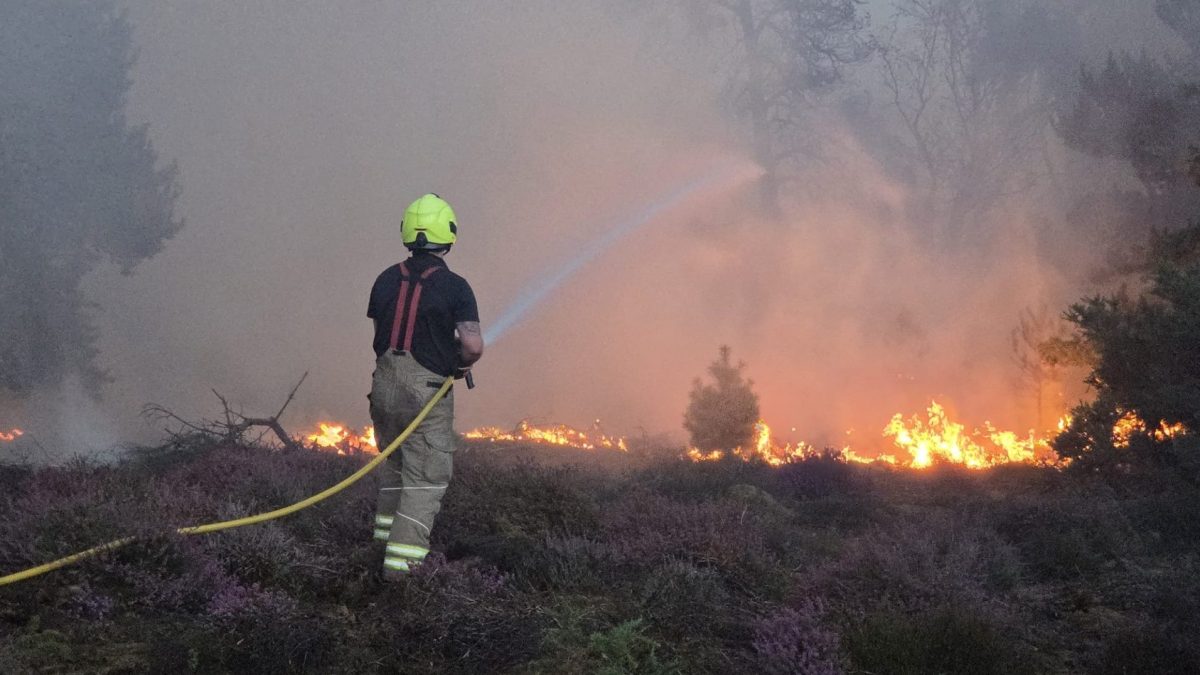
It was lunchtime in a quiet village on the edge of London when Laurence Kamm looked out of his front window and was appalled to see glowing embers streaming through the air. A retired driving instructor with a keen sense of community, he stepped outside to investigate and found himself in a totally unexpected maelstrom of heat and smoke. It was July 19th 2022, Britain’s hottest day, when the temperature reached a record 40°C and the unimaginable was about to become reality: Laurence’s village, Wennington, was soon to be engulfed by fire. The embers were flowing from a semi-detached house nearby. That was just the start. A dried-out marsh beside the village was alight and the wind was driving the wildfire into one home after another. It was like an invasion. Laurence and others banged on doors, shouting at people to get out, one family saving their tortoise, a woman fleeing barefoot with her cat in its bed, others losing everything. After leading his wife to the sanctuary of the medieval church, he had the idea of spraying his burning lawn – only to watch in horror as the water vaporised and the grass reignited. Within a matter of hours, in scenes that resembled a war zone, 18 houses were destroyed. In a lucky twist of fate, Laurence’s survived. In all, a staggering 40 homes in the London area were burned that day with another 30 in West Yorkshire and Norfolk. It was the largest ever loss of British housing to wildfire. And it’s shocking to me how little known this is. It’s the unrecognised impact of temperatures being driven up by carbon-fuelled climate change. Homes gutted by fire on July 25, 2022, in Wennington, east London, on the day the UK recorded the hottest ever weather temperatures (Photo: Dan Kitwood/Getty) Scientists have long talked about wildfires crossing the “rural-urban interface,” which, to British ears, probably evokes images of forest fires burning homes in the United States or Australia. Inconceivable, surely, in notoriously drizzly Britain. But the risks here are far greater than many realise, and they’re growing. The Ordnance Survey calculates that as many as 1.8 million homes in England are close enough to open land to be within reach of wildfire. Few people seem to realise the danger, and they certainly didn’t back in 2022. In interviews for my book, The Response: A Story of Fire and Flood in Britain’s New World of Extremes, I didn’t find anyone in Wennington who’d had any inkling that they faced this risk. The truth is that there’s a lot that the public aren’t being told. For several days before the fires in 2022, an official warning system, the so-called Daily Hazard Assessment, was flagging up the highest level of wildfire risk. I’ve seen these warnings, and they were very specific. But while they were shared with fire brigades and other official organisations, they weren’t released to the public. When I recently asked for access to the system, known as the Natural Hazards Partnership, I was told: “It is not suitable for public broadcast as it may be misleading…” The question of sharing the warnings was raised recently at a hearing of an inquiry into wildfire risk by the Environment Food and Rural Affairs Select Committee. No wonder the people of Wennington were caught by surprise. They did manage to escape and it’s a miracle that no one died but the evacuation was unplanned and chaotic. It could easily have gone wrong. That wasn’t the only failing on that terrible day four years ago. There were so many wildfires – 600 in all – that fifteen fire and rescue services declared themselves to be overstretched. The London Fire Brigade literally ran out of engines. I’ve been through its incident log and it’s painful reading how commanders were pleading for resources that simply weren’t available. And overshadowing everything was a fear about having enough water. Firefighters in much of southern and eastern England have worried about this for years, especially in times of drought like now. The first crew on the scene at Wennington reported that “a poor water supply” was limiting their ability to tackle the fires. The local water company told the brigade control room that the pressure was reduced “to allow them to carry out some testing”. Not exactly the best moment. It turns out that when the water utilities were privatised, a requirement to provide a minimum rate of flow to households didn’t apply to fire brigades; for them, there’s a less specific arrangement. Through Freedom of Information requests, I discovered that it took six hours for the water supply at Wennington to be restored. By then, the worst of the damage had been done and I wonder how many homes might have been saved with a quicker response. The challenge of providing enough water for firefighting is now recognised in the Government’s National Risk Register, its compendium of dangers facing the country. But it’s not clear whose job it is to fix that. I tried to find out but was given a runaround by a sequence of different ministries. It’s just one example of how Britain is still woefully unprepared. The long dry spell and exceptional heat we’re experiencing this summer have led to hundreds of wildfires from Wales to Scotland to Suffolk, where Dunwich Heath erupted a few miles from Sizewell nuclear power station. When Andy Burnham was mayor of Greater Manchester, he saw the risks for himself. He had to deal with a major wildfire on Saddleworth Moor in 2018 and learned something unwelcome about our lack of readiness: Britain doesn’t have any firefighting planes. In Suffolk, the National Trust had to pay for a helicopter to drop water collected from the sea. In comments last year, Burnham summed up a problem that’s now in his in-tray: “The thinking at the centre of government has not caught up with the changing world.” He has a chance to remedy that. Banning disposable barbecues would be a start. So would funding a public warning system, along with an education campaign and more intelligent management of the land. Joining up thinking across government is at the heart of this. In the massive fires in France, it was the coordination of firefighters, the military, farmers and others that saved Bordeaux. It’s an approach that can make all the difference at a local level too. After a wildfire destroyed 14 homes in Dagenham in east London in 2022, the local authority worked with the London Fire Brigade to cut firebreaks on the edge of parks. The strategy worked last year, saving a row of homes from a fire that ignited on playing fields. Jonathan Smith, Commissioner of the London Fire Brigade, told me recently that wildfires in the city would have been unthinkable even a few years ago. Now, as the climate changes, the threat keeps him awake at night. Just in the past week, the brigade has faced more than sixty grass fires. “We’re not putting the genie back in the bottle here any time soon,” he said. David Shukman is a former BBC News Science Editor and author of The Response: A Story of Fire and Flood in Britain’s New World of Extremes (Witness Books)
The secret wildfire warnings that aren’t being shared with the public
Full Article
Original Source
Read the full article at Inews →KhanList aggregates and links to publicly available news content. We do not host full articles from third-party sources. Always verify important information with original sources.