
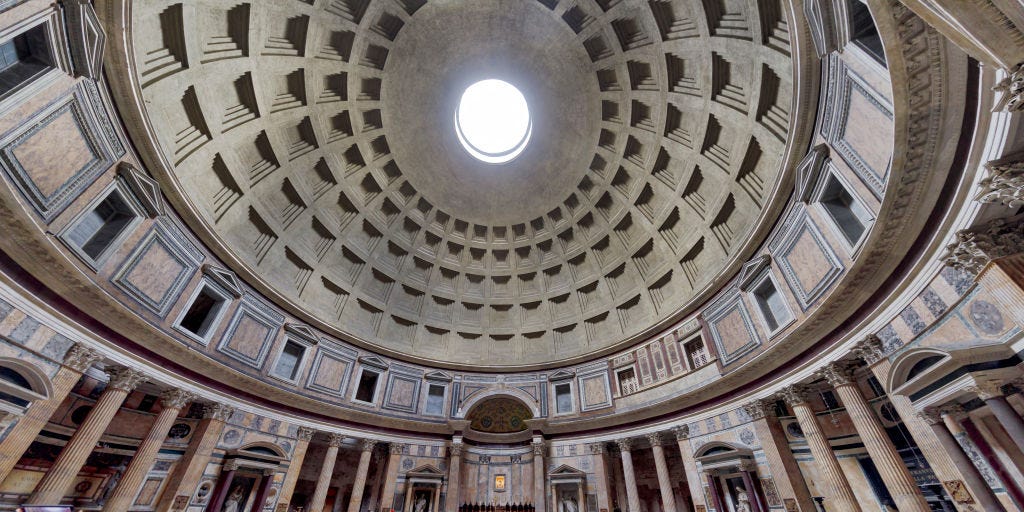
4 min readHere’s what you’ll learn when you read this story:Ancient Roman concrete is known as one of the strongest in history, allowing structures to defy the test of time and last for more than 2,000 years.Researchers discovered how this concrete’s secret ingredient plays a simple yet ingenious role in allowing structures like the Pantheon to heal themselves.We could return to this simple “hot mixing” process today, because we already have all the ingredients and methods at hand, and it’s far cheaper than modern self-healing concrete.The Pantheon, Rome’s unreinforced concrete dome, constructed around 118 to 125 C.E., still stands intact to this day. The Aqua Virgo, part of the ancient Roman system of aqueducts, was built in 19 B.C.E., yet still supplies Roman fountains, including Trevi, today. Is it any wonder that ancient Rome still draws our global admiration?For decades, researchers credited the inclusion of volcanic ash from Pozzuoli, a city in Naples, Italy, for the unique strength in the mix; others claimed that lime, a calcium oxide or calcium hydroxide binder created from heating limestone, was the key ingredient. Massachusetts Institute of Technology’s Admir Masic, a civil and environmental engineering professor, thought there must be more to the story.Masic established a lab at MIT with the specific goal of researching ancient Roman concrete. First and foremost a chemist, he says he knew there was something beneath the surface of Roman concrete potentially lending it strength. His team of researchers, from MIT, Harvard, Italy, and Switzerland, discovered that ancient Roman concrete gets its strength—and therefore its incredible longevity—from its inherent self-healing properties. As cracks form, the surrounding material somehow fills them back in, over and over.Scientists commonly suspected that ash, and not lime, was the hero of the Roman concrete-making process, because the Romans were the first to add volcanic ash to the mixture. This hydration-based method gives the mixture additional strength and makes it possible to build in all seasons.But it didn’t explain the self-healing quality. Another mystery was in the concrete’s apparent crystalline phases, known to take shape only at high temperatures—at least 80 degrees Celsius (or about 176 degrees Fahrenheit). Yet, the Romans wouldn’t have exposed their concrete mixture to those sorts of temperatures.Then, researchers discovered calcium aluminate hydrate being used as a binding agent in ancient Roman concrete, which only created further intrigue. This is where the mystery of self-healing gained its first big clue—trying to learn where the calcium came from, Masic says. So his team’s focus shifted to the overlooked role of lime, which is primarily composed of calcium compounds.Masic notes that modern concrete, when mixed with lime, volcanic components, and water, creates a homogeneous mixture—quite unlike ancient Roman concrete, which is studded with tiny, distinct white particles. “How is it possible that every construction site would make this heterogeneous material even though they put so much effort [into] making it very standard in terms of ingredients [and] how to mix it?” Masic wondered.The research team decided to investigate the mechanical, structural, and chemical properties of these particles, dubbed “lime clasts,” which were present in every sample they analyzed, Masic says. It led the team to realize “that lime clasts are not an error in mixing, or sloppy mixing, but they are the root of a very specific way of mixing mortars.” Not present in modern concrete, but ubiquitous in the ancient Roman version.Originally, researchers believed that the Romans added water to the lime mixture to make a slurry. This “slaking” creates a homogeneously structured mixture. However, the presence of the lime clasts didn’t fit into this model.What the Romans actually did was “hot mixing,” which introduces a novel series of chemical reactions. They ground the stone into tiny pieces of calcium oxide and mixed them with volcanic ash and a dry aggregate. Finally, they added water. “This is where the reaction of calcium oxide with water happens, and the entire mix gets hot, [which] releases energy, and creates hot spots up to 200 to 250 degrees Celsius,” Masic explains.Courtesy Masic et. alA large-area elemental map (Calcium: red, Silicon: blue, Aluminum: green) of a 2-centimeter fragment of ancient Roman concrete (right) collected from the archaeological site of Privernum, Italy (left). A calcium-rich lime clast (in red), which is responsible for the unique self-healing properties in this ancient material, is clearly visible in the lower region of the image.While lime and the ash formed the basis of the mixture, the constellation of millimeter-scale, mineral particles embedded throughout the mortar turned out to be the secret outcome of the hot mixing process. The key to hot mixing is that it doesn’t dissolve all of the lime clasts. Instead, they get systematically embedded into the concrete mix, creating a reservoir of calcium. When the concrete is exposed to water, the calcium spontaneously expands, creating a protective layer of nanoparticles that fill in the cracks before they can spread. Voila, self-healing concrete. Masic’s team published their findings in the journal Science Advances.The team’s own recreation of Roman concrete healed a crack within two weeks. A modern concrete mixture didn’t heal at all, allowing water to flow through the crack. Eventually, water seepage like this destroys the integrity of modern concrete structures.Roman self-healing concrete allows the mixture to last longer and requires less maintenance and less new material for construction—which also reduces emissions during concrete production. Standard cement production, the solid binder in concrete, accounts for about 8 percent of global CO2 emissions today.Our world actually has various forms of self-healing concrete, such as bioconcrete, in which bacterial spores activate and produce calcium carbonate to fill in cracks. However, the high costs of modern methods keep the industry from using them widely, says Masic. Meanwhile the ancient Roman method offers “self-healing at an extremely competitive price,” he says.Now that we know the secret, should we return to making concrete this way?In fact, Masic co-founded a company in 2021, that uses lessons he has learned from studying ancient Roman concrete. Today, DMAT is creating a concrete additive “that increases the lifespan of concrete structures by 50 percent and reduces CO2 emissions to 40% of traditional concrete,” according to MIT’s Climate Portal. As of August 2026, their material is part of underground water tanks, road barriers, and pavement in Italy and Switzerland. DMAT also plans to expand to U.S. infrastructure projects.Manasee Wagh contributed to this story.Download Pop Mech Digital IssuesTim Newcomb is a journalist based in the Pacific Northwest. He covers stadiums, sneakers, gear, infrastructure, and more for a variety of publications, including Popular Mechanics. His favorite interviews have included sit-downs with Roger Federer in Switzerland, Kobe Bryant in Los Angeles, and Tinker Hatfield in Portland.
The Secret Reason Why Ancient Roman Concrete Is So Remarkably Strong—And How One Engineer Has Recreated It
Full Article
Original Source
Read the full article at Popularmechanics →KhanList aggregates and links to publicly available news content. We do not host full articles from third-party sources. Always verify important information with original sources.