
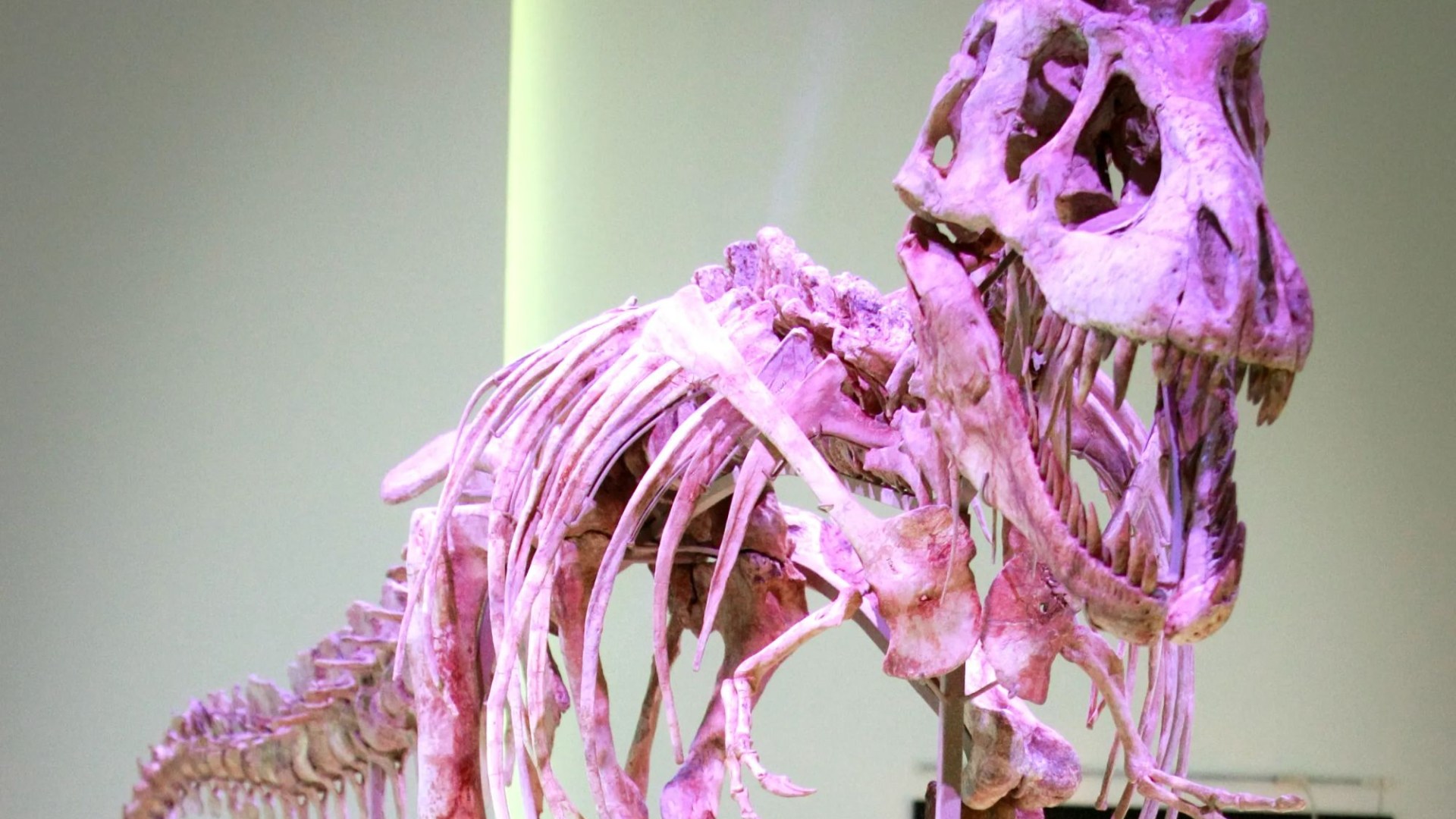
DINO bone smugglers looking to cash in on the global fossil fad are driving an increasingly aggressive and shadowy market. Fuelled by fossils fetching multi-millions at fine art-style auctions, bone runners are raiding sites and gluing bones together to sell off Franken-fossils for a quick quid. ‘Gus’, a 67-million-year-old Tyrannosaurus Rex skeleton, sold for more than $50million last month Credit: AFP This relative of the T.Rex was illegally smuggled into the United States from Mongolia Credit: AFP Traders are also exploiting loopholes in import and export laws to create a bustling black market. Professor Steve Brusatte, an Edinburgh University palaeontologist who was a consultant on Jurassic World: Dominion, told The Sun: “It’s very secretive. It’s on the level of drugs. Sign up for The Sun newsletter Thank you! “We don’t know much about it, it is so murky and dark.” Legal fossils going for life-changing money at auctions has led to dino-mania. A 67-million-year-old T-Rex skeleton, named Gus, sold for a breathtaking $50.1million (£37.2m) at Sotheby’s in New York last month. The record-breaking purchase smashed the $44.6m (£33.1m) paid for Stegosaurus “Apex” by hedge fund financier Ken Griffin two years before. Soaring prices have been fuelled by high-profile bidding wars between billionaires and celebrities, turning dinosaur skeletons into trophy assets. Stars like Leonardo DiCaprio and Nicolas Cage – said to be avid collectors – battled over a Tyrannosaurus bataar skull in 2007. Most read in The Sun A Stegosaurus – named “Apex” – went for £33.1million in 2024 Credit: Getty Excavators spend entire seasons extracting dinosaur bones from protected sites Credit: AFP Gladiator star Russell Crowe bought a Mosasaur skull, quite legitimately, from DiCaprio during a drunken evening before selling it off at auction in 2018. Brusatte says the fact that dinosaurs are such a hot commodity nowadays is proof that they remain “interesting, inspiring and awesome”. But he warned that the boom in interest has come at a cost, with dinosaurs being “auctioned as if they were high-end art” and becoming “status tokens for uber-wealthy collectors”. The surging commercial demand has also created a shadow market that threatens genuine scientific research. Smugglers actively stalk legitimate academic digs in far-flung areas of Mongolia or Brazil, watching the sites and striking in “fly-by-night operations” once scientists leave for the season. Professor Paul Barrett, a senior palaeontologist at the Natural History Museum, told The Sun: “There is an element of them ‘casing the joint’, as it were. “We think of field crews being essentially spied on. Once they’ve left for the season. They move in and dig.” But these amateur excavations destroy the scientific value of the fossil deposits. Celebrity dinosaur enthusiast Nicolas Cage forked out nearly £200,000 for a T-Rex skull Credit: Getty Hollywood superstar Leo DiCaprio is also known to keep a collection of fossils Credit: AFP Barrett said: “Some of the illegal collectors will just be going in with pickaxes as fast as they can to dig out what they can. “They’ll often be smashing up more complete material to sell it off in smaller pieces to maximize the amount of money they’ll get.” Bone raiders will also destroy surrounding sediment layers, surrounding plant matter and obscure the actual burial depths, which palaeontologists need to determine a dinosaur’s age and environment. Brusatte said: “This illegal fossil trade has terrible consequences. “Commercial collectors hack the bones out of the ground and damage them and make them essentially useless for scientific research or for public display. “This is a downstream consequence of the high prices that legal fossils are fetching at auction.” Once extracted, fossils are moved across borders via legal loopholes rather than smuggled in suitcases. Countries like Mongolia, Brazil and China strictly prohibit the export of their fossil heritage. Part of Cage’s 70 million-year-old Tyrannosaurus Bataar skeleton that had to be repatriated to Mongolia Credit: AFP Eric Prokopi spent three months in prison after selling a T-Rex relative Credit: Reuters Brusatte said: “If you see a dinosaur from one of these countries up for sale, it is likely to be illegal.” Nicolas Cage learnt that to his own cost, when the £185,000 T-Rex skull he beat DiCaprio to had to be handed back to Mongolian authorities. It even led Florida man Eric Prokopi – described as a “one-man black market” – being jailed for selling the fossil. But wily smugglers will often still skirt around the law, with few Western countries having laws preventing the import of dinosaur fossils. Barrett explained: “[A fossil] leaves the country potentially illegally, but it then enters the next country legally. “For example, it is illegal to export a dinosaur fossil from China, but it is not illegal to import a Chinese dinosaur fossil into another country. One particular loophole involves exploiting Taiwan’s contentious self-determination. Barrett said: “China regards Taiwan as its sovereign territory, whereas Taiwan regards itself as a separate nation. Dig site raiders risk damaging incredibly valuable fossils Credit: AFP T-Rex skeletons are the most sought after dino prize for trophy collectors Credit: iStock “But it does mean that if you wanted to get fossils out of China, you could legally export things from the Chinese mainland to Taiwan, because it might regard that as essentially an internal transfer.” Commercial collectors could then argue that by exporting a fossil from Taiwan, they are not technically taking it from China. David Martill, Emeritus Professor of Palaeontology at the University of Portsmouth, told The Sun: “It’s the same as anybody exploiting tax loopholes. “The attitude is that laws are there to be challenged or bent.” Traders can also bypass strict fossil laws by listing illegally-gotten fossils online as being “from an old collection”. Martill pointed to a major fossil show in Tucson, Arizona, where some on display come from countries with very strict laws. But it is very difficult to track when they came from, creating headaches for authorities. Martill explained: “Imagine that we brought in a law that says it is illegal to export British fossils for commercial gain. A T-Rex skeleton at the National Mueum of Scotland, Edinburgh Credit: Alamy Professor Stephen Brusatte excavates dinosaur fossils for research Credit: Christophe Hendrickx “What about all of those fossils that are in people’s collections that were collected last year, the year before or even 100 years ago? “And so one of the things you will see is fossils advertised on the internet and it will say ‘from an old collection’.” At the lower end of the market, local diggers will glue completely different bones together to pass them off as being more valuable. Martill said: “In Morocco, there’s a very vigorous fossil trade, because there are hundreds and hundreds of square kilometers of fossiliferous strata in the Sahara Desert. “They can get lucky and find something really good and valuable, like a nice big dinosaur tooth or something like that. “But they often find half a bone, and they will glue another bone to it to make it because they think they’re going to get more money for a complete bone than half a bone. “It’s a very common practice. Fossils will get improved or faked, but just to make it look better.” “I used to see it in Brazil. I remember buying a bone from a dealer and it was a pterodactyl at one end and a dinosaur at the other.” Dino-enthusiasts have a close look at the skull of a Tarbosaurus Baatar from Mongolia Credit: AFP – Getty American explorer Roy Chapman Andrews finding dino eggs in the Gobi Desert Credit: Alamy For scientific institutions, the primary danger remains the permanent loss of valuable or rare specimens. Publicly funded museums are simply unable to compete with eight-figure auction budgets. Brusatte said: “I know of no museum that could put down $50million to buy a dinosaur. “These largely complete, well-preserved, pristine fantastic skeletons belong in museums, where they can be conserved, studied by scientists, and most importantly displayed to the public. “If dinosaurs are commodities hoarded by the oligarch class, it is the 99.9 per cent of the rest of us who suffer. “Imagine if a billionaire owned the Mona Lisa, and kept it in his house, and nobody could see it or enjoy it. That’s the situation we may be facing with dinosaurs.” These sales also risk leading to critical discoveries being locked away out of researchers’ reach. Barrett warned: “The worst scenario for us is a key specimen being so expensive that it can’t be purchased by a museum, and then basically disappearing in someone’s aircraft hangar.” But he pointed to the number of philanthropist billionaires who have ultimately donated their collections to public institutions. Barrett said: “A number of these people are interested in the research and science, so [these fossils] are not necessarily being kept in a beautiful gold-plated mansion somewhere that no one else is going to see [them].” Martill added: “[They] will eventually end up in a museum. Because rich people, just like poor people, die. “Future generations of palaeontologists will get a chance to do the science.” However the commercial bone rush shows no sign of slowing down. Barrett recalled thinking the market had reached its peak when a T-Rex skeleton, named Sue, sold for $8.3m (£6.1m) in 1997. In under 30 years, he’s witnessed that figure increase more than six-fold. Comment now
The secret dinosaur black market where smugglers raid sites & glue bones into ‘Franken-fossils’ to flog for millions
Full Article
Original Source
Read the full article at Thesun →KhanList aggregates and links to publicly available news content. We do not host full articles from third-party sources. Always verify important information with original sources.