
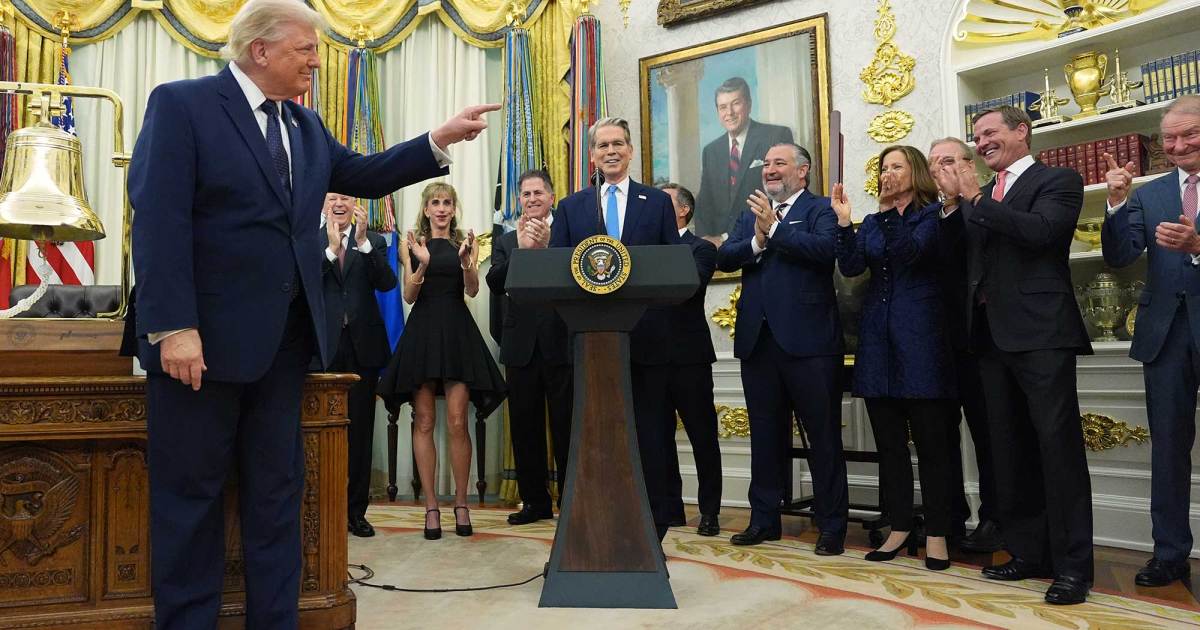
President Donald Trump gestures to Paul Atkins, chairman of the Securities and Exchange Commission, after ringing the opening bell for the New York Stock Exchange and the Nasdaq in the Oval Office at the White House in July. Mark Schiefelbein/AP Get your news from a source that’s not owned and controlled by oligarchs. Sign up for the free Mother Jones Daily. Earlier this month, the Securities and Exchange Commission quietly published a proposal to rescind a long-standing anti-corruption measure that prevents private equity firms and other investment advisers from buying access to billions of dollars in pension funds that belong to public employees like teachers, police, firefighters, and more. The regulation, which has come to be known as the “pay-to-play” rule, was passed nearly two decades ago, on the heels of scandals where Wall Street firms made huge donations (and even secret payments) to state and local officials in return for work managing multibillion-dollar public pension funds—an enormous and lucrative source of business. Some of the pension fund investments made by these firms later tanked, hurting thousands of retirements accounts. The SEC’s rule now prevents asset managers from getting paid to manage money for government entities—from pensions to public school funding—for two years after they donate to the elected officials who oversee those pools of cash. “The rule was intended to, and does, ‘combat pay-to-play arrangements in which advisers are chosen based on their campaign contributions to political officials rather than on merit.'” The SEC’s chairman, Paul Atkins, said in a statement that one rationale for rescinding pay-to-play is that the way many investment firms avoid dealing with its complexities is to prohibit staff from making any campaign contributions—even though the rule does carve out a limited allowance for employee donations, from $150 to $350 per election. The rule, he said, has “needlessly” burdened these firms and led to serious penalties for “small, often impulsive” donations, and has “resulted in the suppression of political speech.” “Not so. It has resulted in the suppression of corruption,” said Benjamin Schiffrin, the director of securities at think tank Better Markets, in a written statement. “The rule was intended to, and does, ‘combat pay-to-play arrangements in which advisers are chosen based on their campaign contributions to political officials rather than on merit,’” he added, quoting the SEC’s own words from the 2010 release of the original rule. Across the United States, pensions present an enormous opportunity for investment managers: Public pensions alone contain roughly $9 trillion. Public and private pension funds already make up more than 40 percent of the assets invested with private equity firms, paying them large fees in exchange for promises of greater returns. In the early 2000s, several firms set up huge pay-to-play schemes to secure a slice of this pension pie. In 2009, the California Public Employees’ Retirement System uncovered that one of its former board members had accepted more than $40 million from Apollo Management, the private equity giant run by billionaire Leon Black. In return, the board member helped Apollo get a major win: about $3 billion of CalPERS pensions invested with the firm. That board member funneled at least $250,000 worth of gifts to the CalPERS CEO to secure investments for Apollo, as well as paying for meals, travel, and a big portion of his wedding. Without any restrictions in place, investment firms would be free to once again buy access to Americans’ retirement savings—which could ultimately lead to significant losses. That same year, another private equity giant, Carlyle, agreed to a $20 million settlement for making more than $13 million in payments to a top aide for the New York state comptroller in order to secure about $730 million in investments from New York state pension funds. Yet another private equity firm, Quadrangle, settled with the SEC over claims that one of its executives paid more than $1 million to the same aide for the New York state comptroller in order to get $100 million invested from New York pension funds. (The executive also allegedly paid nearly $89,000 to purchase the distribution rights for a low-budget film called Chooch, produced by New York’s chief investment officer and his brothers, according to the SEC’s complaint.) By the end of 2009, yet another pay-to-play scheme came to light: Elliott Broidy, the founder of private equity firm Markstone Capital, pleaded guilty to paying nearly $1 million in gifts to the Office of the New York comptrollers’ office to secure a $250 million investment from New York pension funds. (Broidy later became a top Trump fundraiser.) If the SEC succeeds in throwing out “pay-to-play,” it could transform the landscape of pension investments. Without any restrictions in place, investment firms would be free to once again buy access to Americans’ retirement savings—which could ultimately lead to significant losses. That was evident during the heyday of such schemes: According to CalPERS own 2009 accounting, their pension funds lost at least $475 million while being managed by Apollo. Some investment firms may decide to enact their own policies or ethical guidelines. But these appear to be substituting a strict, clear rule that for a series of soft guidelines that may be hard to enforce. Private equity returns have lagged behind that of the stock market for the past several years. A McKinsey report found that private equity funds underperformed the stock market from 2023 through 2025, returning about 7 percent compared to the S&P 500’s 18 percent. The SEC’s proposal notes that some investment firms may decide to enact their own policies or ethical guidelines to prevent pay-to-play, and the agency is considering the possibility of issuing advice on what those should look like. But all of these appear to be substituting a strict, clear rule that has protected the finances of retirees for a series of soft guidelines that may be hard to enforce. In its proposal, the SEC also gives the public 60 days to comment on the rule. The agency claims that existing rules under the federal Investment Advisers Act are likely enough to prevent pay-to-play schemes. This despite the fact that this law, passed after the Great Depression, did little to prevent the schemes that played out in the early 2000s. What’s more, even with the current pay-to-play rule in place, pension fund scandals have not gone away: In February, a judge found that two board members of Ohio’s teacher pension fund had been acting as agents for an investment firm that was vying for business from the $103 billion plan, in “a high-stakes scheme that jeopardized the financial security of half a million teachers and retirees.” This spring, two executives of Iowa’s largest pension fund lost their jobs following misconduct allegations. All while the SEC published data about its enforcement work that showed a steep decline in prosecutions of cases involving abuse of public finance, like pension funds: While the SEC brought 97 such cases in 2016, it brought just seven in 2025.
The SEC Wants to Scrap a Key Anti-Corruption Rule Targeting Private Equity
Full Article
Original Source
Read the full article at Motherjones →KhanList aggregates and links to publicly available news content. We do not host full articles from third-party sources. Always verify important information with original sources.