
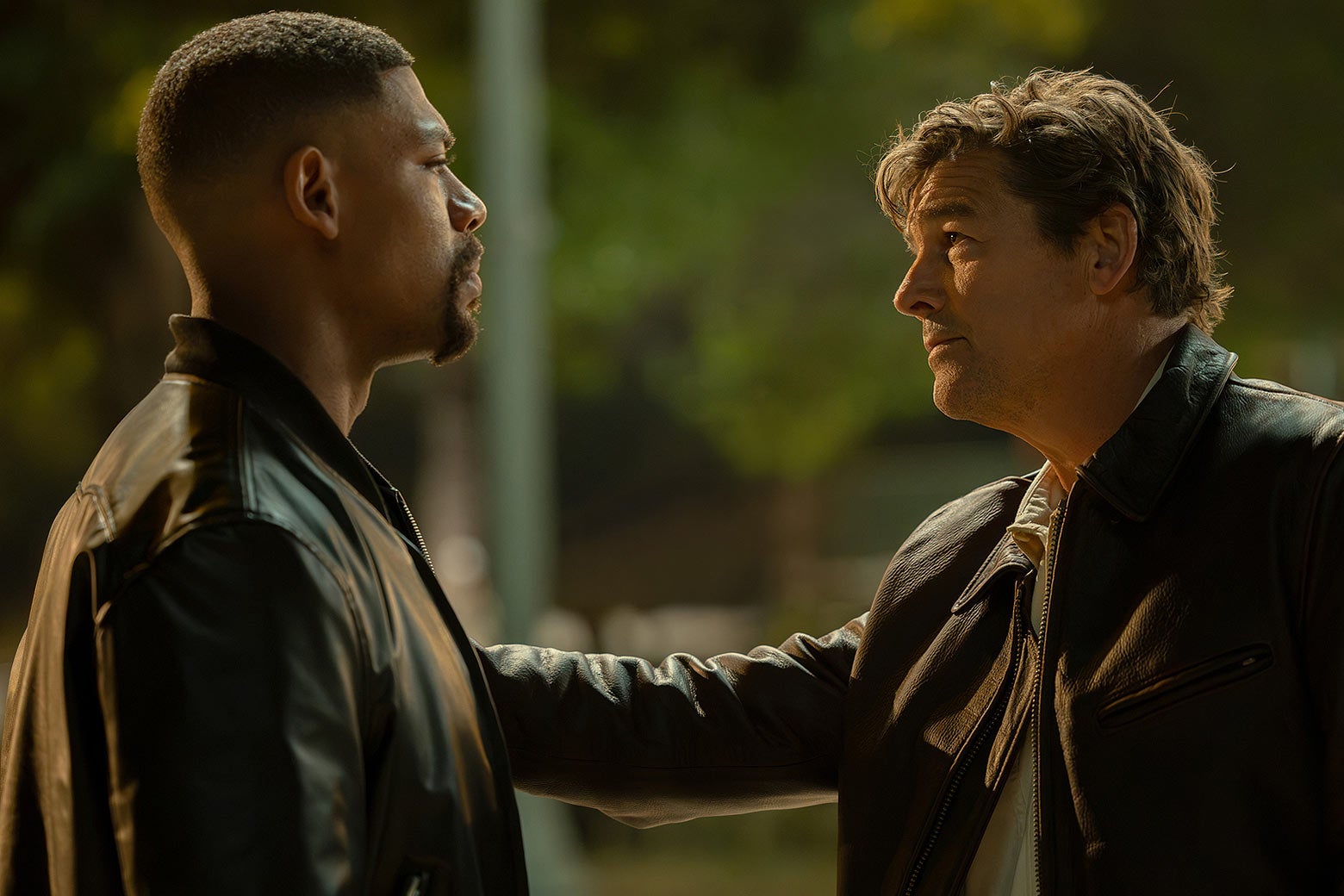
Television Lanterns’ Season Finale Pissed Off a Lot of Fans. Frankly, That’s on Them. John Johnson/HBO Max Sign up for the Slatest to get the most insightful analysis, criticism, and advice out there, delivered to your inbox daily. In 1940, Martin Nodell, like everyone else in New York City who could draw, wanted a piece of Superman. Superheroes were flooding the market, and yet they were still unable to meet demand; more and more people were drawing stranger and stranger characters and making money at it, too. Nodell was on a subway platform, watching the newly bankrupted train system lumber through the station with the help of operators holding signal lanterns. As the lights turned from red to green, he got a very good idea—a superhero who draws his powers from a magic ring and a green lantern—and somehow it has managed to stick around for nearly 90 years. Superman, who dresses like a 1930s circus strongman, and Nodell’s Green Lantern, who is named after a defunct municipal traffic signal, are such potent Americana that they and their contemporaries make up the bedrock of a $110 billion acquisition that closed Tuesday. Lanterns, the new HBO show based on the latter, ended its first season on Sunday to much fanboy sturm and YouTube drang, primarily over the fact that Hal Jordan (Kyle Chandler), the best-known version of Green Lantern (though not the original), who has been found dead at the end of the first episode, turns out to be really and truly dead after eight episodes’ worth of teasing ways he might possibly live on into the second season. John Stewart (Aaron Pierre), his junior partner, solves his murder at the eleventh hour but finds that he can’t bring himself to bring the perpetrators to justice. A second season is in the works, though not officially greenlit yet. Fandom’s cries of agony—and there are lots of Green Lanterns, so this is a larger fandom than you might expect—have been loud. Some comic-book loyalists were horrified that Hal seems gone for good; others thought the show’s version of John simply isn’t interested enough in meting out justice. Among popular YouTubers, consensus seems to be that the creators—showrunner Chris Mundy, Damon Lindelof of Watchmen and The Leftovers fame, and comic-book pro Tom King—ended the series on a confusing low note; the big action-packed finale turned out to have already happened halfway through the show, and they didn’t get the resolution they thought they were owed. (James Gunn, who is the co-head of DC Studios, has also received his fair share of heckling online.) Yes, some of these people are neckbeards raving compulsorily about how “we’re still in woke,” but not all of them. I tend to get frustrated with fans who want slight variations on stuff they liked as kids, but I understand that it’s fun to see your favorite character onscreen and kind of sucks when it turns out they’re not going to be around for more adventures. I still have the Hal Jordan Super Powers action figure I got when I was 5, complete with plastic lantern. But I have to confess I’m a little baffled by the contingent who seem to have watched the seven previous episodes and assumed they were getting a happy ending with their superhero alive and intact, or at least avenged. Cards on the table: I liked Lanterns all the way through, with the exception of a really distasteful scene in the final episode where John, a former Marine, tortures the villainous Sinestro (Ulrich Thomsen) with a ducking stool (which is obviously supposed to read as “waterboarding” to an audience that doesn’t know what waterboarding looks like but knows the term). I loved Pierre as John and Chandler as Hal, and I’m delighted that Hal is really and truly dead. There’s a surreal sequence in the seventh episode where John is paddling across a lake on an alien world with a computerized version of Hal riding shotgun, a sci-fi version of a ghost being ferried to the afterlife, that is one of the coolest things I’ve ever seen on television. Most of all, though, I loved how deliberately the show riffed on and subverted detective story conventions, especially the plot of The Maltese Falcon (1941), one of my favorite movies, and that movie’s central problem, which is that Sam Spade has to avenge his partner, a giant asshole who was murdered by a hot girl. “When a man’s partner is killed he’s supposed to do something about it,” Spade (Humphrey Bogart) observes in that film right before he turns Brigid (Mary Astor) over to the cops. “It doesn’t make any difference what you thought of him.” Making the Bogart character a Black man changes the story in fascinating ways. In Lanterns, the killer is Kerry Kane (the marvelous Kelly Macdonald), Hal’s girlfriend. Her son Noah (Shea Pritchard) is, through sci-fi biology, a murderous quasi-android called a Manhunter—another creation of the Green Lantern Corps’ bosses, the Guardians of the Universe—and she can’t let Hal force the family to leave town, which is his proposal to avoid the Guardians. So she shoots him in the face. With Hal dead, unmourned by either the Guardians, who considered him a disrespectful liability, or his successor, Guy Gardner (Nathan Fillion), who is desperate to forget Hal ever existed, John is both the last guy who cares who killed Hal and the only Green Lantern affiliate who knows that there’s a dangerous, possibly monstrous alien on the loose. But Noah is not a monster, or not yet one. The corny oath written by Alfred Bester in 1943 is pretty clear on whether John is allowed to show mercy: In brightest day, in blackest night, no evil shall escape my sight. Let those who worship evil’s might beware my power, Green Lantern’s light. Is John going to turn the teenage Manhunter over to the Guardians, probably to be destroyed like a rabid dog, just because of the accident of his birth? No, he isn’t. Some evil, it turns out, might escape his sight, if there’s a good reason for it. Turns out evil escapes everyone’s sight from time to time. And who judges what reasons are good? John does, but mostly because he’s the only one who wants the job. When a man’s partner is killed, he’s supposed to do something about it, but he still has to decide whether what he’s supposed to do is the right thing. That friction is, unusually for a TV series about space cops, the whole point. The entire show has been a superhero story in a minor key, where the problem is the notion of heroism itself. If this less-than-easy ending isn’t the gigantic SFX spectacle some of its fans were hoping for, they can’t say they weren’t warned. For all those reasons, I’m sorry for the show’s writers, who are going to have to deal with the worst idiots in Sector 2814, Hal Jordan’s passionate fandom. These are the guys who threatened to kill DC editor Kevin Dooley when the character died in the comics in the 1990s and have hounded writer Ron Marz, who did nothing except write some unusually good Green Lantern stories for most of his career. They’re currently out there on X, still posting days later about how the show disrespected Hal Jordan’s legacy or something. Superhero fans love to care more about ink on paper than about the people who put it there, so that is nothing new, but it can be vicious, and I hope it doesn’t dissuade Mundy, Lindelof, and King from traveling further down the path they’ve chosen here. (I hope the merger doesn’t, either.) My only notes for the next season are more weirdness, less waterboarding. Also, John should lose the goatee. Comics HBO Race TV Superheroes
The Season Finale of HBO’s Superhero Hit Pissed Off a Lot of Fans. I’m Baffled by the Backlash.
Full Article
Original Source
Read the full article at Slate →KhanList aggregates and links to publicly available news content. We do not host full articles from third-party sources. Always verify important information with original sources.