
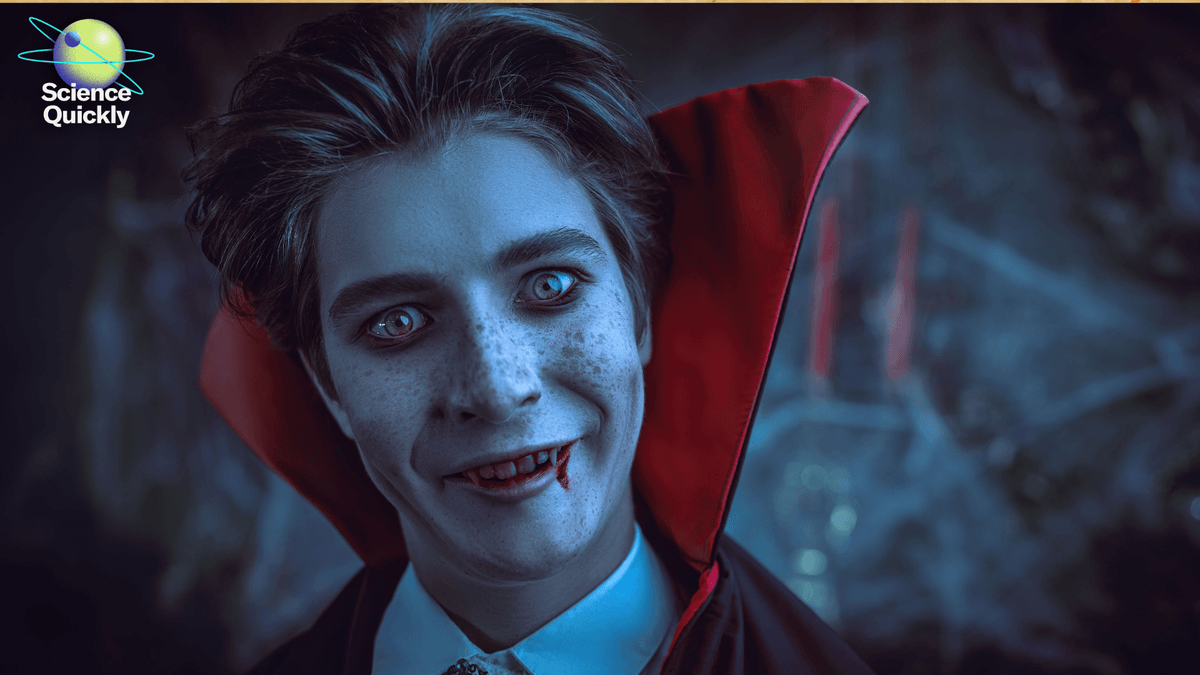
Rachel Feltman: Happy Halloween, listeners. For Scientific American’s Science Quickly, I’m Rachel Feltman.When I was about 13 years old, I stumbled upon a vampire story that I became obsessed with. I wrote reams of fan fiction and made my crush on all three members of the main love triangle into an entire personality. Many girls on the cusp of teenhood in 2005 could no doubt say the same, though most of them were probably fixated on the recently released book Twilight, and I, ever the contrarian, had gone to my local Blockbuster and discovered a movie from 1987.[CLIP: Kiefer Sutherland as David in The Lost Boys. “Now you know what we are. Now you know what you are. You’ll never grow old, Michael, and you’ll never die. But you must feed.”]On supporting science journalismIf you're enjoying this article, consider supporting our award-winning journalism by subscribing. By purchasing a subscription you are helping to ensure the future of impactful stories about the discoveries and ideas shaping our world today.It’s been more than 20 years, but I’m still firmly Team Kiefer. So you can imagine my delight when, just this past April, a musical based on The Lost Boys made its Broadway debut. And that’s far from the only vampire media people are paying to see in droves: With his award-winning movie Sinners, Ryan Coogler brought creatures of the night into prestige cinema like never before. And AMC’s adaptation of Anne Rice’s The Vampire Chronicles series has launched her beloved character Lestat into the stratosphere.[CLIP: Sam Reid as Lestat in Interview with a Vampire: “Are there any readers in the audience tonight?”]Then, of course there’s Robert Eggers’s Nosferatu, Cynthia Erivo’s solo Dracula show on the West End, the delightful comedy What We Do in the Shadows, which sadly has ended, Dimension 20’s “City Council of Darkness”—I could go on.So today we’re going to talk about what makes vampires so fascinating that they keep showing up in our media—and how these seductive fictional figures can actually be traced back to public health horror stories.Tales of humanoid creatures that feed on life are about as old as stories get, but the use of the term “vampire” for a bloodsucking monster seems to have emerged around 18th-century Europe. And throughout the [1700s] and 1800s, many people saw vampires as a real and present danger.Aaron Mahnke: It’s just a bizarre story, you know. And there’s some grief involved in it, there’s some tragedy and some weirdness and some grossness, but at the core of it, it’s a fascinating story.Feltman: That’s Aaron Mahnke, a historian who hosts the hit podcast Lore. His latest book is called Exhumed: Unearthing the History of the American Vampire.Mahnke: What we think was going on was essentially a community would experience an outbreak, usually of what we think was tuberculosis because of the symptoms.Feltman: Basically, people got it into their heads that certain illnesses could be transmitted posthumously, with the dead somehow staying tethered to the living and draining their health away. Because tuberculosis could spread between family members and then slowly kill several of them in a row, the disease might seem almost like a curse. Inventing vampires as an explanation helped people feel like there was something they could do to keep tragedies from multiplying.Similar “epidemics” show up in earlier historical records around the world and were particularly common in Europe in the 1700s. But Mahnke’s book focuses on the story of Mercy Brown, who died of what was likely tuberculosis in Exeter, Rhode Island, in 1892.Mahnke: You have to imagine these are people in the early to mid-1800s who had no concept of virology and how illness was passed around. So what people were doing was reacting to this belief that the reason why people in their family were sick was because someone who had already died from the sickness in their family was literally lying in their grave, drinking the life force from those who were still above ground. So not in a sense—like the vampire that we think of today as running around in leather pants with handguns and, you know, battling werewolves and drinking the blood out of someone’s neck. So in the century of the New England vampire panic, it was more Colin, the emotional vampire from What We Do in the Shadows. They were sucking the life from someone from a distance.Feltman: You can see the threads that would eventually weave into the bloody vampire myths we know today in the methods New Englanders used to “prove” a vampire’s existence. Mahnke says folks had a pretty binary understanding of decomposition and the degradation of blood in particular. If a body was really and truly dead, they figured, blood would be dried into powder. The presence of liquid meant something was still kicking around in there. But there are a few reasons someone might see what seemed to be fresh blood in a definitely actually dead corpse: Liquids produced by decomposition might ooze out of orifices tinted red by dried blood, for one thing. And in New England and much of Europe, where death during winter meant loved ones were temporarily interred aboveground to wait for the ground to thaw, blood and tissue might freeze instead of rotting.Mercy Brown, for instance, died in January and was “exhumed” that March.Mahnke: Her exhumation was literally just opening a shed and removing her coffin. They miraculously discovered that she looked very well preserved, but that’s kind of what you’d expect from somebody who’d spent two months in a walk-in freezer.Feltman: As Mahnke’s latest book makes clear, this visceral fear of the undead was really quite recent. Mercy Brown’s sister lived until 1954. But during her lifetime, our attitude toward vampires made a radical shift from a manifestation of grief and fear to, well, maybe still a manifestation of grief and fear but one that we might also be interested in dating. So how did they make the transition from rotting spectres of disease to hot anti-heroes?In her 1995 book Our Vampires, Ourselves the late literary scholar Nina Auerbach argued that vampire stories take on the fears and desires of the people telling them. The folk vampires Mahnke described, where dead relatives drain the living and doom a whole family, are one version of that. Another is the predatory aristocrat figure introduced in John Polidori’s 1819 novella The Vampyre—which took cues from his notoriously rakish associate Lord Byron—and then popularized by Bram Stoker in 1897. So what does the influx of cool, sexy vampires say about our current cultural needs? Speaking personally—which I hope you’ll allow me to do since this is more of a question of cultural analysis than empirical research—I think it might have something to do with a shift in what it means to be “other.” The fears that once built monstrous figures like Nosferatu, like xenophobia, still exist especially systemically but are perhaps less popular with mainstream audiences than they were in the 1800s. When Joseph Sheridan Le Fanu published Carmilla in 1872, it was radical in its presentation of a lesbian vampire—but she was also literally a monster. Her otherness was compelling but horrifying. In the latest TV adaptation of Interview with the Vampire, queerness and colorism make the bloodsuckers all the more “other” in the context of their own worlds but actually serve to humanize them for the audience. So maybe our modern vampires reflect a more modern sense of how many of us are the “other” in one way or another.I spoke about that a bit with Jenny Hamilton, a senior lecturer in counseling and psychological therapy at the University of Lincoln. Her professional work on monsters focuses on how people use them to help process trauma, but she has some thoughts on how monstrous characters have changed with the times. On the one hand, she says, our monsters have shifted from less physical to more psychological in nature as our fears have gotten less primal and more existential.Jenny Hamilton: In modern and postmodern societies, our anxieties are often less tangible: things like climate change, pandemics, AI, uncertainty about the future.Feltman: Now, obviously vampires are not the only monster game in town but it makes a lot of sense that being humanoid figures that still engage in very human activities and relationships, they offer a really good template for exploring anxieties that are more social and cultural than physical.And as figures that sit more firmly on the fuzzy line between human and monster than, say, goblins or dragons, it makes sense that they’ve also been at the forefront of our increasingly complex sense of what makes a monster.Hamilton: They kind of sit on a lot of boundaries that are a bit difficult for us or taboo. So, you know, the boundaries between life and death, being human and animal.Feltman: Jenny says that vampires have always been these very contradictory figures who are on the fringes but that our own relationship with the idea of good and bad, villain and hero, is what’s become more nuanced. It’s become more complex as binary traditional ideas about who belongs and who doesn’t have been shed in modern society. In other words, we’ve thankfully come to value a lot of the qualities that used to keep people on the fringes of certain kinds of society.Now, I’ll pause here to say that of course I know vampires aren’t the only monstrous characters that have gotten the romance treatment, especially in recent years. Just off the top of the dome, I got classic [choices] like Beauty and the Beast, avant-garde ones like The Shape of Water, even zombies thanks to Warm Bodies. We had Lisa Frankenstein, not to mention all of the werewolves in the Twilight franchise and Teen Wolf and similar fiction. We’ve even got that new Olivia Colman movie where she’s married to a big, giant, beautiful man made of wicker, which I cannot wait to see. But I do think vampires are a little unique because most of the other monsters I talked about, you know, they occasionally show up as the love interest in kind of a subversive way. Vampires have become so synonymous with sensuality that, at this point, it’s actually surprising and subversive when a movie makes them gross and not sexy. I’m looking at you, Robert Eggers.But when it comes to how and why we’re able to find literal monsters so attractive, from a purely physical point of view, there’s no clear-cut scientific answer—but there are a lot of really interesting angles to explore.To get into this I spoke to Mathias Clasen. He’s the co-director of Aarhus University’s Recreational Fear Lab, which is exactly what it sounds like: its mission is to investigate the kinds of things people do because they scare them.Mathias Clasen: It’s not just watching horror movies.... It’s also some of the earliest playful activities that we expose kids to like, you know, peekaboo, which is a sort of baby jump scare…, running after kids pretending to be a monster. It’s also so-called risky play, you know, kids riding their bikes too fast, climbing trees until they feel butterflies flapping their wings in their stomachs. It’s young women listening to true crime podcasts. It’s middle-aged guys buying fast cars and driving too fast. So there’s a whole range of things people do to get pleasure out of being scared, and that’s what we’re trying to understand.Feltman: Clasen doesn’t currently research our love of monsters, but it’s something he’s thought about a lot.Clasen: Before, I spent most of my time doing empirical research, like going to haunted attractions to measure the heart rate of guests or try to draw blood samples to look at immune activation, I did a lot of more kind of conceptual theoretical work, including an attempt to explain why monsters are ubiquitous in the landscape of popular culture.Feltman: One of his favorite examples is the movie Jaws, which led to an actual drop in beach tourism while drawing huge crowds at the theater.Clasen: The odds of being eaten by a big white shark are, you know, as close to zero as you can get. But there’s something about that monster with the mouth brimming with sharp teeth and the, you know, the dead black eyes that just, I think it triggers something deep within us, and I think that’s what good monsters do, is they trigger, you know, an ancient defense system that evolved way before we were human.Feltman: Basically, some evolutionary psychologists think that scary play—which includes telling stories about monsters—taps into the same mechanisms for learning and adapting that helped our ancient ancestors survive real threats.Clasen: We’re kind of hardwired to not just keep our distance but to actually, you know pay attention because that’s the way to learn about different kinds of threats in the environment. So it makes sense that there would be that sort of push-pull ambivalence associated with, you know, monsters and frightening creatures.And so the reason why there are many more monsters in popular culture than in the real world is that we’re still sort of at the core kind of these cowering, you know, Stone Age hominins, you know, sitting around the bonfire telling stories about all the horrors that exist outside that protective circle of light.Feltman: But why have so many of those campfire stories turned so sexy? For some reason there don’t seem to be any psychology labs working on what to me is obviously an urgent question. But there’s some adjacent research that’s worth unpacking a little bit.As Mathias pointed out, we have sort of a push-pull relationship with our favorite monsters, where they intrigue us while also, on some level, freaking us out. The push and the pull might not always feel at odds with each other because fear and attraction share a lot of the same physiology. In 1974 psychologists ran a now infamous experiment on the so-called misattribution of arousal where male study subjects met with female interviewers on either wobbly rope suspension bridges or low, sturdy bridges. The ones on shaky footing apparently were more likely to call the interviewer, who offered her number in case they had “follow-up questions.” As you might guess based on the absolutely bonkers nature of that methodology, this study isn’t considered a particularly strong piece of research. But while the idea that we can literally misinterpret fear as sexual arousal is shaky, other research suggests that a fearful rush of physiological arousal could amp up the perceived intensity of whatever else we’re feeling.In other words, maybe seeing Spike skulk into a room on Buffy can simultaneously trigger both standard physical attraction—because, I mean, have you looked at a picture of James Marsters lately?—and something deep-seated that tells us to sit up and pay close attention to the apex predator in our midst. I’m picturing my nervous system flooding itself with chemicals à la that one scene in Flashdance.Another idea I’ve seen bandied about is that vampires are, generally speaking, just so evolutionarily fit that we can’t look away. You might hear people mention the so-called dark triad personality traits of narcissism, psychopathy and Machiavellianism. Some research argues that these noxious traits make men more successful at reproducing, and I’ve seen a lot of pop psychology arguing that this is some kind of explanation for the bad boy stereotype and our love of hot villains. But the reproductive edge actually goes away for everything but short-term mating strategies, and women generally don’t rate those traits as attractive in long-term relationships or necessarily at all—so it’s probably more that those qualities lend themselves to seeking out lots of partners and saying whatever it takes to get them into bed them and not that psychopathy makes the average gal go, “Awoooooga.”It is true that, broadly speaking, humans look for signs of health and reproductive fitness in their potential partners. And it’s technically true that there’s no greater sign of fitness than eternal life. But I personally think that our attraction to vampire characters is less about them short-circuiting our unconscious search for a reproductive mate and more about our own complicated relationship with the idea of sitting at the top of the evolutionary food chain.Clasen: I think the reason why that figure won’t go away is that it embodies, at the same time, some of our, you know, the things we really fear and detest, the most nasty impulses in human nature, the, kind of, animalistic, predatory, power-seeking, selfish drives. But there’s also something appealing about, you know, eternal youth and not dying and, you know, never changing, and it’s just a sort of symbolic container for our deepest fears and our, you know, their most burning desires—for example, to not die.Feltman: That’s all for today’s episode. I hope you’ve enjoyed this very freaky Friday Fascination. We’ll be back on Monday with our usual science news roundup.Science Quickly is produced by me, Rachel Feltman, along with Fonda Mwangi, Sushmita Pathak, Allison Rodgers and Jeff DelViscio. This episode was edited by Alex Sugiura. Marielle Issa and Aaron Shattuck fact-check our show. Our theme music was composed by Dominic Smith. Subscribe to Scientific American for more up-to-date and in-depth science news.For Scientific American, this is Rachel Feltman. Have a great weekend!
The science of why we’re obsessed with vampires
Full Article
Original Source
Read the full article at Scientificamerican →KhanList aggregates and links to publicly available news content. We do not host full articles from third-party sources. Always verify important information with original sources.