
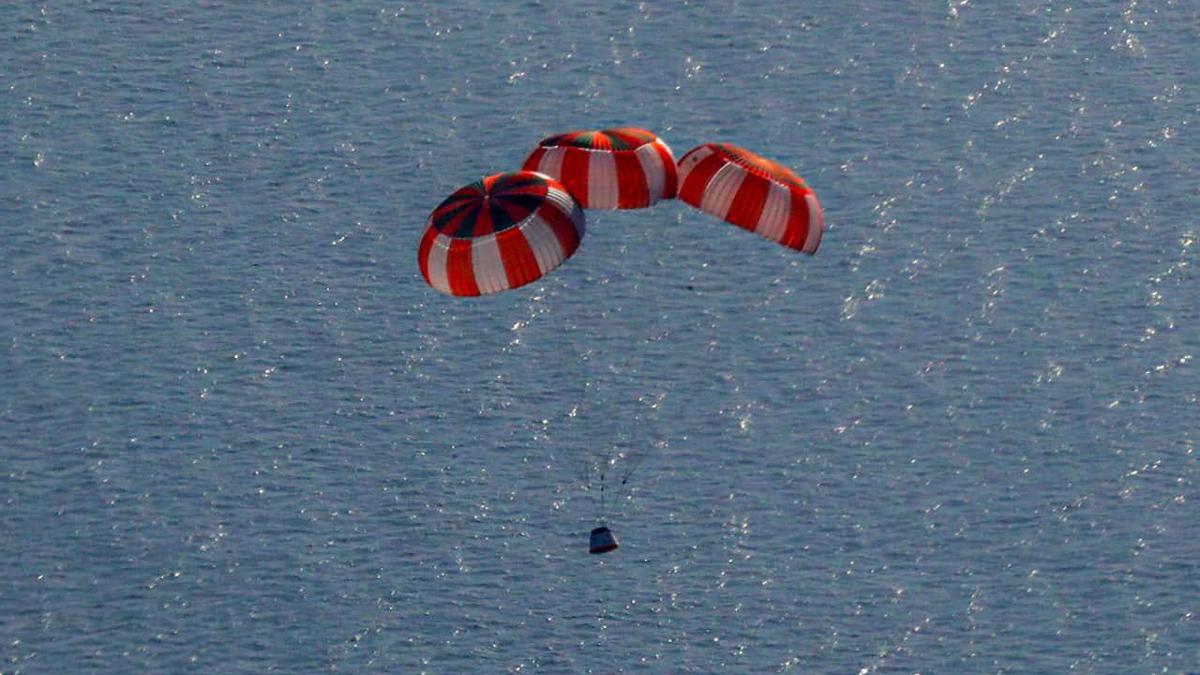
Any spacecraft entering the earth’s atmosphere will rely primarily on atmospheric drag to reduce a significant portion of its velocity as it aerobrakes.Towards the terminal phase, to gently touchdown on land or in sea, additional decelerating systems like parachutes have to be activated to further reduce its velocity to acceptable limits.The parachute used for crewed space vehicles demands extraordinary engineering with multi-staging, redundancy, high-performance materials and high-pressure packing for reducing the storage space.How are parachutes deployed?Generally, the parachute system contains three types of chutes: pilot, drogue, and main. The pilot chute is a mini-parachute deployed to pull out larger diameter drogue or main chutes. The drogue chute is deployed early in the descent to stabilise the module and first reduce the velocity. The main chute has a wider canopy and is used in the final phase to reduce the velocity enough to achieve gentle soft-landing conditions.The blunt shape of the crew module creates a turbulent wake in its rear side and the parachute has to be ejected through this wake. The ejection mechanism should ensure that the energy imparted to the parachute is sufficient enough to cross the wake in the shortest time and deploy the parachute in the far-wake region behind the module. Some of the conventional deployment methods used are as follows:Static line: Used extensively in parachute testing using aircraft. It has a physical tether anchored to the aircraft to automatically strip open the container and extract the parachute as the payload is dropped from the aircraft. Drogue Guns: A drogue gun is either a mechanical or pyro-technic device activated to fire a slug mass at high velocity. Its momentum will forcibly pull out the parachute through the wake into the free stream air for deployment. Mortars: A mortar is like a short cannon designed to throw the packed parachute at high velocity using an expanding gas pressure generated by a pyrotechnic charge. It uses a controlled explosion to launch a projectile, which is attached to the parachute bag, away from the module’s wake for clean and entanglement free deployment. Generally, the parachute deployment takes place when the module has reduced its speed to sub-sonic condition (lower than the speed of sound. At supersonic speeds, standard canopies get shredded due to shockwave interaction and intense dynamic pressure.What is the purpose of multi-staging in parachute deployment? The Gaganyaan crew module returning from orbit would be having a high velocity of about 170 m/s ( faster than a Formula 1 car) when it is in the lower atmosphere. If the full-sized main parachute is directly deployed, it would generate very high opening shock levels which will either lead to shredding of parachute canopy fabric or subject the crew to unacceptably high deceleration levels.The solution is to go for multi-stage release of parachutes wherein the diameter of the chute will be increased in successive stages for reducing the deceleration and dynamic pressure to acceptable levels. Why do we need reefing in a parachute?If a large Main parachute opened fully all at once at high speed, the instantaneous large force would destroy the canopy fabric and exert lethal deceleration forces on the crew. To prevent this, the parachute canopy mouth is allowed to open only in steps. The process is analogous to gradually opening an umbrella in strong winds. If you pop it open all at once, the wind will likely snap the umbrella. For the parachute, a strong cord is taken through the skirt around the canopy and the length of the cord decides what percentage area of the parachute canopy should open in the first step. Attached to the cord is a reefing line cutter - a small rugged tube containing a tiny blade and a chemical timer. Once a few seconds have passed and the speed is safe, the cutter fires and the cord is cut, allowing the entire canopy to bloom fully.How are parachutes tested?There are different platforms used for the testing of parachutes. The RTRS (Rail Track Rocket Sled) is a ground facility where a sled will be accelerated along rails by firing small solid motors and the parachutes will be deployed from the sled at appropriate velocity. The TBRL (Terminal Ballistic Research Lab) in Chandigarh has a state-of-the-art RTRS facility. Other modes of testing include dropping the test article from a Helicopter or aircraft or using small rocket-powered Test vehicles to take the crew module to the appropriate altitude and releasing from there.After the splash down in the sea or upon soft-landing on land, if the parachute is not detached immediately, the wind acting on the canopy could drag the module on land or capsize it in sea and this might cause injuries to the astronauts. Hence the parachute is released by activating pyro cutters or mechanical quick-release devices that will release the strap connecting the parachute to the module.What materials are used in aerospace parachutes?Material selection for parachutes is controlled by conditions like high tensile strength, thermal resistance and low mass. Modern aerospace parachutes use advanced synthetic polymers engineered to meet specific design conditions.Kevlar is used in high-load suspension lines, risers, and structural reinforcement tapes due to its exceptional tensile strength and heat resistance.Nomex finds application in heat-exposed areas to withstand hot mortar gas discharge and aerothermal heating.Nylon is widely used for canopy broadcloths because of its elasticity, which helps absorb initial dynamic shock loads during inflation. It is highly compressible, so it can be packed into a relatively small volume.What parachutes are in the Gaganyaan crew module?In crewed missions, recovery systems utilise redundant clusters of pilot, drogue, and main parachutes. The Gaganyaan crew module has two drogue chutes deployed by mortars and three main chutes deployed by mortar-ejected pilot chutes.If one main parachute suffers a major anomaly, the remaining two independent chains are fully capable of ensuring a safe touchdown. ADRDE in Agra, which is a laboratory under the Defence Research & Development Organisation, is the developing agency.Unnikrishnan Nair S. is former director, VSSC and IIST; Founding Director, HSFC; and an expert in launch vehicle systems, orbital re-entry and human spaceflight technologies. Currently Dr Sarabhai Professor at VSSC
The science of Gaganyaan parachutes | Explained
Full Article
Original Source
Read the full article at Thehindu →KhanList aggregates and links to publicly available news content. We do not host full articles from third-party sources. Always verify important information with original sources.