
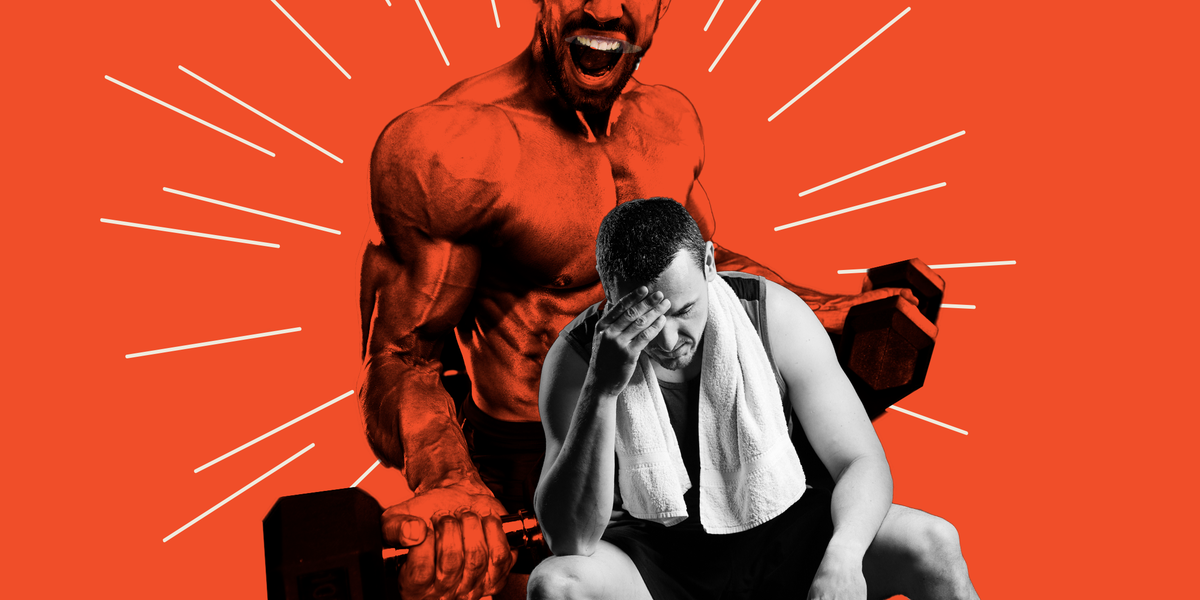
Getty Images; Jason Speakman/MH Illustration6 min readAT SIX-FOOT-FOUR, I’m not accustomed to feeling physically dwarfed. Sure, I might not have bulging muscles—but I confess I occasionally survey the other men in the gym and entertain the idea that I might be the hottest guy in the room. Sometimes, though, a bigger, better looking dude walks in and starts lifting heavier weights than me. My confidence evaporates, along with, I imagine, the admiring glances of all the men and women (who, on reflection, might not actually have been paying me any mind).Until recently, I didn’t have a name for this peculiar, perhaps Palaeolithic phenomenon. Mogging, derived from “alpha Male Of the Group,” describes the act of one man outshining another, through any combination of height, muscularity, facial attractiveness, status, or charisma (a.k.a. “aura”). On the receiving end, it’s the sudden, visceral realization that another man might be stronger or better-looking than you, and the cascade of feelings of inferiority that follow.“To mog” entered the lexicon thanks to figures like Braden Peters, better known as Clavicular. The 20-year-old looksmaxxing influencer was spectacularly “frame-mogged” on his own livestream in a viral moment earlier this year. The curious phrasing captured online attention, and on November 3 “mogging” was crowned Collins Dictionary’s word of the year for 2026.But this type of social scenario didn’t just emerge with the dawn of the internet. I was curious: Does this emasculating sensation stem from an ancient status instinct, an ego threat, a form of social comparison, or something else? And why are some men so sensitive to it?To Mog and Be MoggedTHIS ISSUE OF mogging raises a question: Why should another man’s stature have such an immediate effect on my self-esteem? It’s a theme explored in the classics. In Homer’s Iliad, the ancient Greek epic, King Priam spots the enormous warrior Ajax, “whose head and shoulders tower above the rest.” Yet Homer also understood that size wasn't everything. Earlier in the same passage, Menelaus is described as broader-shouldered than Odysseus, the cunning hero played by Matt Damon in The Odyssey—but the shorter man’s extraordinary eloquence renders his stature irrelevant.Modern researchers have also looked for answers. Human judgment “is by nature comparative” and social comparisons are “spontaneous, effortless, and unintentional reactions to the performance of others,” according to a 2014 review of the early indications on the brain mechanisms of social comparison and their influence on the reward system.Meanwhile, other related research found that physically stronger men were perceived as having higher social status, partly because they were considered more capable leaders. But does this make the discomfort of being mogged inevitable?Psychologists distinguish between dominance, in which status is secured through intimidation, and prestige, which is earned through the admiration of others. Research suggests that even if the strongest and most attractive may initially draw outsized attention, or mog, prestige is ultimately conferred upon those who benefit the group, rather than pursue aggressive self-interest.For couples therapist Sarah Tilley, this dynamic reflects the tension between our instinctive deference to appearances and our recognition of its limitations. Snap judgments of competence from candidates’ faces predicted almost 69 percent of US senate races in 2004, according to a study in Science, “There is a deference to beauty and we’re all culprits,” she says. “Beauty trumps intelligence, but only for a short amount of time. Smart people will know that, but it takes wisdom.” In other words, the actual effects of a mog could be fleeting if there is someone smarter in the room.The Neuroscience of Getting MoggedWHAT IS ACTUALLY happening when you feel the mog? Turns out, there are chemical responses behind those feelings of self-doubt.“A review of more than 200 lab studies found that our cortisol is reliably spiked when we feel that others are judging us and when we can’t control the outcome,” says Dr Manesh Girn, a neuroscientist and men’s work facilitator.“Envy toward someone who outranks you on something you care about also activates the anterior cingulate cortex, a region tied to processing pain and conflict,” he says, citing a study on the neural correlates of envy and schadenfreude (the feeling of satisfaction when someone faces consequences they deserve).But the susceptibility to feeling mogged also depends on one’s values and sense of self-worth. “Shorter men are more sensitive than taller men to dominance cues in other men's faces and voices,” adds Girn. In the envy study, pain responses only arose when the other person’s perceived superiority was in a domain the participant particularly cared about.Looksmaxxer-in-chief Peters admitted last month that he now simply removes himself from social settings when there’s a possibility he might be mogged. “It really has a soul-crushing effect,” he told podcaster Patrick Bet-David, recalling a recent weight room encounter. “We just felt the mog from all the way across the gym to the point where I just left. Why would I want that internal pressure?”Such an extreme reaction suggests “a maladaptive mindset,” says Charlotte Markey, a professor of psychology at Rutgers University. “Social comparison is a very normal process, including in terms of our physical attributes.”For some men in 2026, that drives an obsession to become the strongest of the pack. This can become genuinely debilitating.“I've cared for young people who then go to the gym five plus hours a day, and it starts to detract from their quality of life,” says Jason Nagata, an associate professor of pediatrics at the University of California, San Francisco, who researches male body image. “The concern is when self-improvement becomes self-worth, because it becomes dependent on outperforming someone else.”And while this might be driven by instinct, the experts caution against succumbing to our baser instincts. “It may be evolutionarily baked in,” says Markey, “but we want to be careful not to oversimplify here. We aren’t cavemen.”Would You Spend 5 Hours a Day in the Gym to Avoid the Mog?HOWEVER, THE CAVEMAN is not quite dead. We form impressions of a face within a tenth of a second, and people can estimate a man’s upper body strength from his face alone. For our ancestors, misjudging who could beat them in a fight may have been a costly mistake. Some research suggests that our sensitivity to physical formidability reflects this ancient pressure, which may help explain why strength continues to influence perceptions of status.Despite sometimes feeling the mog (and after injuries that prevent heavy lifting), I’m generally content to stick to lighter weights in the gym rather than packing on mass to stand out more in a room. Yet I wonder whether my own instinctive competitiveness has affected my relationships with other men. If I’m constantly assessing where I stand in some invisible hierarchy, like a dog jostling for position in its pack, surely it becomes more difficult to strike up friendships.In a 2017 study of 100 physically active young men, researchers found that those at risk of muscle dysmorphia were less inclined to socialize than their peers, potentially due to social comparison tendencies. The pursuit of the perfect physique, it seems, can come at the expense of the very relationships it might be intended to improve.The Mogging Never StopsSO WHY, AFTER millennia of social comparison, do we have this very modern understanding of the mogging dynamic? Social media has transformed what was once a largely local competition into a global one, exposing men to an endless parade of gorgeous bodies and faces against which to measure themselves (albeit at lower rates than women). “The Greeks didn’t compare themselves with the best, idealized versions of everyone in the world,” says Nagata.Indeed, researchers effectively recreated the experience of being mogged in a study involving 300 men aged 18 to 30. They were randomly assigned to view images of bare-chested and muscular men alongside clothed photos and pictures of scenery. Exposure to the half-naked Chads resulted in significantly lower body satisfaction.I would never flee a gym or a bar upon the entrance of a potentially more attractive man. But back in April—shortly after mogging entered my lexicon—I couldn’t help noticing how much attention a very handsome (and very muscular) longtime male friend was receiving. One woman I didn’t even know basically cat-called him on the street and complimented his outfit. Naturally I assessed my own. It wasn’t nearly as cool, I lamented.Now, after years of feeling this mysterious, disempowering sensation in his company without entirely being able to place it, I had a name for my predicament: I’d been mogged. Still, I was able to keep it together. We enjoyed our lunch, and we remain friends.Perhaps the instinct to compare ourselves is unavoidable. Sometimes I wonder whether the worst thing about discovering mogging is becoming conscious of a competition I never even realized I was in.Mattha Busby is a journalist who covers drug policy, culture, and health.
The Science Behind Mogging
Full Article
Original Source
Read the full article at Menshealth →KhanList aggregates and links to publicly available news content. We do not host full articles from third-party sources. Always verify important information with original sources.