
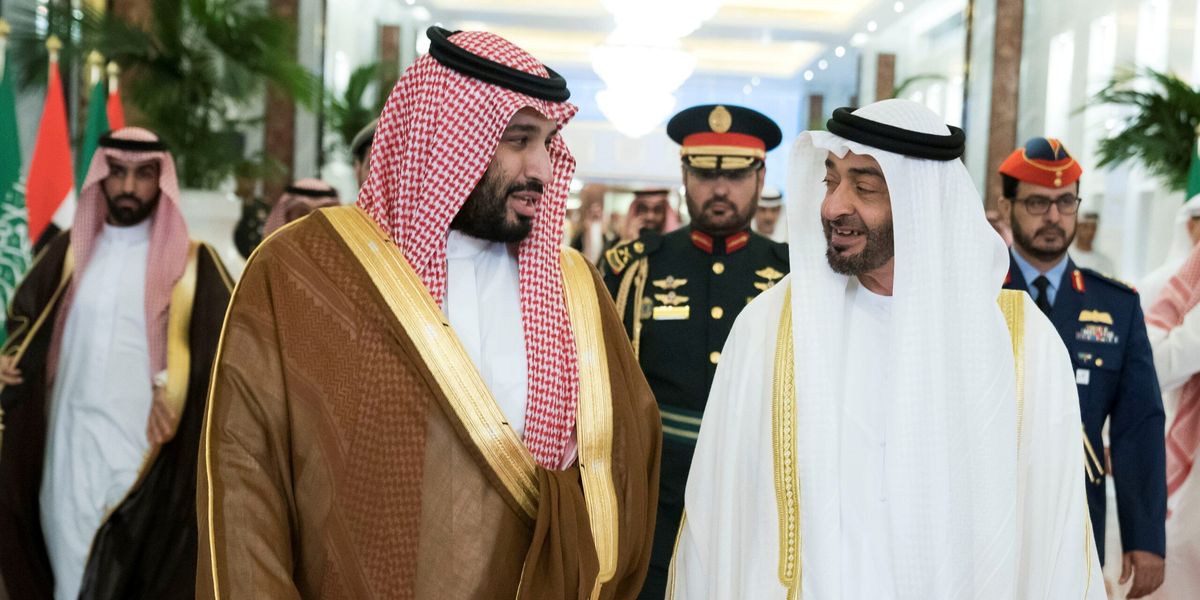
The Houthis’ lightning advances in Yemen have given Saudi Arabia and the United Arab Emirates an opening to set aside their differences after a notable rupture over the country’s political makeup less than a year ago.However, even if a unified threat manages to bind them together, their unresolved disagreements over the future of Yemen could limit the effectiveness of renewed military cooperation against the Houthis and deepen fragmentation elsewhere in Yemen.At least for now, both countries have signaled a willingness to compartmentalize their disputes. Saudi Defense Minister Khalid bin Salman’s meeting with UAE President Mohammed bin Zayed on October 18 provided a public indication of renewed dialogue, with bin Salman praising the “historical relations between our two brotherly countries.”The official readout did not announce a Yemen military agreement, but the Guardian separately reported that Abu Dhabi had agreed to resume payments to government-aligned forces it had previously backed in southern Yemen, a region where it has long sought influence. In exchange, Saudi Arabia’s air force would provide support for those forces against the Houthis. Further details of Emirati involvement remain scarce. But numerous prominent Saudi and Emirati media outlets have published conciliatory commentary following the recent meeting, emphasizing the shared benefits of cooperation and calling for an end to public feuding.The shift in tone signals an effort to sideline the December 2025 rupture in relations, which saw UAE-backed Southern Transitional Council (STC) forces capture large parts of the Hadramawt and al-Mahra provinces bordering Saudi Arabia.The advance, which Riyadh viewed as a direct threat to its national security within its southern neighbor, triggered severe public recriminations. It also led to a Saudi-led airstrike on a weapons shipment at Mukalla port that it said had arrived in support of the STC, and an abrupt demand for the remaining UAE forces to leave Yemen, along with the severe weakening of the STC.That confrontation exposed competing visions for Yemen that had strained their intervention from the outset.Although both led a war against the Houthis, known officially as Ansar Allah, starting in 2015, Riyadh backed the internationally-recognized government, while Abu Dhabi cultivated southern armed groups, including the separatist STC.The Saudis wanted a unified government capable of defeating the Houthis, while the UAE prioritized advancing southern Yemen’s independence via the STC in a bid to gain control over ports, including Aden, which lies near the mouth of the Red Sea.Those differences flared up in 2019, when STC and government forces fought for control of Aden, until a marriage of convenience saw Riyadh and Abu Dhabi unify these factions into a fragile power-sharing agreement.Nevertheless, describing this simply as Saudi support for the internationally-recognized government against Emirati support for separatists would obscure both countries’ reliance on myriad local armed partners. Those relationships offer Abu Dhabi a means of re-engaging without returning its own forces to the battlefield.The UAE is unlikely to fight the Houthis directly as it did in the previous stage of the war. The Houthis had previously struck Emirati territory, notably in 2022, showcasing the risks for the UAE, whose economy relies on projecting an image of a secure commercial oasis in an otherwise turbulent region.And having already faced intensive Iranian missile and drone attacks since the U.S. and Israel launched their war against Iran, Abu Dhabi may be more inclined to limit its role to supporting local anti-Houthi factions, particularly given the Houthis’ markedly improved strike capabilities.Still, even though Emirati involvement in Yemen would likely prove secretive, it could play a critical role in the coalition.Abu Dhabi has built influence through relationships with capable local militias – including the Giants Brigades and Tarek Saleh’s National Resistance Forces – and a wider network of commercial and security interests. Although some major Emirati-backed factions merged into the Saudi-led military structures in Yemen following Abu Dhabi’s withdrawal of direct funding last year, residual command networks and personal loyalties remain intact.Therefore, Abu Dhabi maintains significant leverage, which it can tap into by rapidly reactivating financial and logistical support. The question is whether it will use that power to boost the coalition or counter Riyadh, including by constraining its options in the south.Indeed, the real danger is that Riyadh and Abu Dhabi will each maintain their own channels of influence and back parallel structures that end up causing fractures in territories beyond Houthi control.Beyond geostrategic differences, there are potential ideological clashes. One longstanding source of friction is the Islamist Islah party, which is allegedly tied to the Muslim Brotherhood. Despite both governments’ hostility towards the Muslim Brotherhood, Riyadh has maintained relationships with Islah politicians within the internationally-recognized government.Abu Dhabi, meanwhile, has seen no room for compromise. The UAE has reportedly even hired mercenaries to assassinate the faction’s leaders.As long as Riyadh insists on working with Islah as a pragmatic means of strengthening the anti-Houthi coalition, this disagreement alone may hinder the level of support that Abu Dhabi will provide for government-backed forces.Agreement on confronting the Houthis therefore does not necessarily extend to agreement on which Yemeni actors should be empowered.Disagreements over who should govern Yemen could also complicate decisions about how to fight the Houthis and on what terms to negotiate. Since the U.N.-brokered ceasefire in April 2022, Riyadh has spent years seeking a negotiated exit from Yemen’s war, but the renewed Houthi attacks on Saudi territory — including deadly strikes on the Riyadh airport and attacks on oil infrastructure — have shown the limits of its containment policy, which aims to check Houthi advances without a return to full-scale war.Regional factors matter too. Saudi Arabia has already called on Turkey, Pakistan and Egypt for defensive support against Houthi strikes, in line with the Mecca Defense Alliance, signaling that it is looking beyond its traditional reliance on the UAE.That could deepen divisions and suggest that Riyadh increasingly views its alliance with Abu Dhabi as less essential. Meanwhile, divisions among various anti-Houthi groups remain deep. Southern factions are still divided over independence, autonomy, the distribution of power and their relationship with the rest of the country, reflecting longstanding tensions that predate Yemen’s unification in 1990.Ultimately, any Saudi-UAE military coordination will remain fragile so long as the two Gulf powers continue to pursue conflicting endgames for Yemen.The real test is whether any renewed cooperation yields accountable financing, coherent command structures and a political process that genuinely includes Yemen’s competing factions.Without those elements, Riyadh and Abu Dhabi may very well end up assembling a coalition that will fight the Houthis today but crumble tomorrow, further fueling the instability that has long plagued Yemen.
The Saudi-UAE split is ending. That may be bad news for Yemen.
Full Article
Original Source
Read the full article at Responsiblestatecraft →KhanList aggregates and links to publicly available news content. We do not host full articles from third-party sources. Always verify important information with original sources.