
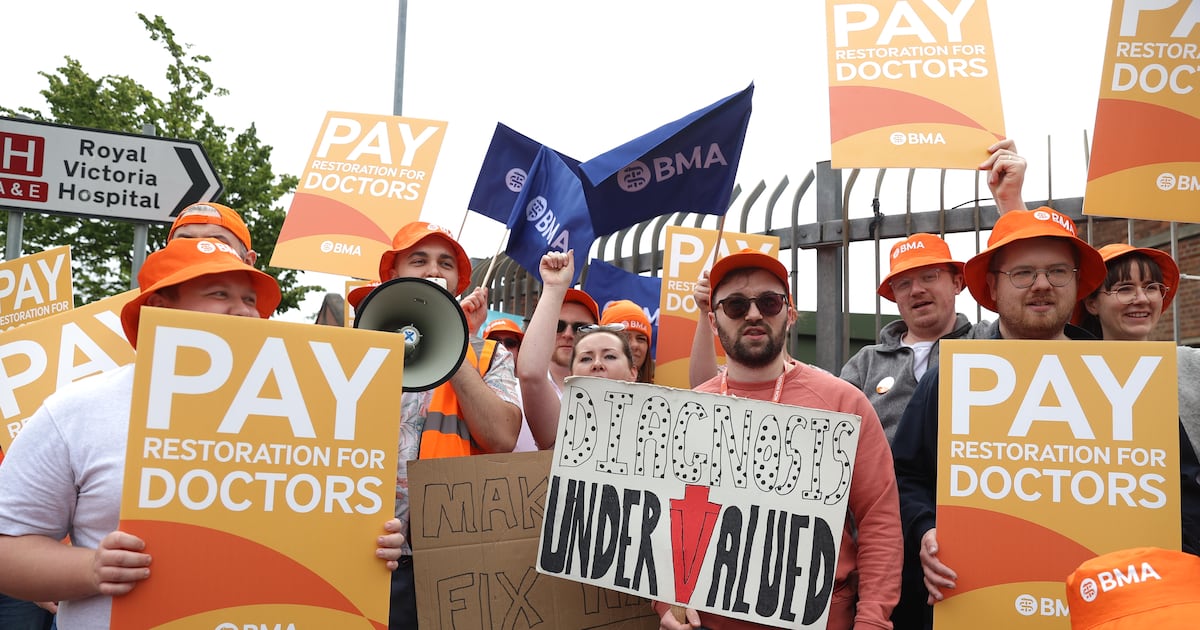
When Oisín Fearon was a teenager, his father cautioned against following him into the medical profession. The warnings about the “pitfalls” of long hours and tough conditions were ignored and the now 30-year-old qualified as a doctor five years ago after graduating from Queen’s University Belfast. Fearon is currently training to be a cardiologist, at a time he believes the health service in Northern Ireland is “crumbling”. Today he will be among 2,000 resident doctors (formerly known as junior doctors) going on strike over pay.Despite being in the first year of a three-year medical training scheme at the Mater Hospital in Belfast, the Co Armagh man is already considering his future job prospects in the Republic.READ MOREHe is around “10 years off” becoming a consultant.“The NHS is in a slow, terminal decline unless something is done to change it,” says Fearon, who grew up in Ballymacnab, outside Keady. “Years of constant cuts have led to this. You do your best but you’re working in a failing system.”Many of Fearon’s consultant colleagues have already moved South for better pay and conditions.“The salaries in Dublin are insane,” he says. “It’s tempting, definitely. There’s better opportunities. I’m sure the grass isn’t always greener but from chatting to those who’ve made the switch, they’ve not looked back or regretted it.”Dr Oisín Fearon, from Co Armagh, who is training to be a cardiologist Hospital consultants in Northern Ireland have a starting salary of £110,681, which tops out at £145,517, based on a 40-hour working week. This compares with a baseline salary of €233,527 to €280,513 in Ireland, based on a 37-hour working week.Fearon, whose father is a GP, recently met a Queen’s classmate from Dublin who had returned to the South to work.“We trained together in Daisy Hill Hospital [in Newry] and he couldn’t stick it out. He left after a year – it’s fairly damning of the system,” says Fearon. “He’s now a GP in Dublin and he couldn’t get over the pay and conditions. He thought things would have improved in the North. The disparity is unbelievable.”But it isn’t just about pay, Fearon insists. With more than a quarter of Northern Ireland’s population currently on a waiting list to see a consultant, better patient outcomes and better access to health services in the Republic are important factors, he says.“The South far outperforms us in health outcomes and life expectancy, which, for the same land mass, the same diet, roughly ... it’s disgraceful really how we underperform,” he says.“It was the opposite 20 years ago. Figures have flipped because the Republic has been investing in their staff, investing in their health service.”[ June 2026: NI consultants and specialist doctors stage 24-hour strike actionOpens in new window ]Today’s strike is the second walkout by resident doctors this year. Labour will be withdrawn from hospitals and GP surgeries across Northern Ireland for 24 hours, ending at 7am Saturday. The dispute centres on pay erosion, with doctors arguing that their salaries are, on average, worth 20 per cent less than in 2008. Consultants are due to strike on Monday.Dr Steven Montgomery, chair of the BMA NI Resident Doctors Committee “Really what this is all about is trying to restore our pay back to where it was,” says Steven Montgomery, chair of the British Medical Association (BMA) NI resident doctors’ committee.“It is a last resort. We don’t want to be out on strike.”Montgomery (33), from Limavady, Co Derry, says he has “no qualms” about admitting that he is exploring job opportunities in England.“It’s night-and-day difference compared to the situation we have to deal with [in Northern Ireland],” he says. “It’s massively better.”Montgomery is based at the Children’s Hospital in Belfast, where he is training in high dependency care.Northern Ireland’s health service is “haemorrhaging staff”, he says, adding that “pay is central to retention and recruitment” of doctors.“There’s not a day goes past that I don’t hear colleagues talking about looking for work either in the Republic of Ireland or the UK – or even places like Canada, Australia, New Zealand.” .People are leaving because they “don’t have any faith in the government to improve things”, he says.“We’re not able to provide the level of care that our patients deserve.”In a statement, Northern Ireland Minister for Health Robbie Butler said he understood the frustration felt by the BMA and other healthcare trade unions over pay.“I remain committed and will do everything in my power to implement this year’s pay award,” he said. “Unfortunately, I am currently unable to do so in the absence of a sufficient budget being agreed for my department.”Butler warned the strike action would have “real consequences” for patients, waiting lists and service delivery.“When similar strike action took place over two 24-hour periods in June, over 2,200 appointments were cancelled across the system,” he said.Butler said that in the past three years there had been cumulative pay rises of 30 per cent for resident doctors, 25 per cent for specialist doctors and 24 per cent for consultants.However, Montgomery said he “questioned” how the department figures on pay “were arrived at”.For Helen Kerr (31), an A&E doctor from Belfast, the ongoing pay row “undermines morale”.Dr Helen Kerr, from Belfast, is training to be a consultant in emergency medicine She is looking at future career opportunities over the Border in Letterkenny and Sligo hospitals.“It’s definitely my reality. I’ll be considering a job in the South because I could be paid more for potentially doing less hours per week – and then there’s the availability of jobs. I’m not guaranteed a job in Northern Ireland,” she says.“I’ve still got 2½ years left of my training to become a consultant. Moving is something I’m beginning to think about because it’s in the very near future.”
‘The salaries in Dublin are insane’: Doctors looking to leave NI as 24-hour strike starts
Full Article
Original Source
Read the full article at Irishtimes →KhanList aggregates and links to publicly available news content. We do not host full articles from third-party sources. Always verify important information with original sources.