
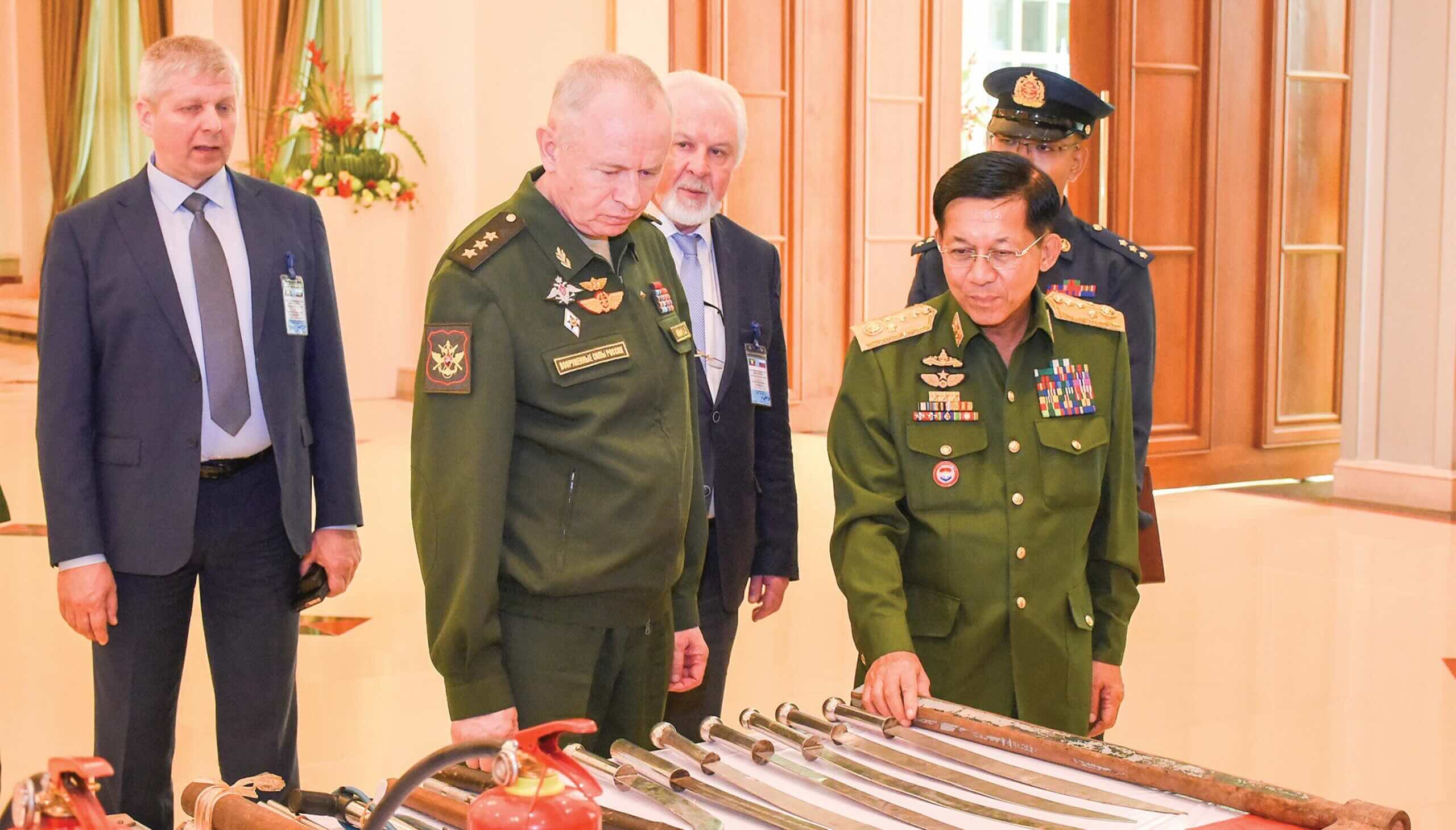
“Victory! Victory! Victory!” Myanmar military leader Min Aung Hlaing and a senior Russian general raised their fists and chanted together at a Buddhist ceremony outside Moscow in July 2022. The occasion was the consecration of a replica of the Shwezigon Pagoda, one of Myanmar’s most revered Buddhist monuments, at the Ethnomir cultural park, about 45 miles from the Russian capital. Among those attending was Col.-Gen. Aleksandr Fomin, Russia’s deputy defence minister and one of the architects of Moscow’s long relationship with Myanmar’s armed forces. On the surface, the gathering was a celebration of Buddhism and friendship between the two countries. Behind it, however, lay a military relationship established over more than two decades—long before Myanmar’s 2021 coup transformed Russia into one of the regime’s most indispensable international partners. Fomin has been at the centre of that relationship almost since its beginning. His first known visit to Myanmar was in 2000, during the military dictatorship of Sen.-Gen. Than Shwe. At that time, Min Aung Hlaing was still climbing the military hierarchy, soon to become a key regional commander in strategically important Shan State, where the military had fought ethnic armed organisations for decades. Little has been publicly disclosed about Fomin’s first visit, but remarks he made in a 2021 interview with Myawaddy—a regime-run broadcaster—indicate that discussions at the time included sending Myanmar military officers to study at Russian universities. That initiative would become one of the foundations of the relationship between the two armed forces. Fomin said in the 2021 interview that more than 7,000 Myanmar military officers had received advanced education in Russia since 2000. The training extended well beyond conventional military instruction with Myanmar officers studying engineering and other technical disciplines at Russian institutions. Fomin cited graduates of St Petersburg’s naval engineering programmes as an example, stating that their training had enabled Myanmar’s navy to build advanced frigates. As Min Aung Hlaing rose through the ranks, his personal relationship with Fomin also deepened. After he became commander-in-chief in 2011, Myanmar’s military welcomed Fomin on visits to Naypyitaw with all the honours afforded to a close defence partner. Fomin, in turn, frequently received Min Aung Hlaing during his trips to Russia. By early 2021, those years of military exchanges and personal ties were about to acquire a far greater significance. Ten days before the coup On January 21, 2021, Russian Defence Minister Sergei Shoigu and a delegation that included Fomin, made an undisclosed trip to Naypyitaw. The visit came amid rapidly escalating tensions between the Myanmar armed forces and the civilian government led by Aung San Suu Kyi’s National League for Democracy, which had won a landslide victory in elections the previous November. During the visit, the Russian side pledged to continue accelerating cooperation between the two countries and their armed forces, despite the Covid-19 pandemic. Ten days later, before dawn on February 1, Myanmar’s military arrested Aung San Suu Kyi and other civilian leaders, rejected the election result and seized power in a military coup. The takeover triggered nationwide protests. The military’s violent suppression of opposition subsequently helped drive the emergence of an armed resistance movement that has since spread across much of the country. But while the coup left Myanmar’s generals increasingly isolated from Western governments, they did not have to look far for an international ally. Russia had already spent two decades fostering ties with the institution that had taken power. Less than two months after the military takeover, Fomin was back in Naypyitaw. On March 26, he met Min Aung Hlaing and presented five senior Myanmar officers with Russian military decorations for strengthening “combat companionship-in-arms”. The timing was striking. As much of the international community condemned the military takeover, one of Russia’s most senior defence officials was in the Myanmar capital publicly honouring members of the military establishment that had carried it out. Among the recipients was Ye Win Oo, then-chief of Myanmar’s military intelligence apparatus and one of Min Aung Hlaing’s most trusted generals. A key figure in the 2021 coup and the subsequent crackdown on protests, Ye Win Oo became commander-in-chief of the armed forces in March 2026 when Min Aung Hlaing relinquished the post and assumed his self-appointed presidency. The transfer formally placed Ye Win Oo at the head of the armed forces, although Min Aung Hlaing is widely believed to retain decisive influence over key military decisions. Fomin’s decoration of Ye Win Oo therefore carries added significance in retrospect: one of the officers he honoured just weeks after the coup would eventually become the formal head of Myanmar’s armed forces. More broadly, Fomin’s visit demonstrated the value of the networks Moscow had spent years building. Russia did not have to establish ties with Myanmar’s post-coup leadership from scratch; many of those relationships were already in place. From military education to strategic partnership Fomin’s swift return to Naypyitaw after the coup foreshadowed the substantial role Russia would play in the years that followed. As Western governments imposed successive rounds of sanctions over the takeover and the military’s violence against civilians, Russia continued supplying weapons and military equipment, training Myanmar personnel and maintaining high-level contact with the country’s generals. The military hardware accumulated through that relationship has been extensive. Data from the Stockholm International Peace Research Institute’s Arms Transfers Database shows that Myanmar has acquired a range of major Russian weapons systems over the past three decades, including MiG-29 and Su-30 combat aircraft, Yak-130 trainer and combat aircraft, Mi-17 and Mi-24 helicopters, as well as air-defence systems and missiles. The transfers also included armoured reconnaissance vehicles and missiles for Russian-made aircraft and air-defence systems, embedding Russian equipment across several branches of Myanmar’s armed forces. Myanmar junta leader Min Aung Hlaing views Russian weaponry during a visit to Moscow in 2022 (Photo: Myawaddy) For resistance fighters confronting the military, that decades-long relationship is not an abstract matter of defence cooperation. “Every day we are faced with the bombs and ammunition imported mainly from Russia and China,” said Myat Min Thu, a former Myanmar Navy sergeant and engineer who defected to join a People’s Defence Force unit fighting against the regime in the jungles of Karen State near the Thai-Myanmar border. “Many of the jet fighters dropping bombs across the country are mostly made in Russia.” Myat Min Thu said Russian supplies are also evident in the close air support military helicopters provided to junta ground forces. The rockets and ammunition used by those helicopters are imported from Russia, he said. Against that backdrop, Min Aung Hlaing publicly credited Fomin in 2023 with helping strengthen relations between the two militaries. He also awarded the Russian general the Thiri Pyanchi, a high-level Myanmar state honour, for his contribution to the development and modernisation of the country’s armed forces. By then, however, the relationship Moscow had spent decades building through its military was expanding well beyond defence. Min Aung Hlaing has travelled to Russia seven times since the coup, establishing Moscow as one of his regime’s most important international partners alongside China. His latest trip demonstrated the extent of that expansion. Russian President Vladimir Putin received Min Aung Hlaing at the Kremlin on August 18, with talks ranging from finance and energy to nuclear technology and space cooperation. Putin disclosed that about two-thirds of business transactions between Russia and Myanmar are now conducted in Russian rubles—a rare indication of the extent to which bilateral commerce has shifted towards Russia’s currency. The shift is particularly significant for two governments facing extensive Western sanctions and seeking alternatives to Western-dominated financial channels. Energy could become an even larger component of the relationship. Putin said Russian companies were prepared to participate in oil and gas exploration and production in Myanmar, including on the country’s continental shelf. Moscow is also considering supplying Russian liquefied natural gas (LNG) to Myanmar, potentially including shipments for onward delivery to third countries. Myanmar’s military authorities have since provided further details of those discussions. Regime spokesperson, Khaing Khaing Soe, told the junta-controlled Ministry of Information on Monday that the two sides discussed cooperation in oil and gas, electricity generation and nuclear energy during Min Aung Hlaing’s latest visit. She said talks also included a proposal to build an LNG facility at the planned Dawei deep-water port on Myanmar’s southern coast, from where LNG and natural gas could be exported to neighbouring countries. If implemented, the project could turn Dawei into a hub for Russian-backed energy exports to neighbouring countries, extending Moscow’s potential role beyond supplying Myanmar’s domestic energy needs. The latest talks also ventured into a very different field: space. According to Khaing Khaing Soe, Myanmar and Russia signed memorandums of understanding covering four areas of space and satellite cooperation during Min Aung Hlaing’s visit. The most ambitious proposal, she said, is for a Myanmar astronaut to travel into space in 2028. The agreements also cover plans for a satellite-based search-and-rescue station and a Global Navigation Satellite System, or GNSS, station in Myanmar, as well as a facility to monitor potential hazards from space, according to her account. Yet, even as the partnership reaches into new sectors, its military foundations remain firmly in place. Putin said the two defence ministries maintain regular contact, conduct joint naval exercises and arrange visits by Russian naval vessels. In July, around two dozen Russian military personnel joined Myanmar forces in Naypyitaw for the nearly two-week Tiger-2026 exercise. The training included demonstrations involving Russian-made firearms, drones and other military equipment. Russia’s defence ministry described it as the first joint “training and methodological gathering” involving Russian and Myanmar special forces. The breadth of the relationship today recalls what Fomin told the gathering at the Shwezigon replica outside Moscow four years earlier. Toward the end of the 2022 ceremony, the Russian deputy defence minister said the occasion was about more than religion and predicted that cooperation between Russia and Myanmar would expand across multiple sectors. That prediction has largely been proven true. A relationship built over decades through military training, arms transfers and personal ties between senior officers now extends into energy, finance, infrastructure, technology and even proposed space cooperation. For Myanmar’s military, those decades of cultivation meant that when it seized power in 2021 and became increasingly isolated internationally, a powerful partner was already in place.
The Russian general behind Moscow’s decades-long military courtship of Myanmar
Full Article
Original Source
Read the full article at Myanmar-now →KhanList aggregates and links to publicly available news content. We do not host full articles from third-party sources. Always verify important information with original sources.