
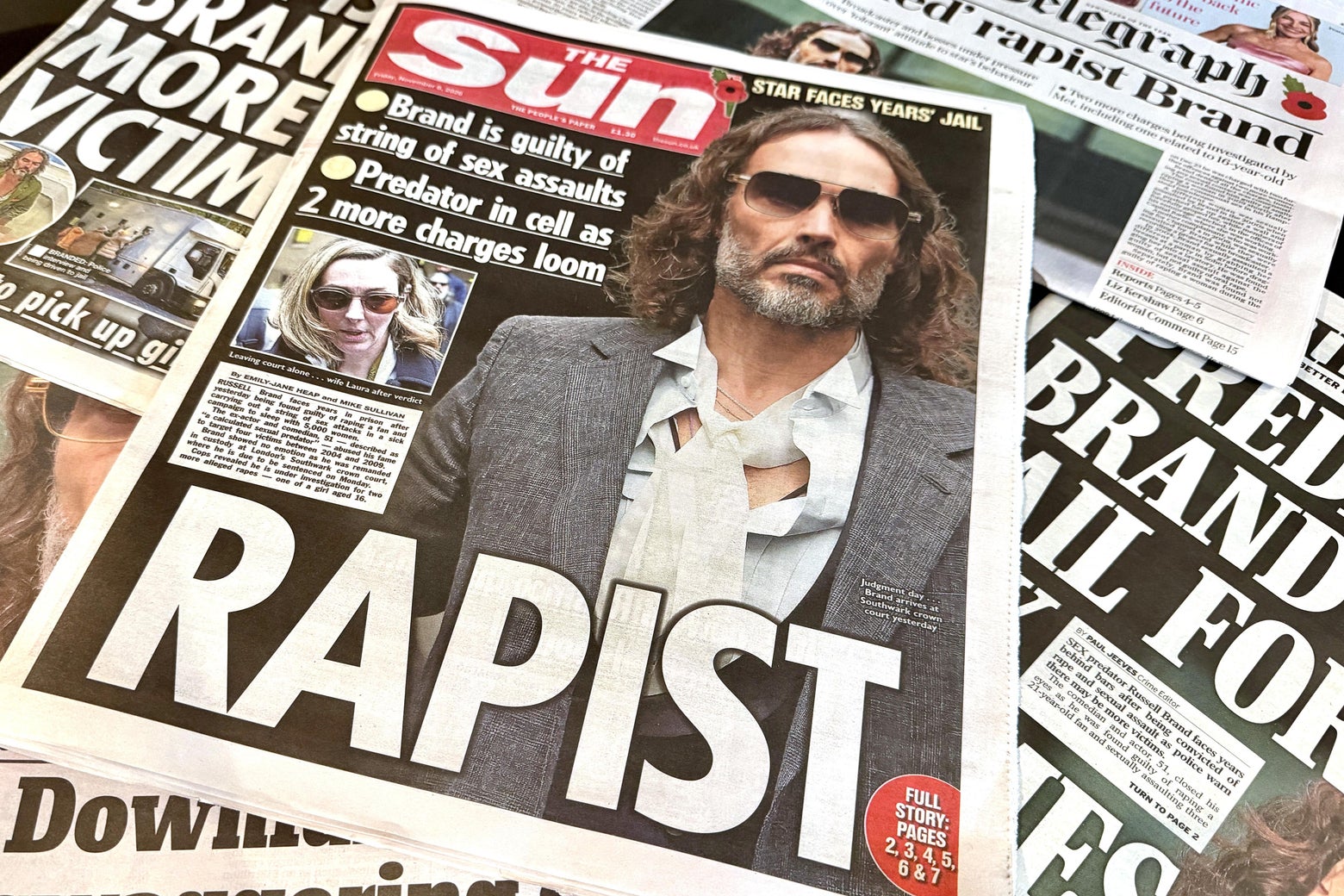
Fame William J. Connolly/Getty Images Sign up for the Slatest to get the most insightful analysis, criticism, and advice out there, delivered to your inbox daily. Russell Brand is going to prison. A few hours ago, the judge who has been presiding over Brand’s four-week trial for three counts of rape and three of sexual assault handed down a sentence of a total of 10 and a half years in prison. Brand will have to serve two-thirds of that time before he becomes eligible for parole. This has been a long, long time coming. For many years, Brand’s abusive behavior was an open secret in his industry, but the true extent of his crimes was only made public in a documentary produced by Channel 4, and accompanying reporting in the Sunday Times of London, released in 2023. This trial was the culmination of the police investigation that followed, and it’s been an ugly one. Brand’s defense lawyer rolled out some pretty nasty tactics, including arguing that the Channel 4 documentary and Times reporting had led women to come forward with “invented or reimagined” nonconsensual encounters with Brand. The lawyer argued that these four crimes of which he’s been found guilty should be treated as “isolated incidents,” that they mattered less because they happened 17 years ago, and that it was the circumstances of Brand’s enormous, mind-addling fame that led to his behavior, rather than that his enormous fame allowed him to get away with it. The case featured video testimony from six women accusing the actor and comedian of rape and sexual assault (he was acquitted on two of the rape charges and one of sexual assault), wherein they detailed not only what Brand did to them but the impact it had on their lives thereafter: a feeling of powerlessness, shame, prolonged difficulties with alcohol and the effects of trauma, exacerbated by having to see their attacker on television. Their fears that although they might be able to talk to trusted people in their lives about what happened, they could never take it to the police and deal with the backlash that comes with accusing a powerful man. And then there was Brand’s lead barrister’s behavior outside the courtroom. Ian Winter KC confronted Rosamund Urwin, a Sunday Times investigative journalist who worked on the initial reporting of Brand’s crimes, telling her, “I hope you’re pleased with yourself.” Urwin is one of the people who is responsible for Brand facing these charges. This, according to Brand’s barrister—and to Brand too—is a bad thing. Since the allegations came out a few years ago, he’s railed again and again against the mainstream media in YouTube rants. I imagine Urwin is pleased with herself, and rightly. Without Urwin and people like her who got the documentary and the newspaper reports over the line and into the public eye, there would have been no trial at all. Brand’s politics have shifted a great deal over the course of the past 20-odd years. There is a credible enough theory that his pivot from leftist pontificator to MAGA-adjacent new-age Christian can be traced to his knowledge that this day was coming, and a desire to align himself with factions of people who are typically anti–mainstream media and would reliably come to his defense once that media started reporting on his crimes. Sure enough, the small handful of people brave and stupid enough to stand outside the courthouse and protest Brand’s innocence had signs reading: “Christ was crucified for telling the truth. Russell is the truth.” Predictably, in the aftermath of his downfall, both the left-wing and the right-wing media here are busily trying to distance themselves from him. But the reaction from the public seems, in general, to be one of pleasant—if that’s the word—surprise at the fact that Brand was indeed found guilty, for starters, and then that the jail time is so long: The minimum possible sentence here was four years. It’s how I felt too. I’ve grown accustomed to expecting leniency toward famous people in the courtroom, especially in cases like these sexual assaults, where there is a built-in lack of corroborating witnesses to the attacks, as well as easy pickings for defense lawyers of alcohol being involved, and so victim testimony must be believed. Brand made his name as an actor and a comedian by taking up as much space as possible, flamboyantly overperforming his persona as a lovable rogue. There is great satisfaction in seeing a man like this up in the dock, at last unable to bluster, brag, and blag his way out of taking responsibility for his behavior. Despite Brand’s lawyers’ best attempts to paint him as a reformed lothario guilty of some forgivable indiscretions and lapses of judgment, he will be punished as a rapist and sex offender to the fullest extent of the law. “Whatever women wear, wherever they go, indeed whatever they drink, they retain the right to say no and to demand justice from the criminal courts,” the judge said in his sentencing statement. What does the Brand verdict mean? The landscape here is, one hopes, finally shifting away from a general understanding that once a man is rich and powerful enough, he’s untouchable by the law, to one in which we can call for justice to be served for sexual crimes and hear those calls answered. We are now in a post-Weinstein world, but, perhaps more pertinently here in the U.K., a post–Prince Andrew one. The Met Police are actively inviting any other victims of Brand to come forward in light of these convictions. Perhaps other women, victims of other famous and powerful men in this country, will feel that the time is now right to get justice for themselves too. Lord knows there are plenty of them out there. Celebrities Crime Criminal Justice United Kingdom
The Russell Brand Verdict Is Seismic in the U.K.—and a Sign of Things to Come
Full Article
Original Source
Read the full article at Slate →KhanList aggregates and links to publicly available news content. We do not host full articles from third-party sources. Always verify important information with original sources.