
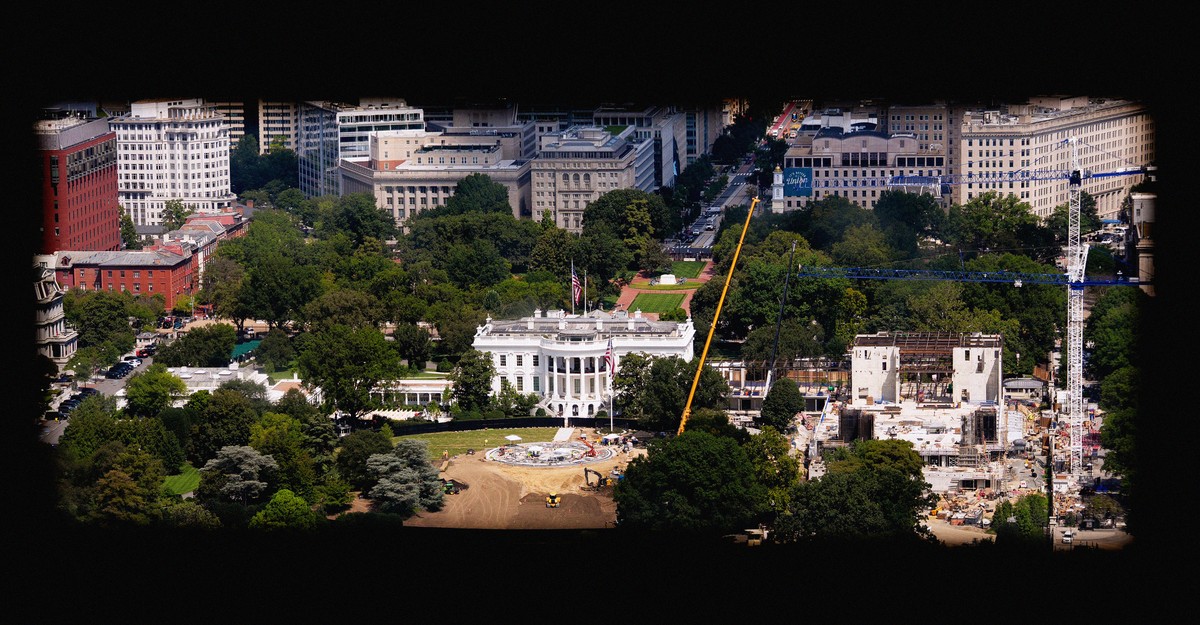
Construction is notoriously slow-going work. But in Donald Trump’s Washington, cranes and bulldozers appear like DoorDash deliveries: fast, frictionless, and on demand.To build the president’s White House ballroom, roughly 250 workers have been pouring concrete and installing steel framework, keeping the site humming for 20 hours a day, seven days a week. The National Park Service has proposed a similarly intensive schedule for Trump’s planned triumphal arch: Construction will begin, Interior Secretary Doug Burgum announced on Thursday, in the next two weeks. And officials are trying to shut down the Kennedy Center for two years to carry out renovations that consultants say will take twice as long if the building remains open during the work. These are very different and ambitious projects, but they share the same presumed deadline: January 20, 2029.They also share a risk: The compressed schedules could lead to shoddy work that will require more repairs later.Trump has less than three years to complete his transformation of Washington, D.C., before his projects fall into—and perhaps die in—the hands of a successor. “Nobody will do it once I’m gone. When I leave here, nobody will,” he told New York magazine. The next president, whomever they are, likely won’t share Trump’s enthusiasm for gold finishes and Italian marble. To get the work done, his administration has found ways to circumvent the procedural obstacles that tend to slow federal projects.Construction—one of the world’s least productive industries—may present its own paradox. Research has shown that long hours, additional shifts, and overlapping work tasks can shorten a project’s timeline—but only to a point. In many cases, the effort to build faster can invite new delays, higher costs, and revisions. Trump’s botched repairs to the Reflecting Pool ahead of the nation’s 250th-birthday celebrations, in July, offer a classic example of the problem.The ballroom project, a hulking party venue that overshadows the White House’s main building and its modest neoclassical design, could be another. The Supreme Court ruled 5–4 this week that its construction could continue, saying that the preservationists trying to halt the project did not have standing to sue. The three liberal dissenting justices—along with, notably, Chief Justice John G. Roberts—argued that the construction was “likely unlawful.” But government filings claim that it’s already 65 percent complete—even as project leaders have continually revised design plans. By the time a new lawsuit from a challenger with stronger standing advances through the courts, how far along will the ballroom be?Read: The Court’s ballroom decision is a sign of deeper problems“We have hundreds of happy construction workers in D.C. busily doing their job building the finest Ballroom/Military complex anywhere in the World,” Trump wrote on Truth Social this week after the Supreme Court decision.With his lawyers saying that the project will be “substantially” finished by November, the clock is ticking fast.Trump’s building spree presents a tricky calculation: The returns he wants are about time rather than cost. But speed in construction can get expensive fast, especially for a project whose anticipated costs have been hard to nail down. When Trump announced the ballroom plans in July 2025, he put the price at roughly $200 million, to be paid for by private donors. By October, he’d knocked down the East Wing of the White House without seeking any approvals. As the work has started, stopped (because of the preservationists’ lawsuit), and started again, the original estimate has tripled to $600 million, and taxpayers are expected to cover half of that amount, according to internal documents from the ballroom’s general contractor, Clark Construction, that were obtained by The Washington Post.Those projections could rise again. “Accelerated construction is always at higher cost, no matter what you do,” Awad Hanna, the chair of the construction-engineering and -management program at the University of Wisconsin at Madison, told me. There are essentially three ways to make construction move faster, according to Hanna: Workers can put in overtime, contractors can add second or third shifts, or the project can resort to overmanning—that is, adding an unusually large number of workers to a site. Each method may buy some time but sacrifices some productivity, Hanna said.Researchers have documented that trade-off for decades. A 1997 study published by the American Society of Civil Engineers examined 121 weeks of labor-productivity data from four industrial projects and found efficiency losses of roughly 10 to 15 percent for 50-to-60-hour workweeks.Hanna’s own research has found similar patterns. With overmanning, the problem is that there’s only so much room for specific tasks to be performed. As the site fills up with workers, they can find themselves competing for tools, materials, and information—or simply getting in one another’s way. Meanwhile, overtime can lead to fatigue for workers who are spending 10 to 12 hours on their feet, carrying heavy objects while also needing to remain diligent about their own safety.There is another way to speed up construction without adding hours or workers: starting construction before a design is complete. The industry calls this fast-tracking. But a 2023 study found that construction professionals perceived the fast-track strategy as posing a different set of risks, including construction errors and productivity declines, when better productivity is supposed to be the whole point.A certain amount of secrecy surrounds the White House worksite, in part because of a large military structure that is being built underground, beneath where the ballroom will stand. The methods to speed up the work are unclear, although the teams behind the project are reputable: Clark Construction is a seasoned federal contractor, and the architectural firm Shalom Baranes Associates repaired the Pentagon after 9/11. A White House spokesperson told me that the project is proceeding with the 20-hour schedule for now.In April, Trump turned his focus to the Lincoln Memorial Reflecting Pool, a century-old landmark that has long struggled with leaks and algae blooms. Trump first claimed that he could complete a repair project in a week for less than $2 million. “I have a guy who’s unbelievable at doing swimming pools,” he told reporters at the time. The costs climbed to more than $16 million, which included the installation of a waterproof liner tinted in a color that he called American-flag blue. But shortly after the pool reopened, in June, algae returned in force and the sealant peeled, leading crews to repeatedly drain and scrub the basin over the summer. Now it sits completely empty and fenced off. Trump accused vandals of damaging the pool, but his own U.S. attorney for D.C. refuted those claims, pointing to the contractor’s failures and the Interior Department providing “less than fulsome information at the outset of the case.” Federal officials recently hired a new contractor to deal with the algae.Trump has already cleared one obstacle blocking the ballroom. But the legal case is not over. Following the emergency ruling, the government still has to formally ask the Supreme Court to hear its appeal. And the National Trust for Historic Preservation, which brought the suit against Trump, can continue a fight in the lower courts.For each of Trump’s Washington projects, officials have beefed up their justifications in one way or another in the face of legal challenges. In the administration’s view: The Kennedy Center may have to be “taken down” if its planned two-year shutdown for renovations is blocked. (Critics have pushed back on officials’ claims that the building’s conditions are existentially dire.) The Reflecting Pool’s needed repairs were urgent enough to exempt them from the typical competitive-bidding process. (The urgency was the July 4 celebrations.) And now? The White House ballroom is needed for security reasons, because it’s connected to a military bunker.Read: The Kennedy Center has a problem that courts can’t fixThe administration has also pointed to the ballroom’s progress in arguing against an injunction, raising a larger question about whether speed itself has become a form of power in Trump’s building spree. If a president can build faster than Congress or regulators can review, legal constraints may matter less in practice—not because they have disappeared but because enforcing them comes too late. This week’s Supreme Court ruling has already prompted at least one federal judge to consider its implications for another Trump project. Yesterday, U.S. District Judge Carl J. Nichols ordered lawyers representing the Interior Department to address how the Court’s ballroom decision affects its pending motion to dismiss a lawsuit challenging work on the Reflecting Pool.When asked about the start of excavations for the triumphal arch, the White House spokesperson said in an email, “Work will begin that does not require approval, but rather helps in the process. We will of course continue on our path of seeking final approval from all applicable entities.” The arch still needs final approval from the National Capital Planning Commission, to which Trump has added loyalists. But the administration has also been working to water down historic-preservation rules governing federal projects just as the arch has become subject to that process. Meanwhile, the Kennedy Center—which Trump also controls—cannot start its renovation until a judge signs off on the latest plan. But this week, the center removed a prominent artwork near the Potomac River, a sign that top-down change has begun.All three projects—the ballroom, the arch, and the Kennedy Center—may soon be moving forward simultaneously, red tape cleared (or ignored). But sped-up construction can impose its own obstacles. When unexpected delays crop up, even presidents have to wait.
The Rush-Job Presidency
Full Article
Original Source
Read the full article at Theatlantic →KhanList aggregates and links to publicly available news content. We do not host full articles from third-party sources. Always verify important information with original sources.