
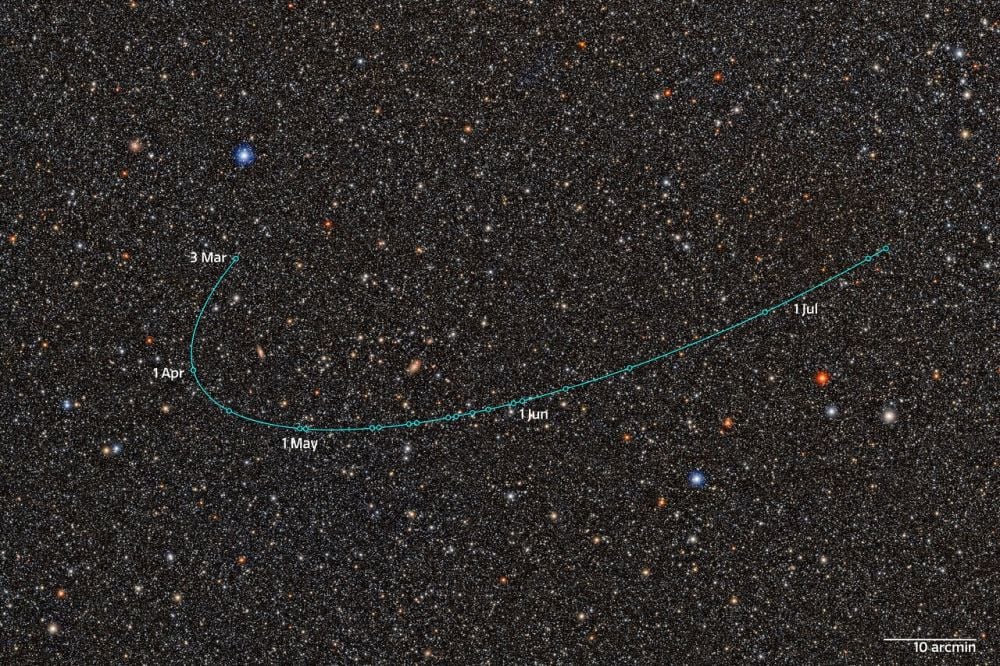
The Vera Rubin Observatory (VRO) has found its first dwarf planet candidate. The planet, named 2026 ED138 (ED138), is way out beyond Pluto's orbit, and if confirmed, would be one of the largest dwarf planets found beyond Neptune. This is the realm of other dwarf planets including Makemake, Haumea, and Eris. ED138 turned up in observations taken before the VRO began its primary mission, the decade-long Legacy Survey of Space and Time (LSST). Matthew Holman, Rubin team member and senior astrophysicist from the (Center for Astrophysics | Harvard & Smithsonian [CfA]), is credited with the discovery. Holman works on the algorithms that shape the Rubin's search for transient objects in the night sky. The VRO is a game-changer in the search for objects moving through the distant Solar System. Its wide and deep field catches moving objects that other telescopes struggle to detect, because Rubin images the same field repeatedly. Algorithms search through these images and detect even the faintest transient objects. The Rubin is expected to find many new objects like ED138. “Rubin Observatory's super power is the ability to clearly capture movement and change among a vast number of objects and phenomena that humans have never seen before,” says Edward Ajhar, NSF Program Director for Rubin Observatory. “That power greatly extends our ability to reveal and understand new things about our Solar System, the Milky Way, and billions of other galaxies across the Universe.” This view of the Solar System shows the orbital pathway of the newly discovered dwarf planet candidate 2026 ED138. This image shows ED138's position on May 8th, 2026. Image Credit: NSF–DOE Vera C. Rubin Observatory/NOIRLab/SLAC/AURA/R. Proctor Image Processing: M. Zamani (NSF NOIRLab) Orbit data provided by the IAU Minor Planet Center (MPCorb catalog), funded by NASA PDCO and the Tamkin Foundation. Star map: NASA/Goddard Space Flight Center Scientific Visualization Studio. Gaia DR2: ESA/Gaia/DPAC. “Rubin Observatory’s unique strengths make it an incredible tool for investigating a wide range of astrophysical phenomena, from dark energy to the discovery of this dwarf planet candidate,” says Kathy Turner, DOE’s Program Manager for Rubin Observatory. Holman found ED138 on October 13th in data gathered earlier in 2026. He was running VRO data through a search algorithm that examines billions of detections, compares them, and identifies detections that belong to the same object. ED 138's brightness and distance showed that it was an exceptionally large object, likely a dwarf planet. “My first reaction was one of excited disbelief,” Holman said. “Objects like this are very rare, so I immediately started checking whether I or the code had done something wrong.” Mario Jurić, faculty member at the University of Washington and Rubin Solar System Lead Scientist, set about finding other ED138 detections in more VRO data. By sifting through VRO's catalogued data, Jurić uncovered 20 more detections of the object. All in all, Rubin's Simonyi Survey Telescope detected the dwarf planet 30 times in 20 separate nights between March 4th and July 11th. Additional confirmations were found in images from the Dark Energy Camera that date back to 2016. All of this combined data traced ED138's orbit over a ten-year period. At this point in its orbit, ED138 is about 46 astronomical units (au) away, compared to Pluto's average distance of about 40 au. That distance places ED138 in the class of Trans-Neptunian Objects (TNOs). TNOs are beyond Neptune's orbit, and orbit the Sun at more than 30.1 au, which is Neptune's average distance from the Sun, also known as its semi-major axis. There are thousands of TNOs, though the large majority of them haven't been given numbers. The Minor Planet Center (MPC) is responsible for cataloguing these objects, and 1006 of them have orbits well-defined enough to be numbered, while another 4,000+ have only provisional designations, since their orbits are awaiting confirmation. As those numbers show, this region hosts a sizable population of faint objects, and is a murky region of the Solar System that's difficult to study. TNOs are typically divided into sub-categories like Kuiper Belt Objects, which contains most of them, including our old friend Pluto. There are also scattered disk objects, with high eccentricities and inclinations and orbits that are affected by Neptune. Then there are detached objects, which aren't affected by Neptune. There are also Sednoids, which are described as the most extreme subset of detached objects. There are only four of these objects, and their semi-major axes are greater than about 60. Sometimes, the Sednoids are sometimes described as Inner Oort Cloud Objects. Smallish, dimly-lit chunks of rock orbiting in the Solar System's distant reaches might seem like trivial discoveries compared to something like a new, Earth-like exoplanet, or an interstellar comet. But they're not. The Solar System is like a jigsaw puzzle, and without these pieces, our understanding is incomplete. ED138 isn't at the most extreme reaches of the Solar System. It's a puzzle piece that fits in elsewhere; not just because of its distance, but because of its other orbital characteristics. Since its orbit is inclined by about 25 degrees from the Solar System's plane, it's described as a hot-classical TNO. In astronomy, hot means its orbit was disturbed, in this case by Neptune. It needs to be pointed out that not all TNOs are dwarf planets. To be a dwarf planet, an object must have strong enough gravity to form itself into a round shape. ED138's albedo, distance, and brightness indicates its diameter is between 600 and 1500 km. Astronomers expect icy objects this large to be round, making them dwarf planets. These are only preliminary measurements for ED138, and they will be refined over time. But they show that it's one of the largest candidate dwarf planets found beyond Neptune. “If confirmed as a dwarf planet, ED138 would join a very small family of worlds,” said Holman. “Rubin will image the whole southern sky again and again for ten years, so any others hiding in the places earlier surveys skipped are now within reach.” Unanswered questions abound regarding the Solar System, its history, and how it formed its modern architecture, and these small distant worlds hold clues. Objects like Pluto and Orcus follow orbits that are best explained by Neptune migrating outward early in the Solar System's history, and sweeping them up. So in a sense, they're like fossils that tell the tale of Neptune's migration history. The Kuiper Belt's total mass is small, much smaller than Earth's, and that implies that its member were too massive to have formed there. That in turn suggests that the Kuiper Belt was once far more massive, and that its residents were scattered. Other distant objects, like [Eris]—the most massive dwarf planet—and Gonggong, are in the scattered disk. So they interacted gravitationally with Neptune in the past, and may still be interacting today. Then there are the detached objects like Sedna. Their perihelia are so far away from Neptune that it couldn't possibly have placed them there. This brings up the mystery of Planet Nine, a disputed, hypothetical object that could explain some of the most puzzling members of the outer Solar System, the extreme Trans-Neptunian Objects (ETNOs), which includes the Sednoids, explained earlier. The nested panels in this figure show the extremely distant reaches of the Solar System and some of the bodies that orbit there. Sedna's orbit is highlighted as one of the most distant objects, sometimes called an Extreme Trans-Neptunian Object. How it got there is a mystery, as it's too far from Neptune for that planet to have placed it there. Image Credit: NASA/JPL-Caltech/R. Hurt (SSC-Caltech) The outer regions of the Solar System are coming into closer view, thanks to more powerful telescopes, including the Rubin. To help us make sense of how these objects all fit in, the VRO’s Education and Public Outreach team built OrbitViewer, an interactive tool that helps place the region and its population into context. ED138's discovery, and the discovery of more than 11,000 new asteroids, shows how the Rubin is living up to its promise, and how it's poised to elevate our understanding of the Solar System. And all of these objects were found before it even started its Legacy Survey of Space and Time. “Rubin is giving us an unprecedented capacity to explore the sky through a combination of speed, depth, and precision,” said Jurić. “And the discovery is just the beginning: once we identify a new object, we can search back months, and sometimes even decades, finding it in images where nobody knew to look. This ability to both discover and ‘precover’ objects is transforming how quickly and accurately we can determine their orbits and understand the distant Solar System.”
The Rubin Observatory Finds Its First Dwarf Planet Candidate
Full Article
Original Source
Read the full article at Universetoday →KhanList aggregates and links to publicly available news content. We do not host full articles from third-party sources. Always verify important information with original sources.