
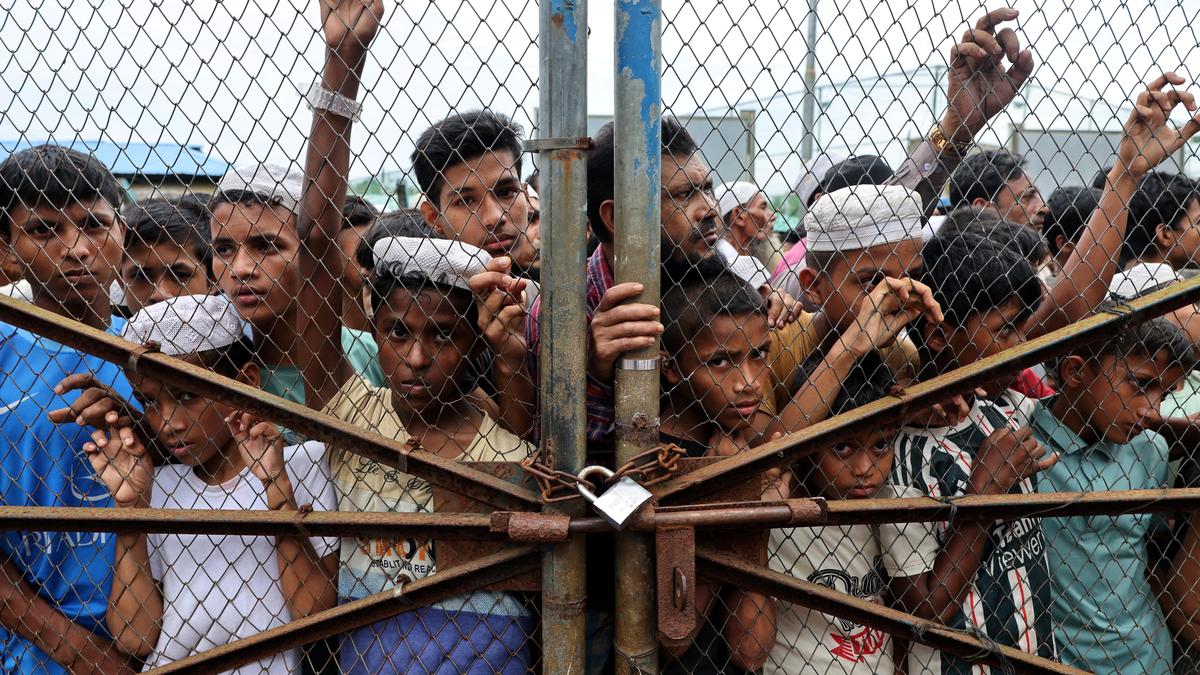
Rohingya refugee children look through a metal net as they gather to watch the live announcement of a verdict by the International Court of Justice in a case accusing Myanmar of committing genocide against the minority Rohingya population on a big screen at a refugee camp in Cox's Bazar, Bangladesh, on November 19, 2026. | Photo Credit: Reuters In a first of a kind ruling, the International Court of Justice held on November 19 that Myanmar committed genocide against the Rohingya in northern Rakhine State during the military’s “clearance operations” in 2017. This was the first time the ICJ found a state responsible for committing genocide. Nine judges against six voted in favour of the ruling, in a case brought in 2019 by The Gambia.The court also found that Myanmar failed to prevent genocide by civilians who joined its forces, failed to punish the perpetrators, never enacted the laws that the Genocide Convention requires, and destroyed evidence in breach of the court’s 2020 interim order. It also rejected, by 14 votes to one, the charge that Myanmar directly and publicly incited private persons to commit genocide, but declined to order citizenship for the Rohingya.The judgment holds the state of Myanmar to account but does not convict any individual. It is final and cannot be appealed. The court ordered Myanmar to investigate and, if warranted, prosecute those responsible, guarantee that the violations will not recur, allow the “safe, voluntary and dignified” return of the displaced, restore their property and compensate the Rohingya. The amount of compensation is to be fixed later, after Myanmar reports back to the court within two years.The Rohingya are a predominantly Muslim people who speak an Indo-Aryan language close to the Chittagonian dialect. The 2014 Census in Myanmar estimated over a million Rohingya in the country, concentrated in Maungdaw, Buthidaung and Rathedaung along the Bangladesh border. Muslims have lived in Rakhine or Arakan from the time of the Mrauk U kingdom (15th to 18th century). In 1799, the British physician Francis Buchanan recorded that Muslims “long settled in Arakan” called themselves the “Rooinga”.Many joined them, coming from Chittagong during colonial rule. Historian Jacques Leider has said the “Rohingya” took on a political and ethnic meaning in the late 1950s, when Muslim leaders adopted it to claim the status of a “national race”. In 1961, Brig. Aung Gyi of the Burmese Army publicly accepted them as an ethnic group. But this was before the coup by General Ne Win in 1962 which heralded decades of rule by the military junta in the country. Published - November 22, 2026 02:00 am IST
The Rohingya | Vindication for a persecuted people
Full Article
Original Source
Read the full article at Thehindu →KhanList aggregates and links to publicly available news content. We do not host full articles from third-party sources. Always verify important information with original sources.