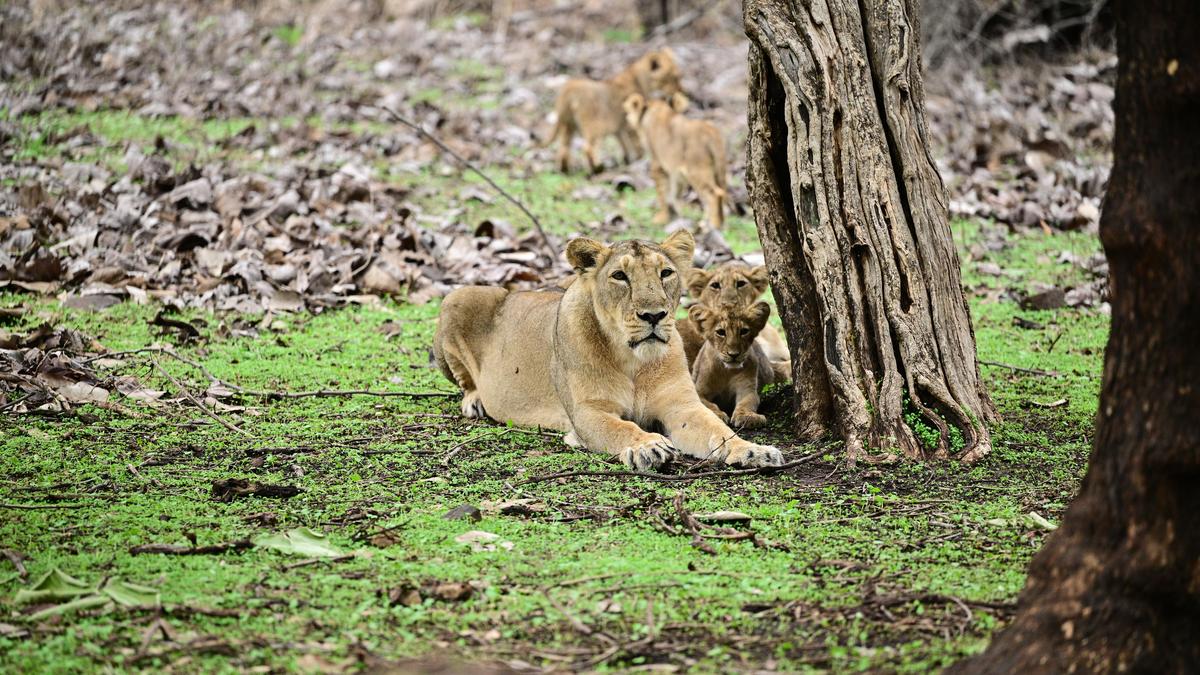
The only free-ranging population of the Asiatic lion today survives in and around the Gir National Park and Sanctuary. The semi-arid landscape of Gir extends into expansive agricultural fields and traditional grasslands, forming a checkered landscape matrix. Dispersing lions use these habitats as passages, stepping stones, and refuges as they navigate riverbeds and mountainous terrain, eventually establishing territories far from their source population.Lions today occupy habitats as ecologically distinct as the rugged hills of Girnar, the forests of Mitiyala, the landscapes around Savarkundla-Liliya, and the sandy coastal tracts stretching across Saurashtra to the Bhavnagar coast. What is perhaps most remarkable is that, at their destinations, these lions are accommodated by the local people.As is evident, the challenge of lion conservation in Gujarat rests not only on protecting Gir, but also on safeguarding the network of habitats and corridors through which lions disperse and establish new territories. Around 50 lions inhabit the coastal habitats of Jafrabad Taluka, linked to the larger lion population through Babarkot. Significantly, the Gujarat Forest Department’s 2025 lion population estimation identifies this coastal sector as Satellite IV, one of nine recognised satellite lion populations in the State, while the Gir Management Plan explicitly designates the Babarkot area as a lion movement corridor. Together, these official documents recognise the area as both an important satellite habitat and a crucial landscape linkage for dispersing lions.A crucial corridor under pressureIt is against this backdrop that a recent proposal to divert approximately 75 hectares of reserved forest for limestone mining has generated concern. The apprehension is that such a move would run counter to the long-standing legal and management framework established to protect lion habitats and movement corridors. If mining were permitted, habitat disruption could functionally disconnect this coastal subpopulation from the larger forest-linked source population and displace lions from portions of their habitat.The proposed project would reportedly require the felling of nearly 5,000 mature trees and affect a landscape that local communities themselves do not wish to see mined. Human-lion conflict could also intensify. The larger question is whether the prime habitat of a nationally treasured species, a landscape showcasing one of India’s greatest conservation recoveries, should be sacrificed for private profit.Over the six decades since the declaration of the Gir Sanctuary, the lion population has grown from about 100-150 individuals to a healthy population of over 1,000 today. More admirable, however, is the fact that nearly half of them now reside outside the designated protected area. Lions have, over the years, shown remarkable recovery, expansion and resilience, sustained by a resourceful habitat and a rich prey base.The unfinished taskThis success has been built through a transition from protected-area management to landscape-level conservation, supported by political will, capable administration, sustained funding and the goodwill of local communities. These have been the sturdy pillars of lion conservation.However, the entire lion population remains confined to a single forested landscape. More puzzling has been the continued resistance to acknowledging the need for a second home for the lions. After years of downplaying the risk of disease in a geographically concentrated population, we received a jolt in 2018 when more than 20 lions succumbed to an outbreak of Canine Distemper Virus (CDV). The forest department responded with a series of immediate measures, but have we effectively applied the lessons learned from previous outbreaks?Mortality is but a part of a natural demographic cycle. If we are to achieve long-term coexistence in shared spaces, we may even need to accommodate a degree of anthropogenic mortality. Yet the reports of lion deaths associated with babesiosis in May 2026, together with suggestions of possible CDV involvement, are worrying.If disease exposes the vulnerability of the population, land-use decisions expose the vulnerability of the landscape that sustains it. These controversies raise a broader question: have the once-strong pillars of the State’s conservation legacy begun to weaken? Are cracks emerging in the framework that has sustained lion conservation for decades? Historically, there was little room for negotiation where lions and their habitat were concerned. Indeed, Gir remains an important case study of how protected areas were progressively expanded around the original sanctuary. Hopefully, there will be no shift in the vision underpinning the law, its application, or administrative decision-making.Next chapter of recoveryGiven the species’ continuing conservation challenges, any ill-advised decision could yet turn the clock back to a far more precarious situation. The International Union for Conservation of Nature Red List tells an encouraging story: the Asiatic lion has moved from Critically Endangered to Endangered. Among the northern lion subpopulations, it is the only stable population exceeding 250 individuals and is therefore of immense global conservation significance. At the same time, the newer Green Status assessments remind us that recovery and restoration are not the same thing.A species can recover substantially and still remain far from fully restored across its ecological and historical range. Under the Green Status framework, the lion remains largely depleted. While the lion has recovered from the brink, it remains far from fully restored across the landscape it once occupied.The story of the Asiatic lion is one of sustained recovery achieved through six decades of unwavering conservation effort, and of the responsibility that comes with safeguarding those gains. Our goal is not merely to celebrate this legacy, but to sustain it.(Meena Venkatraman, PhD, is a wildlife biologist with over two decades of experience in mammalian ecology, with a particular focus on the Asiatic lion)
The road ahead for the Asiatic lion
Full Article
Original Source
Read the full article at Thehindu →KhanList aggregates and links to publicly available news content. We do not host full articles from third-party sources. Always verify important information with original sources.