
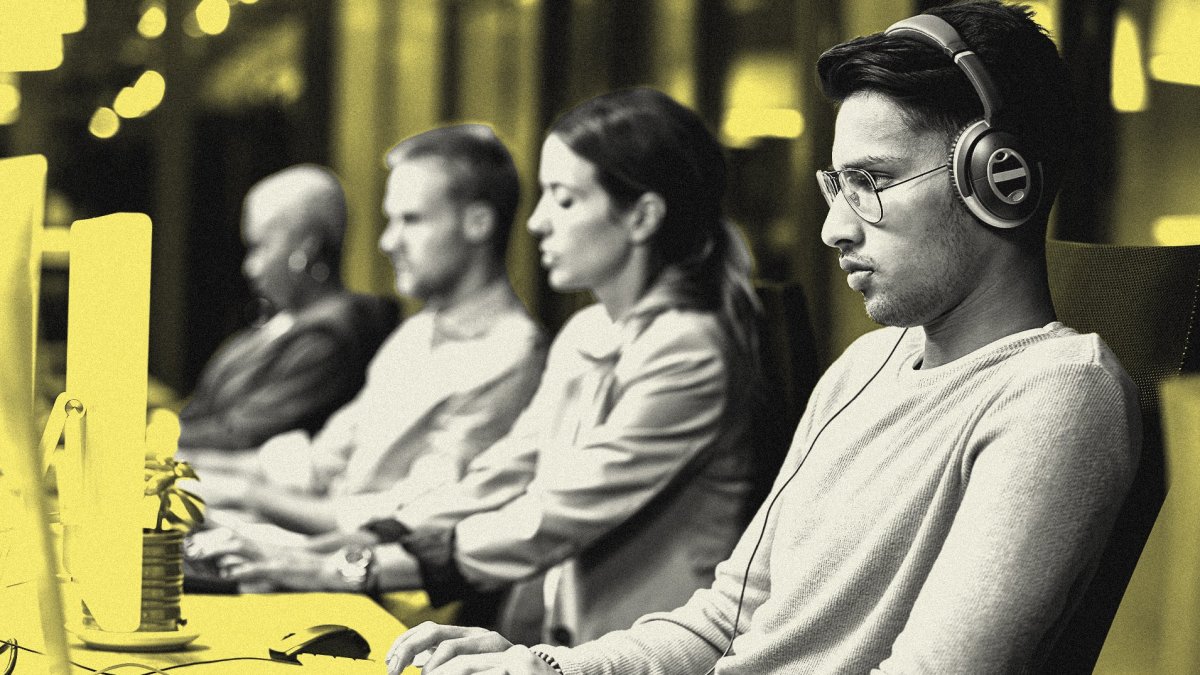
Once upon a time, a common complaint was that offices were too noisy: the din of humans working and socialising in open-plan spaces meant many people found it impossible to focus. When the Covid-19 pandemic drove office workers into their homes, this problem was temporarily solved. But with hybrid working becoming the new norm in the years since, the office, even when populated, has fallen silent. And, perhaps ironically, employees hate it. “I’m currently sat in an office on my own,” explains Simon*, who works in the creative industry. “It’s been like this since COVID. I still like coming in, as it separates my home life from work and it saves on heating bills… But it’s pretty soulless. Workplace culture is near-impossible to create on Teams.” And even in populated offices, the energy has gone, explains Amy, who works in marketing. She had been freelancing for a few years thanks to COVID when she sought out a full-time role, hoping for “office vibes”. She found none. “I’m in my late 30s and a parent now so not up for drinks after work as such, but was hoping for a nice chat, maybe a friend to grab coffee with… honestly it’s so dead, no one even really chats.” Alice*, 27, a journalist based in London, echoes this. “The office is quiet, the energy is much more akin to a library than the kind of go-getting, idea-firing, all-day banter and chit-chat ethos that was sold to us through Bridget Jones and the like. It can be quite depressing when you spend all day in an office and no one says a word to each other.”The data corroborates this phenomenon. A poll of 2,000 office workers in the UK from the training platform Kahoot! found that workers are less likely than ever to interact with each other in person, even when they’re together. 52 per cent regularly message colleagues sat in the same room, 40 per cent feel lonely at work, and 17 per cent can go an entire working day in the office without speaking to anyone face-to-face. This has led to a sense of isolation even more pervasive than when working at home (a third are lonelier in the office now), with 37 per cent saying they have no close friends at work. For workers who were in the office pre-Covid, the difference is acute. Not just in sound, but in the accompanying energy. “I moved to London in 2015 and started my career in marketing agencies when a 9-6 in the office was mandatory,” says Hannah, 34, also based in London. While she’s under new illusions about the downsides (“looking back I was constantly ill and exhausted”), she loved it. “It helped me make friends and build confidence so quickly at a time when I really needed to build my community. And it’s where I met my now long-term partner. I really feel for young people starting out now: it takes teams so long to get to know each other now.” Marion Marincat, founder and CEO of Sownd Affects, a business focused on making businesses audio-inclusive, argues that the pandemic ruined our tolerance for sound in ways we’re still adapting to: “After the pandemic we became a lot more aware of sound and the noise sensitivity threshold has lowered. We’d been pulled out of the daily noise, commutes and crowds, and things we were very used to, and into a much more intimate space of our own.” He points out that even though we’re back in offices, our behaviour has shifted. “Alcohol consumption has dropped a lot, we’re not going out in those rowdy places anymore, we want more intimate social experiences.” One in five late-night venues went out of business between 2020 and 2025, with younger people in particular, with more than half of 18-34 year olds saying noise regularly prevents them from enjoying their visit to venues. “So the classic office space where everyone’s in and you have all the noise you just have to adapt to, that’s no longer the case.” But financial pressures, like an increasing focus on corporate goals at the expense of office culture, hiring freezes and a reliance on freelance staff all pre-date the pandemic – 2020 and 2021 just accelerated those impacts. Aoife O’Brien, founder of the business consultancy Happier at Work, explains that the pressure for efficiency is squeezing budgets and people. “People don’t know each other as well and we’re trying to get more done with fewer resources. We’re really squeezed for time and we’re not having those impromptu chats with people because we’re so focused on getting stuff done.” Plus, there’s been a clampdown on budgets: it’s frowned upon now if you’re having a pizza party for your colleagues.” Basic forms of office culture building like after-work drinks or team-building days have been jettisoned to keep costs down – organised fun may have been dreaded before but the gap it left has just been filled with more pressure. New employees have no way to connect with colleagues, and so workers get increasingly atomised even as they sit in the same room. But the greatest culprit, Aoife argues, is technology, which gave us ways to communicate but avoid interacting. “Because so many people were working from home during the pandemic, we relied on quick online communications – if we are communicating at all. I’m not sure that people necessarily got out of that habit.” While it may keep us in touch, she says it has cheapened the nature of our communication. “I think that even when people want to check in on someone, they feel like they’ve done their duty if they send them a message rather than picking up the phone or having an in-person meeting. We’ve discharged our duty to those small interactions that we have with other humans. And we don’t necessarily notice the loneliness that we feel when we’re not receiving that until much further down the line.” Generative tech is further accelerating this: as we don’t want to bother others or seem incompetent, we direct queries not to colleagues, but to an AI. This may solve a short-term problem but longer term it is eroding any sense of connection. “Some of that spontaneity, some of that joy, has gone from work because we’re not actually having human interaction.” This silence and the resulting lack of community has significant consequences not just for workers, but for general productivity. People burn out quicker, their work gets siloed and people will disengage (or quiet quit). “When we’re not connecting with colleagues, we’re not feeling that sense of engagement in our work which is one of the core psychological drivers that we have at work,” Aoife explains. This lack of community not only affects the employees’ well-being individually but, ultimately, the bottom line. “If you look at the businesses that focus on generating revenue rather than focusing on people and the human side of business, you will see that as a result they have better returns for shareholders, better revenue because they focus on people as opposed to the bottom line. A byproduct of focusing on the humans who work there is that they do tend to make more money. But short-termism gets in the way.” The good news is that fixes are possible – and they don’t require the return-to-office mandate beloved by CEOs. “The arguments that [CEOs] are making to bring people back to the office don’t necessarily make sense,” Aoife says. “If we’re bringing people back to the office just to be on Teams calls and not necessarily interacting with each other, there’s a disconnect there. We need to have a better reason for bringing people back to the office. It’s one thing if they’re working on a project together, but if they’re all back in the office but not necessarily working together, let alone facilitating some sort of social activity, it doesn’t make sense.” Instead, it comes down, excitingly, to scheduling. Marion recommends an anonymous survey to understand what kind of audio needs employees have and scheduling in hours of focus vs hours of collaboration to save having to rebuild the space. And Aoife advocates for really understanding what might drive people to want to be in the office and communicating that clearly: whether that’s social events or just prioritising speaking in person. Or, as Alice put it: “Bring back the bar cart”. *Names have been changed
The rise of the silent office – and why it’s killing your career
Full Article
Original Source
Read the full article at Inews →KhanList aggregates and links to publicly available news content. We do not host full articles from third-party sources. Always verify important information with original sources.