
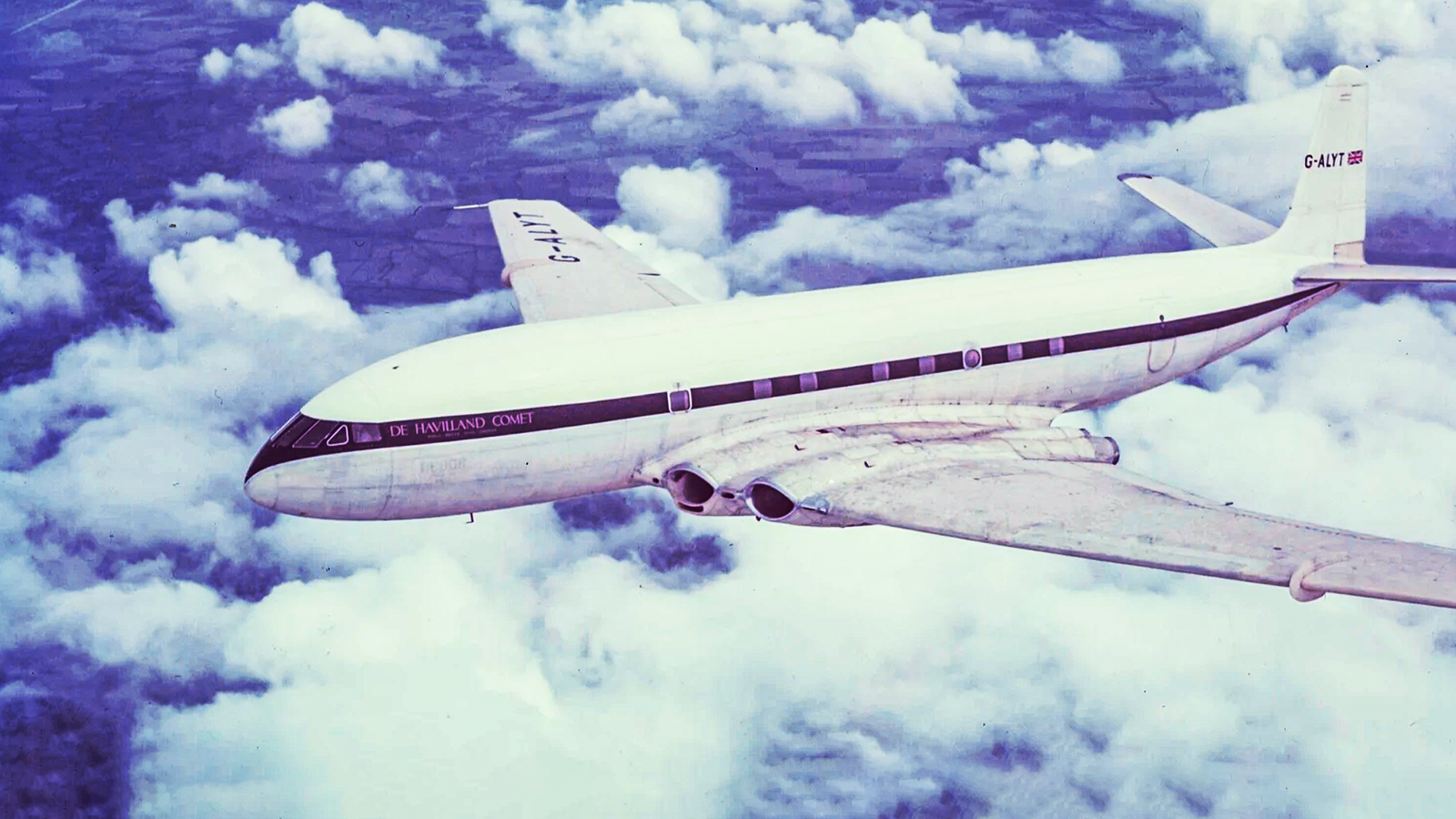
Published Nov 22, 2026, 3:00 AM EST Louis is a military historian and the staff writer for History of War magazine, a leading military history monthly. He also has an interest in private and commercial aviation. Manufactured from 1949 to 1964, the de Havilland DH.106 Comet was the world's first commercial jet airliner. It was powered by four jet engines and included a pressurized cabin. The engines were built into the wing roots, giving it a distinct, aerodynamically sleek appearance. The jet rose to enormous historical significance for the entire aviation industry and was also the high watermark for British commercial aviation. Yet the Comet's success was short-lived. Its design made it prone to metal fatigue after repeated pressurization. Two early fatal hull losses permanently damaged its market position. Development Of The Comet The idea for a British jet airliner was born during the Second World War. The Brabazon Committee recommended developing and producing a pressurized, nonstop transatlantic mail aircraft that could carry a 2,200 lb (1,000 kg) payload. The conventional wisdom at the time was that jet engines were not fuel efficient or reliable enough for transatlantic flight. De Havilland head Sir Geoffrey de Havilland used his influence to propose that there should be a specification for a turbojet-powered design. The Brabazon Committee awarded a contract to de Havilland to produce its Type 106, initially considered a small, short-range jet aircraft, while other manufacturers were also commissioned for other designs. The Type 106 featured untested elements and was financially risky, but the British Overseas Airways Corporation (BOAC) placed an order for 10 aircraft. De Havilland put together a design team to create the aircraft, which was led by Ronald Bishop, the brain behind the Mosquito fighter-bomber. The initial concept was for an unconventional tailless design. However, BOAC's demand to increase capacity from 24 to 36 seats forced the designers to opt for something more conventional. The final version was named DH.106 Comet in December 1947. First orders were then completed, with both BOAC and British South American Airways invested. They committed to 14 aircraft, to be delivered by 1952. The Comet's Entry Into Service The first Comet prototype was ready in 1949. On its maiden flight, the jet took off from Hatfield Aerodrome and flew for 31 minutes. John "Cats Eyes" Cunningham, a former RAF night-fighter pilot, was at the controls. The second prototype, G-ALZK, was registered in July 1950 and amassed 500 flying hours. Qantas sent its experts to observe its operations. The first production aircraft was G-ALYP, nicknamed "Yoke Peter", which first flew on January 9, 1951. The jet completed the world's first jetliner flight with paying passengers. It flew from London to Johannesburg. By September 1952, all the aircraft in BOAC's initial order had arrived. G-ALYZ was the last to be delivered, carrying cargo on South American routes according to simulated passenger schedules. On August 4, 1952, Prince Philip returned from the Helsinki Olympic Games on the aircraft. The table below uses BAE Systems data to show the specifications for the Comet 1: Powerplant 4 x De Havilland Ghost 50 engines producing 4,450 lbf each Wingspan 115 feet (35 meters) Maximum weight 105,000 lb (47,600 kg) Capacity 36 to 44 passengers Cruising speed 400 knots Range (fully loaded) 1,300 nautical miles (2,400 km) Number built 114 (including prototypes) Early Comet operations showed its viability in commercial operations. It carried 30,000 passengers and was profitable on flights with a load factor as low as 43%. The jet also greatly outperformed its piston-engined rivals. The jet flew 55% faster, and its faster climb rate cut flight time. The Airliner Seen All Over The Globe Popular Mechanics magazine wrote in 1952 that the Comet was between three and five years ahead of any other proposed jet aircraft. Writer Aubrey Cookman rode the aircraft on a mammoth six-stop trip from London to Johannesburg. "Scheduled eight-mile-a-minute travel in the stratosphere is here. I did it, and from now on so can you," Cookman begins. "Regular airline life insurance was available at the usual rate and I suspect a few snapped it up," they later admitted. The trip took 17 hours and 16 minutes, but was still about twice as fast as contemporary piston aircraft. These multi-stop odysseys were typical in the Comet's first years of operation. In the summer of 1953, eight Comets left London per week, with the destinations being Johannesburg, Tokyo, Singapore and Colombo. The Tokyo flight took 36 hours, with the same trip on BOAC's DC-4M-4 Argonaut taking over 86 hours. The table below shows the fleet sizes of the Comet's most significant operators in the 1960s, using data collected by Simple Flying: Airline Comets in service BOAC 19 British European Airways 12 United Arab Airlines 9 Aerolíneas Argentinas 6 Olympic Airways 4 East African Airways 4 From 1953, several other airlines placed orders for the Comet. Union Aéromaritime de Transport and Air France both ordered three Comet 1As, which had greater fuel capacity. De Havilland also developed the Comet 2, which had better engines and was longer. Air India, British Commonwealth Pacific Airlines, Japan Airlines and more made orders, although Qantas concluded that the Comet wasn't yet ready for its London to Canberra route. A String Of Accidents Across its service, the Comet was involved in 25 hull-loss accidents, 13 of which were fatal, leading to the tragic deaths of 492 people, according to Aviation Safety Network. That is 22% of all airframes built. The first accident came on October 26, 1952. BOAC Flight 115 was attempting to take off from Rome Ciampino G. B. Pastine Airport (CIA) when it failed to get airborne. It ran into rough ground at the end of the airport. Just two passengers suffered minor injuries, but the aircraft never flew again. A new Canadian Pacific Airlines Comet 1A suffered a similar accident in March 1953, resulting in the deaths of five crew and six passengers. It was the first fatal jetliner crash. The first airborne fatal jetliner crash occurred on May 2, 1953. BOAC Flight 783 crashed in a thunderstorm shortly after takeoff from Calcutta-Dum Dum Airport (CCU). The jet was seen hurtling towards the ground with no wings. All 43 people on board died. The following year saw the notorious Comet disasters of 1954. These were BOAC Flight 781 and South African Airways Flight 201. Flight 781 was the most deadly, with the aircraft breaking up in midair 20 minutes after takeoff from Ciampino. The Cause Of The Accidents "The cost of solving the Comet mystery must be reckoned neither in money nor in manpower," said British Prime Minister Winston Churchill. The Royal Aircraft Establishment at Farnborough led an investigation into the accidents. Its work showed that cabin pressurization cycles had caused metal fatigue cracks. The stress had been concentrated near windows and hatch corners, as well as around the automatic direction-finding (ADF) antenna cutout. These small areas of fatigue were sufficient to cause the thin-skinned fuselage to fail, leading the aircraft to break up in midair with deadly consequences. The findings resulted in the Comet 1 fleet being grounded in 1954. Future Comet iterations, like the Comet 4, had thicker skin, and areas prone to stress were also targeted. De Havilland completed a refit program to strengthen the skin and wing structure of existing aircraft and install rounder windows. The Comet 4 first flew in April 1958, marking the Comet's return to service. Comet 3 customers canceled their orders and switched to the newer iteration, which had improved fuel capacity. BOAC used the jet for regular services from London to New York, completing the trip in an incredibly short six hours and 12 minutes. It was the first jetliner to make a nonstop transatlantic trip. Yetat this time, the Boeing 707 was coming into service, as was the Douglas DC-8. These American aircraft were larger, faster, and had a better range. The days of Britain dominating jet aviation were numbered. The Comet's Last Flight A Dan-Air Comet (pictured above) performed the final flight of the world's first commercial jet aircraft on November 9, 1980. The British carrier flew nearly 50 Comets, usually acquiring them secondhand during the 1960s and 1970s, with three Comet variants in the fleet. The final flight saw a Comet 4C take off from London Gatwick Airport (LGW). The plane then made a low pass at London Heathrow Airport (LHR) before making another low pass at RAF Brize Norton. The destination honored G-BDIW's former owner, the RAF, where it was registered as XR398. The passengers received certificates showing they had been on the last flight. The jet then traveled on to Germany for preservation at the Flugausstellung Peter Junior museum in Hermeskeil. The service was not the last time that a Comet took to the skies. The UK Ministry of Technology continued to use the jet to research avionics, radar, and radio-based technology. That aircraft, XS235, continued these duties until its final retirement in March 1997. It concluded 45 years of the Comet being seen over skies in Britain and around the world. The plane is now part of the Cold War Jets Collection at Bruntingthorpe Aerodrome in Leicestershire.
The Rise & Fall Of The World’s First Commercial Jetliner
Full Article
Original Source
Read the full article at Simpleflying →KhanList aggregates and links to publicly available news content. We do not host full articles from third-party sources. Always verify important information with original sources.