
Three decades ago, there was a breakthrough: computers were going to be able to display “frenzied” 3D imagery in colour. Personal computers, this masthead reported in September 1995, would be able to match the “dizzying pace as the most advanced arcade game,” powered by chips created by a little known, privately held Silicon Valley firm called Nvidia.Founded by a 30-year-old Taiwanese American prodigy called Jensen Huang in 1993, Nvidia became a household name, at least for gamers. It listed on the stock exchange as part of the dot com boom in 1999 at $US12, survived the crash and stayed a respectable performer for the next 20 years.Jensen Huang went from one CEO among many to a global figure because of AI.BloombergThen in 2022, ChatGPT arrived, the world realised that Nvidia’s chips were driving the artificial intelligence revolution – and Jensen Huang transformed from a cult figure to something akin to a statesman, presiding over arguably the world’s most important company. One of his 60-odd leather jackets, which he has been wearing since the early 2000s, sold at a charity auction in July for $US960,000.Now, after revelations that Huang had engaged in one affair with an alleged Chinese spy, and two more alleged affairs with subordinates, Nvidia has lost the only chief executive it has ever known. Huang, who resigned on Friday (AEDT), has lost the company he built into a $US4.2 trillion ($6 trillion) powerhouse and more than $US10 billion of his net worth, according to Forbes. The AI debate has lost its most powerful voice in favour of closer ties between the United States and China. And data centre companies such as Australia’s Iren, Firmus and Sharon AI have lost a champion of complex financing deals that have spurred their rise.So sharp has the fall been in Nvidia’s share price, and so large is the company – accounting for about 5 per cent of the value of all companies, everywhere, combined – that it has taken about a quarter of one per cent off the value of the entire whole world’s stockmarket. Australian funds including Australian Super and UniSuper have about $6 billion tied up in the company, which has taken a battering. “Probably the most expensive sex in human history”, one wag observed on Reddit.These sorts of ribald jokes stemmed from Huang’s affair with Alice Huang (no relation), the glamorous 42-year-old chief executive of a company called Megaspeed that presented itself as a Singaporean firm building data centres in Asia. Her public backstory is far thinner than Jensen’s oft-told tales of working at the chain diner Denny’s and graduating from high school at 16. Alice had been a presenter for Chinese state TV and then emerged in the world of AI after wheeling and dealing in several other fashionable business sectors with her husband, Wang Kei. Wang, the Wall Street Journal reported, introduced Alice to Jensen and appeared, according to people familiar with the couple, to tolerate their affair.An undated photo of Jensen Huang and Alice Huang at an exclusive golf resort in San Martin, California, that was originally posted to her WeChat Moments.As Jensen Huang and Alice Huang were being photographed at tech events and private dinners around Asia, US intelligence agencies were growing alarmed. In September 2025, the Commerce Department started investigating whether Megaspeed was channelling billions of dollars worth of advanced AI chips to China in defiance of US laws designed to retain its lead in the strategically important technology, which can be used for hacking, controlling weapons and more. By October that year, US intelligence services had concluded Alice was a Chinese spy, likely passing information back to Beijing. They told US President Donald Trump, the New York Times reported. The president did nothing.In fact, parts of the Trump administration grew closer to Nvidia. The Commerce Department investigation into Megaspeed was transferred to another agency after Nvidia intervened. Trump approved the sale of more advanced AI chips to China. Huang travelled on Air Force One as part of a state visit to China in May this year. All the while, Huang was the loudest voice arguing that the United States should support AI development at a breakneck pace and companies such as Nvidia to keep shipping their chips to China. Otherwise, Huang argued, China would be spurred to build its own competing chips even faster.An Nvidia chip on display at an expo in Taipei, 2023.Bloomberg“It would be extremely foolish to create two ecosystems, the open source ecosystem and it only runs on the Chinese tech stack, the foreign tech stack, and a closed ecosystem, and it only runs on the American tech stack,” Huang said on an industry podcast in April. “That would be a horrible outcome for the United States.”Other US officials were not buying it. Secretary of State Marco Rubio told colleagues in May of his concerns, but it took until October for the Times to make public the allegations that Huang had been targeted by a spy. Even then, Nvidia denied any affair. John Rizzo, a company spokesman, said: “Jensen’s interactions with Ms Huang are not unusual or unexpected”, casting them as standard meetings between a CEO and a customer. It was not a sustainable defence.As more evidence of an affair came to light in other outlets, including the WSJ, Huang admitted he had been unfaithful to his wife of more than 40 years, Lori Huang, and apologised. He declared he would cooperate with an investigation from Nvidia’s board, which was still downplaying the issue. The board had “no reason to believe that either national security or NVIDIA secrets were compromised”, its 10 members said in a statement. “I love our country and our company,” Huang added in his own. “I am committed to protecting NVIDIA and supporting America’s national security.” He would stay in his job while the investigation happened. China denied Alice Huang was a spy, with a foreign ministry spokesman claiming the allegations were “defamatory slander”. The woman herself has not commented.Jensen Huang receives the National Medal of Science from US President Donald Trump in October.APBut the first affair was not Huang’s last. Days ago, US outlets reported he had slept with at least two subordinates, including the company’s healthcare industry chief Kimberly Powell, 48. Nvidia’s policies all but prohibit such relationships. Trump confirmed the FBI was investigating, even as he praised Huang and failed to explain why he had not acted on the intelligence agencies’ concerns earlier. By the early hours of Friday, Huang had resigned after coming under major pressure from his board. Unlike other chief executives such as Atlassian’s Mike Cannon-Brookes or Anthropic’s Dario Amodei, Huang is not protected by shares with supercharged voting rights. He holds less than 4 per cent of Nvidia’s stock.“Jensen’s contributions to Nvidia are profound,” said the board, now led by former tech executive Harvey C. Jones. “The board and the company thank Jensen for his immeasurable contributions to the company and the industry.” Chief financial officer Collette Kress would lead Nvidia while the board searched for a permanent chief executive, Nvidia announced. Huang had no words in the statement.Those who have long boosted Nvidia have deserted Huang. Dan Ives, a bullish analyst at US firm Yorkville Ives, said Huang’s value to the company had been slashed by his own behaviour. “We also believe the old Jensen with the black leather jacket, Godfather, AI visionary viewed as a rock star globally is over and in the past,” Ives told clients. Already, the US Congress is talking about tougher chip export controls. Senate majority leader John Thune told online news site Semafor that it was a “high probability”, in remarks echoed by Democrats. “I understand people have affairs,” Louisiana Republican John Kennedy told the site. “But if you’re going to do it, try not to have an affair with a Chinese spy.”Australian investors are buying the dip. Data from online stockbroking platform Stake shows that on Thursday morning, after news broke that Huang was on the way out, 86 per cent of orders for Nvidia stock were to purchase shares even though markets in the US were not formally open. “About 70 per cent of buy orders were placed during extended hours,” a spokeswoman said. “Customers were trading the drop live, not waiting for the open.”Thomas Rice, a co-founder of global investment firm Minotaur Capital, said his fund had already been contemplating buying more stock in Nvidia but was waiting for the bad news to abate. Huang, Rice said, was integral to Nvidia, having presided over decades of successful business moves and 60 direct reports. But in the next one or two years, Rice argued, the company would be fine. “Short term, probably not a huge impact because all of the products are designed and being built already,” Rice said. Joseph Ziller of Ziller Funds Management, a firm that invests in founder-led businesses, agreed. “The founders or the CEOs plant the tree and then it takes years for them to bear fruit, he’s already laid out the next couple of years of roadmap for the company.” But over the longer term, Nvidia could be in trouble without Huang. Intel, Rice noted, had been a cutting-edge chip company for years before it floundered in the late 2010s.The Australians who may have the most to lose from Huang’s departure are those who run companies like Firmus. These “neoclouds” typically borrow large sums of money to lease or buy chips from Nvidia, which they install in data centres that do computing work for companies such as Meta. But much of the billions required to make that flywheel spin has been financially backstopped by Nvidia to shore up demand for its own chips. Frazis Capital Partners’ Michael Frazis said the AI trade was bigger than Huang, despite his importance. “At the margin a new CEO would likely do fewer of the aggressive funding deals that have attracted so much scrutiny,” Frazis said. At a Tasmanian parliamentary inquiry last week, Firmus co-founder Tim Rosenfield played down the company’s ties to Nvidia, which is a supplier, financier, and major shareholder. “Our developments are obviously ours and ours alone,” he said. “We are Firmus. We’re an independent company.”The Business Briefing newsletter delivers major stories, exclusive coverage and expert opinion. Sign up to get it every weekday morning.
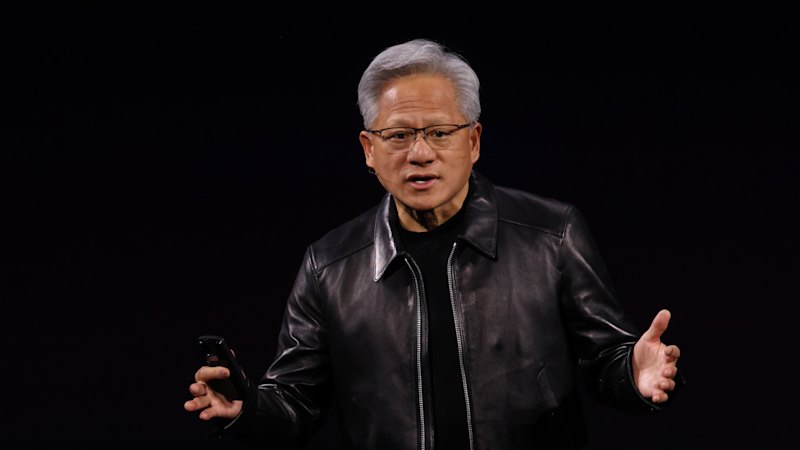
The rise and fall of leather jacket-clad tech ‘godfather’ Jensen Huang
Full Article
Original Source
Read the full article at Smh →KhanList aggregates and links to publicly available news content. We do not host full articles from third-party sources. Always verify important information with original sources.