
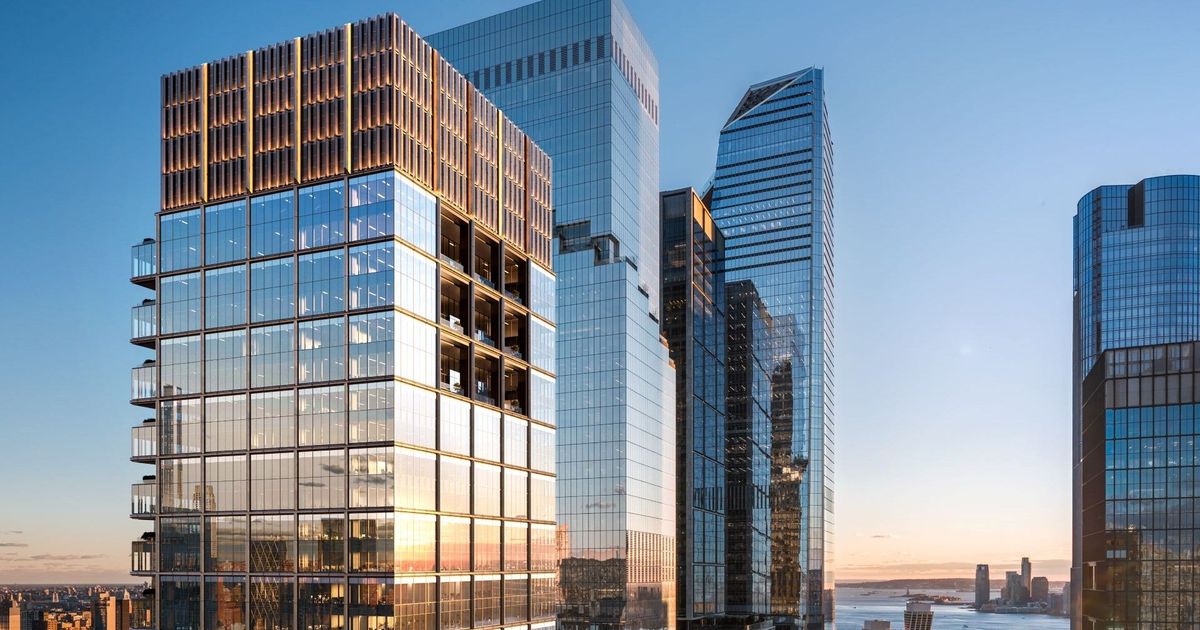
70 Hudson Yards. The office district has a 4.5 percent availability rate, the second-lowest in the city, and the highest asking rents. Photo: Oxford Properties and Related Companies A few months ago, Ruth Colp-Haber, who runs Wharton Properties, a commercial brokerage, fielded a call from a client for whom she’d found a cheap office sublet a few years earlier. The space, on 46th and Sixth, had rented for $28 per square foot in 2023, but the sublease was up and the client wanted to sign a long-term one. “They said, ‘I guess the rent will remain about the same?’” Colp-Haber had to deliver some bad news: Rents in that particular building had tripled. The clients ended up moving to a lower-caliber building at 41st and Lexington, where they pay a little more than double their last rent. “And that’s still a good deal,” says Colp-Haber. “Rents have gone up dramatically.” The Manhattan office market, which was on the verge of collapse just a few years ago, is doing staggeringly well right now: 2026 is on pace to be the single strongest year in terms of leasing activity since 2000, according to Colliers, with nearly 30 million square feet of office space leased since January (leasing averaged 34 million square feet annually before the pandemic). Availability rates in a few corridors — Park Avenue, the World Trade Center — are under 10 percent, rents in some buildings have gone up 20 percent since the winter, and brokers are even starting to see bidding wars over prime office spaces. A few buildings are reportedly asking as much as $250 per square foot. “It’s red hot,” says Kirill Azovtsev, a vice-chairman at Savills. “If you go into Soho and Hudson Square, big blocks of office space are virtually nonexistent.” It’s a turnaround that seemed all but impossible three years ago, when Manhattan had 52 million square feet of available office space, a vacancy rate of 22 percent, and a slew of buildings saddled with unsustainable levels of debt. “In 2021, most of the conversations I had were ‘Can you help me dispose of space?’” says Ryan Alexander, the vice-chair of leasing at commercial brokerage CBRE. “Then, 24 months ago, I started getting calls from founders who needed space.” Tech, and specifically the more recent AI boom, has accounted for some of the splashiest leases in recent months — in July, Anthropic leased all 16 floors of 330 Hudson, in Hudson Square. A few months earlier, in March, Harvey AI doubled its office space at One Madison in the Flatiron from nearly 100,000 square feet to nearly 200,000. AI sales company Clay signed for 163,000 square feet at 11 Madison, while Google renewed its 411,000-square-foot lease at 315 Hudson. “AI is crazy right now. They’re raising money, signing leases for 100,000 or 150,000 square feet, doubling head count, and warehousing space,” says Azovtsev. In 2026 so far, tech companies leased 2.8 million square feet of office space, according to a recent report from CBRE. But it’s hardly the only industry gobbling up offices. “Leasing recovery is widespread — there is no single industry that’s responsible for it,” says Michael T. Cohen, the principal at Williams Equities, a family-owned real-estate firm, and the tristate president of Colliers. “While it may seem that this was a tech- and AI-led recovery because they’ve signed so many big leases recently, it was a recovery led by other industries, especially financial services and law, by the time tech and AI joined the fray.” In June, the law firm Simpson, Thacher & Bartlett signed a lease for 916,000 square feet of office space at Extell’s under-construction tower at 570 Fifth, nearly doubling the amount of space it currently leases on Lexington Avenue. And Amex broke ground last month on 2 World Trade Center, the last tower of the World Trade Center development that it will occupy and own, whose ground lease is held by Larry Silverstein. It’s the latest financial giant to join the build-your-own office-tower boom, after JPMorgan Chase’s 270 Park and Citadel’s 350 Park. What happened? While much of the last six years has been consumed by anxiety about the return to office — whether employers would call workers back to the office, and how often — Cohen says most companies sorted that out a long time ago, realizing fairly quickly that they needed the same number of desks whether workers came in three days a week or five. The more decisive factor in the recent leasing boom is job growth — this year, New York eclipsed San Francisco in the number of tech jobs for the first time. Many AI companies provide financial and legal services and want to be close to clients here. Factor in all the office-to-residential conversions that are happening — 25 million square feet across numerous neighborhoods, according to Frank Wallach, the executive managing director of research and business development, New York City, at Colliers — and it’s clear why things have been moving briskly. Conversions have lowered vacancy rates in both the Financial District and Third Avenue — two of the most blighted office districts a few years back — which in turn has helped to raise the rents. “It used to be very easy for people to find space in Midtown East,” says Colp-Haber. “Now I’d say about a third of the buildings are being converted.” Park Avenue, an established destination for blue-chip firms, has vacancy below 3 or 4 percent, another broker told me, and rents over $200 per square foot. Lexington, usually a cheaper alternative, also has low vacancy, pushing tenants farther east to Third. “I’ve had some tenants who were thinking of expanding, and they put it on hold when they see the bargains aren’t there anymore,” says Colp-Haber. Downtown, most of the new World Trade Center buildings are 90 percent occupied, according to the Savills broker Azovtsev, driving rents up. “At 4 World Trade Center, asking rents were under $90 per square foot eight months ago. They’re now $120. At 7 World Trade Center, rents are $115–$130 per square foot. We haven’t seen rents like that ever.” At One World Trade Center, which is 97 percent leased, there are competing offers for the limited space that’s still available, according to a spokesperson for the Durst Organization. Hudson Yards also has extremely low availability — 4.5 percent, says Wallach of Colliers, the lowest after U.N. Plaza— and the highest asking rents in the city. New office buildings remain the most in demand, brokers say, even at rents that were unheard of a few years ago. When I spoke to Alexander, he was rushing off to show tech clients space at 15 Laight, on the corner of Canal, the only new office building in Midtown South, which is asking more than double that market’s $80-per-square-foot average. For smaller, non-venture-backed businesses, there are still options, says Azovtsev. “You might just have to be a little farther from transportation, okay with a side-street building that doesn’t have all the bells and whistles of new construction. It’s going to be a prewar with more columns in the space, and it may not have windows on all four sides.” Indeed, the older side-street buildings aren’t languishing like they were a few years ago. Brokers say there are enough bargain hunters out there to take space priced under $60 per square foot. And as long as building owners gussy up their lobbies or add some amenities that make sense for the space, like a rooftop terrace, there’s usually a tenant for them. Sometimes several. At 136 Madison Avenue, a 1916 office building on the corner of 31st Street with asking rents reported in the high $60s, Cohen says that three companies ended up bidding against one another for the last office, a prebuilt space a little under 20,000 square feet. “It was move-in ready, built out and ready to go,” he says. “In these small and medium tenants, there’s a lot of impatience. People want an office they can move into immediately.” The Return-to-Office … Boom? Your product is saved! You’ll receive emails when your saved products go on sale. Manage preferences.
The Return-to-Office … Boom?
Full Article
Original Source
Read the full article at Curbed →KhanList aggregates and links to publicly available news content. We do not host full articles from third-party sources. Always verify important information with original sources.