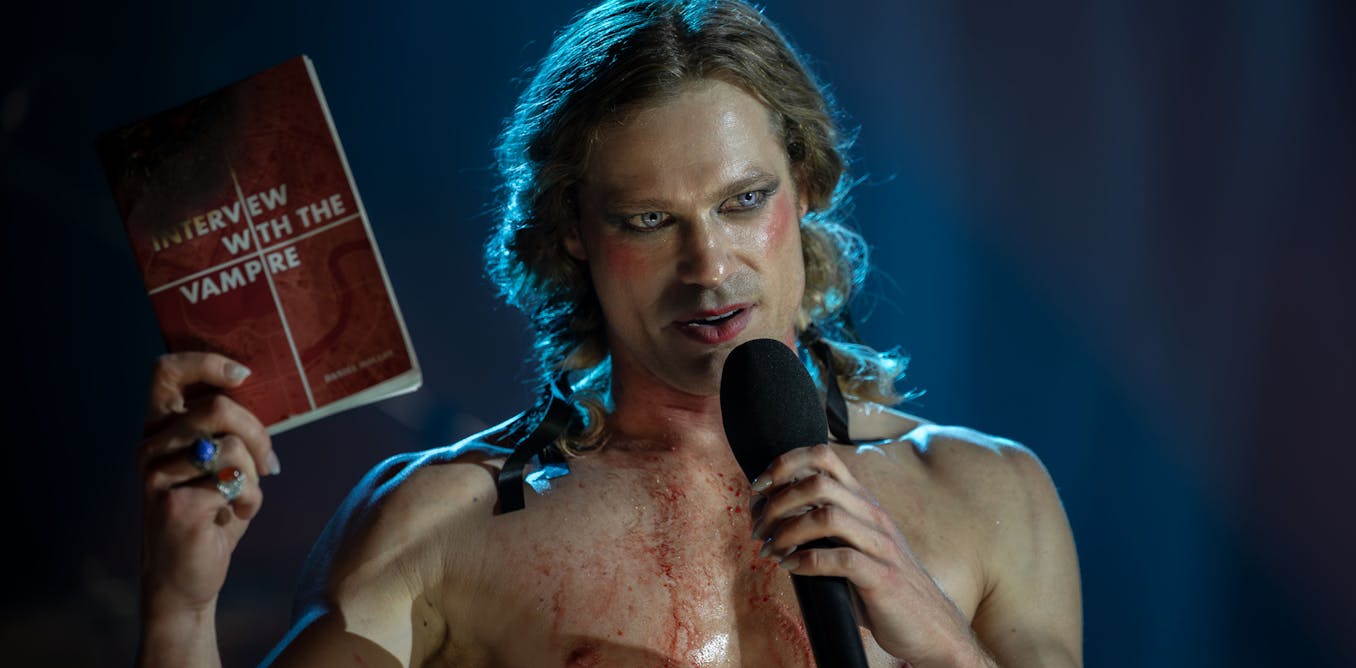
June 7 2026 was a historic day for musical vampires. The stage adaptation of The Lost Boys won four Tony awards and the third season of the TV show Interview with the Vampire, now retitled The Vampire Lestat, premiered on AMC in the US and BBC Two in the UK. In the new season of the show, the French nobleman vampire Lestat is now a rockstar, and the series features original songs and extended musical scenes. Lestat (played by Sam Reid) carries a legacy rooted in melodrama, opera, alternative music and musical theatre. But while musical vampires were hugely popular on the 19th-century stage (see Heinrich Marschner’s 1828 opera Der Vampyr), the modern musical vampire has been somewhat cursed. From 2002-05, the musicals Dance of the Vampires, Dracula and Lestat all opened on New York’s Broadway – and all three were epic flops. While the vampire musical has found success internationally, it’s never had a moment in the sun (or rather, out of the sun) on Broadway. But where Lestat (2005) killed off the vampire musical, TV’s Lestat is resurrecting it. The series has a 100% Rotten Tomatoes rating, and The Lost Boys is one of the hottest tickets on Broadway. Here’s what they’re doing right – and where their predecessors went wrong. Dance of the Vampires Tanz der Vampire (Dance of the Vampires, 1997) was a smash hit in Vienna before the show travelled to Broadway in 2002. The lavish original production featured a grand gothic castle, thrilling power-ballad music by Jim Steinman and a brooding lead vampire, Count von Krolock. Mandy Gonzalez and Michael Crawford in Dance of the Vampires on Broadway. It also involved some problematic politics and a culturally specific sense of humour. With these challenges, Broadway’s production team couldn’t agree on a direction. While some wanted to remain faithful to the original, others wanted to appeal to American audiences with a “Mel Brooks-ish” comedy. With the latter coming to fruition, Austria’s grand romantic spectacle became pure slapstick. To its credit, the production did offer some narrative improvements, but the Broadway revamp misses something crucial: a balance between the serious and the camp. While the original featured plenty of humour, crucially, Krolock remained the “straight man”. When Broadway’s vampire became a clown, the tapestry fell apart. It lost the gothic wonder and emotional integrity that made Tanz a great musical. The Lost Boys As Lestat says in episode two of the new series, “facts are irrelevant – feels are everything”. “Feels”, after all, are the fundamental principle of both vampires and musicals. Both are certainly known for their passion. On a more base level, both create visceral effects through their excessive spectacles. The “feeling” evoked by horror (and live musicals) is immediate, an experience Linda Williams relates to “body genres”. Historically, excessive “feeling” and surface appeal have been shunned by critics of the gothic for lacking substance or moral meaning. But defenders of the gothic like Eve Kosofsky Sedgwick argue that surface affect and its associated “feels” are valuable in themselves. And just as this principle applies to the gothic, it is also true for musical theatre. A trailer for The Lost Boys on Broadway. The megamusical – a term that describes large-scale shows such as Les Misérables and Cats – runs on spectacle. Mesmerising scenery and technical innovation are paramount. The centrepiece of The Lost Boys is its flying vampires (something Dracula also had, although the rest of the show failed to match the whimsy). The Lost Boys looks and feels like an 80s megamusical, retaining that grandeur that was fatally cut from Dance of the Vampires. Its Tony wins for performance and design, and losses for writing, suggest its focus on style over substance – but rather than indicating failure, this seems to be the subgenre’s recipe for success. Dracula Dracula is a successful musical in Europe and Asia, but like many vampires, it had a difficult conception. The Broadway production suffered from static blocking, gratuitous female nudity, and, according to critics, “soberly eschew[ed] any temptations to campy indulgence”. Dracula himself showed no emotion. Actor Tom Hewitt, who had previously starred in Rocky Horror, clearly had a camp vampire bursting to get out, but the production demanded constraint. It was a musical made for the straight male gaze. A clip from Dracula on Broadway in 2004. The show was later revised in Switzerland, Austria, and South Korea. It gradually borrowed elements from the camp masterpiece Bram Stoker’s Dracula (1992), from Eiko Ishioka’s costume design to the iconic bleeding cross scene. Mina’s Seduction was re-blocked into a romantic scene where Mina has more control of the situation. The female nudity was removed, but Dracula was framed as a Twilight-esque heartthrob. The sexual dynamics were transformed: this was now a Dracula for the female gaze. And since women are the primary demographic of musical theatre, and of popular vampire media, this gradual shift directly correlated with its gradual success. The Vampire Lestat If vampires are soulless, it stands to reason that they’re not naturally musical. The vampires in the multi-Oscar-winning film Sinners (2025) are attracted to blues music because it is alive and human: everything they’re not. A trailer for Lestat on Broadway. Some vampires might not be able to sing at all: Stoker’s Dracula praises the sound of the wolves (“what music they make!”) but doesn’t sing with them. In musicals, characters must sing truthfully about their feelings. So how do soulless demons function in this world? To be a successful musical vampire, they must be a failed vampire. Incidentally, Lestat’s albums are called The Failures. Music has “opened up the batch oven” and his feelings are out of control. He’s an inexhaustible vessel of love and pain: he cries, screams, and sings, expressing feelings he’s not supposed to express. After all the enduring vampires tend to do, Lestat is thriving – and inspiring others – in the cathartic communion of live music. Sam Reid as Lestat in the new series of The Vampire Lestat. BBC / © 2026 AMC Networks Entertainment LLC. All Rights Reserved. / Sophie Giraud Broadway’s The Lost Boys also gives its vampires a reason to sing by making the gang a rock band. However, Broadway’s Lestat did not focus on his rockstar era but rather condensed his life story. It missed the opportunity to explore the character’s love of music, to use the musical format to explore Lestat’s identity. In The Vampire Lestat, music is integrated into the show’s structure. It’s the very thing that unravels and reveals the vampire. There’s a specific intersection where the vampire’s appeal meets the musical’s, and while this intersection was a mystery for Broadway producers of the 2000s, it’s being nailed now. The curse is finally over – and now that the singing vampires have been invited in, who knows what they’ll do next.
The resurrection of the musical vampire: from the 19th century stage to The Vampire Lestat
Full Article
Original Source
Read the full article at Theconversation →KhanList aggregates and links to publicly available news content. We do not host full articles from third-party sources. Always verify important information with original sources.