
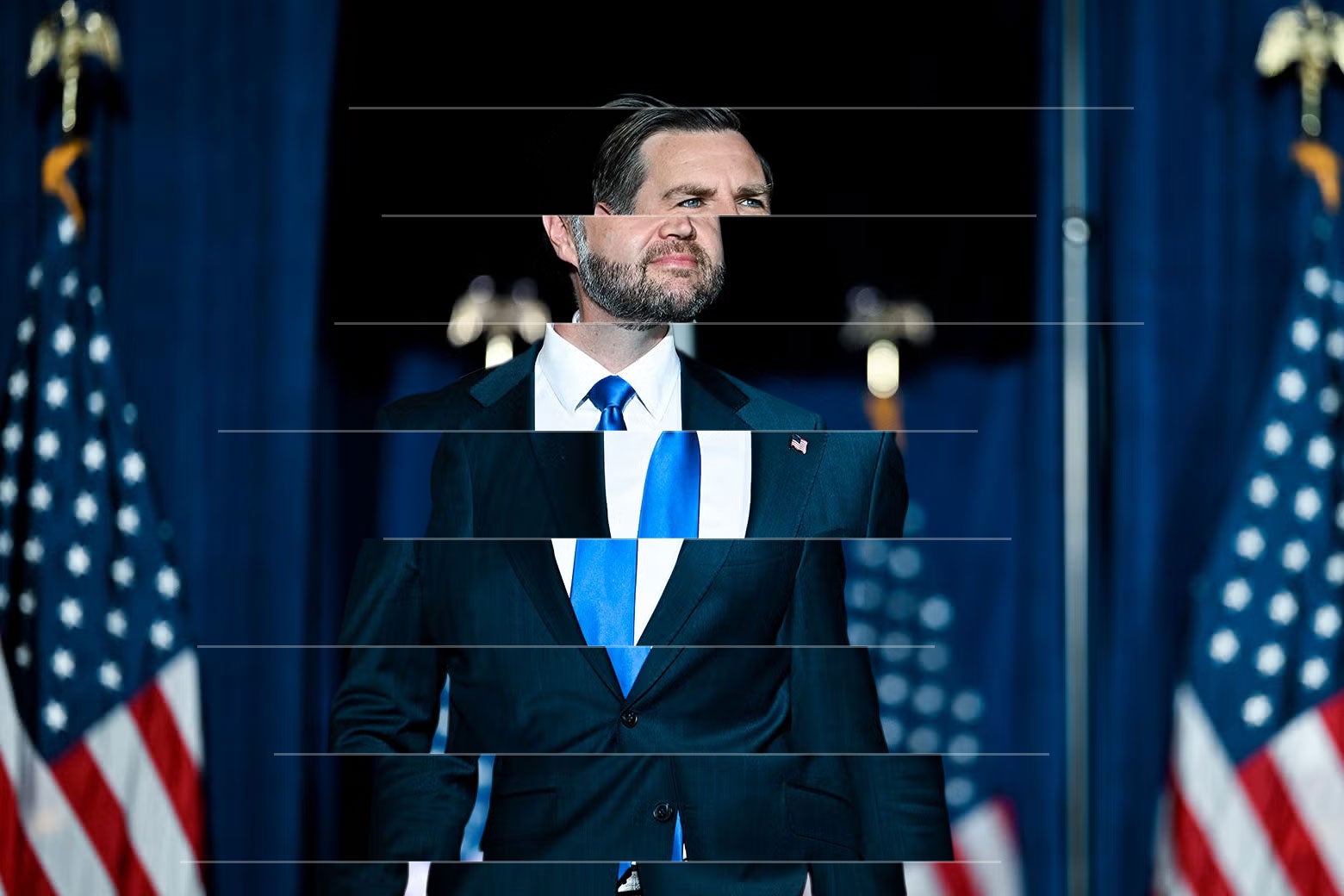
Politics But up close, it becomes clear just how easily he could lose it. By Enter your email to receive alerts for this author. Sign in or create an account to better manage your email preferences. Unsubscribe from email alerts Are you sure you want to unsubscribe from email alerts for Molly Olmstead? Nov 24, 20265:40 AM Photo illustration by Slate. Photo by Kenny Holston/Pool/Getty Images. Sign up for the Slatest to get the most insightful analysis, criticism, and advice out there, delivered to your inbox daily. The signs were there, even before the election, that J.D. Vance was not going to just cruise to a 2028 nomination. On Oct. 27, dozens of Michiganders had gathered at a rally an hour outside Detroit to hear Vance and Mike Rogers, the state’s Republican Senate nominee, make their final pitch for their party. The event was held in an airplane hangar in Howell, the seat of a county that had gone for Donald Trump by almost 24 points in 2024 and that would, days later, vote for Rogers by 20 points. This rally crowd was full of GOP stalwarts; Howell is a heavily white city in Michigan’s automotive country. In other words, this was Vance’s ideal audience—a setting where he could really hit his lines about shuttered factories and his buddies who had lost jobs, the “casualties of politicians in a faraway place who didn’t give a damn what happened to Michigan or Ohio,” as he would say later that day. And yet, the crowd did not seem particularly fired up for Vance. “I like him just fine,” a 61-year-old local named Jerry said while waiting in line to get into the event. “I don’t have a real strong opinion on him. But, um, everything I’ve seen or heard from him, I support.” No one expects Vance to rally a crowd the way Trump does, but the energy barely even changed when the event started. It did not feel like a party. The music was not thumping. There was no chanting. At one point, when an event official started tossing out red MAGA hats in an effort to get the crowd excited, will.i.am’s “Hall of Fame” playing in the background, fewer than a dozen people put their hands up. It had all the energy of a high school assembly. And that was before the midterms drubbing. On the other side of these November elections, Democrats beat Republicans in every conceivable way—retaking both chambers of Congress and flipping seats and states that were assumed red. Now the Republican Party has less than two years to find its new identity, and Republican intellectuals have begun to get panicky. Who is even capable of reconfiguring a new shape to the shattered GOP coalition? Well, maybe J.D. Vance. In many ways, the 2028 nomination remains his to lose. He has the biggest name recognition. He remains the vice president. He just needs to figure out how to become a leader who will maintain the loyalty of MAGA while also reclaiming and invigorating the wayward GOP. The question isn’t really whether he can transform himself. He can. Vance has been reinventing himself the entire time he has existed in the public eye—a relatively condensed period, given his youth. In the past decade, he has gone from “hillbilly” whisperer to Never Trump pundit to MAGA senator to New Right philosopher and edgy Trump attack dog. Each of these versions pulls alternatingly from his working-class origins and his Ivy League intellectual interests. But the various Vances don’t always blend well together in terms of political messaging. In combining them, he weakens each part of himself, and ultimately, he often seems to represent nothing. The question is instead whether he can create something that finally sticks. With his post on X the day after the midterm elections blaming the losses on the war in Iran, Vance indicated his new evolution, out from under Trump’s shadow. But what will emerge from there? Will this next version of Vance work, and last? Or will he finally face the consequences of his constant reinventions? That day in Michigan, Vance offered a tour of what he has been—and where he might go next. When Vance took to the stage that day in Howell, about an hour earlier than scheduled, he opened with a tidy anecdote about his 6-year-old son calling Michigan “the M-word” because of the state football rivalry with Vance’s alma mater Ohio State. “I have a very broad vocabulary of curse words, ladies and gentlemen—I’d never heard the M-word,” he said, to laughs, the practiced everyman. That was a nod to the earliest version of Vance, back when the American intelligentsia first learned to love him as a translator for the white working class. With Hillbilly Elegy, which was published in 2016, Vance had written with some sophistication about how poor white Appalachian Americans had come to resent institutions and about the ways white workers in the Rust Belt floundered in the wreckage of the industrial economy. Since becoming a politician, Vance has quashed the elements of Hillbilly Elegy that were critical of the white working class itself (he had called the young white men of his hometown “lazy,” as well as “consumerist, isolated, angry, distrustful”) and played up the very grievances (against President Obama, Democrats, and factories moved abroad) that he had once derided as petty excuses. Can Vance’s grown-up hillbilly act help him connect with voters now? In theory, it should. At least one attendee, a man named Scott, told me that he had come to the event specifically to see Vance. “I just—I feel like he relates to all of us, you know, common folk,” he said. But there’s something odd to how Vance speaks of his years among the industrial-town poor. In 2016, when the book came out, he was already a Yale-trained lawyer who had worked in Washington for a white-shoe law firm and in Silicon Valley as a venture capitalist. A decade later, he stood before the audience in Howell in a suit and tie, with more years and significantly more experiences separating him from his working-class origins. It may be that it doesn’t really matter what kind of class background a candidate has. Trump, after all, captured the hearts of the white working class while bragging about his own riches. What MAGA seems to care more about is the working-class attitude—something, as Vance himself described in Hillbilly Elegy, that amounts to a kind of unfiltered authenticity. And unfortunately for Vance, he reads striver all the way. Part of the hollowness of his presentation may have something to do with Vance’s blatant revisionism. In the speech, Vance recalled his childhood playing peewee football with white and Black working-class children, “never worrying about the color of our skin or our privilege—we were all privileged to live in the United States of America.” He remembered that the team’s jerseys were sponsored by local businesses, and “your jersey would bear the name of a place where you’d go with your grandma for ice cream or where your friend’s buddy, his dad, worked.” The point was to stir nostalgia and longing for an America past: Those businesses had all folded, victims of callous economic policies. But the “hillbilly” we first met didn’t idealize his childhood; he wrote of the trauma of poverty and violence, of unpredictable father figures, of rotating homes and caregivers, of his mother’s drug addiction. Nor did he fantasize, back then, about a kind of Leave It to Beaver–esque version of life. He wrote critically of American society being built around “the modern WASPy nuclear family,” for example, arguing it failed to account for the bigger and messier kinship networks in his community. A reader might disagree with the Vance of Hillbilly Elegy, but he at least seemed to be honest. Now he wants to will the public into remembering his book as a love letter to Ohio and the good ol’ days and a screed against factory owners and East Coast elites that it very much was not. At one point, in Howell, Vance described the Middle East as “a region of the world made up of countries whose name I couldn’t even pronounce.” To read this charitably, he meant he couldn’t pronounce those names back when he was 17. But even so, to hear it coming from an Ivy League–educated lawyer and the current vice president, it sounded offensively pandering. Afterward, I asked attendees what they had thought of Vance’s speech. One couple did mention him being down-to-earth, but most took away a different message. Most others spoke of him being “classy” and “presidential”—positive terms, to be sure, but not the words you’d choose for someone you’d want to get a beer with. That might be a problem for Vance in a campaign, given that he might just need something special in his personal brand to set him apart from, say, Marco Rubio, his presumed closest competitor. And already, there are reports that Trump is frustrated with Vance over his critique of the war in Iran. Trump has begun to punish Vance for his independence, pulling him off negotiations with Iran right after Vance’s post about the election. Vance will need to find something to fortify him against the consequences of breaking from Trumpism. It would make sense for him to try to use his working-class roots here—but his performance in the neighbor to his home state revealed that they may now be too sanded down to be of any real use. The second version of Vance that he trotted out that night was Vance the intellectual. Frankly, this might be his most natural state. Since his law school days, Vance has been a man who, unlike Trump, enjoys debating ideas and writing essays. Vance can quote philosophers and theologians. He converted to Catholicism largely because of its intellectual tradition. (He wrote as much in his latest book, Communion, which was all about his religious conversion.) He is close with his former mentor Peter Thiel, the tech oligarch, and has immersed himself in the experimental, reactionary ideas batted around by certain Silicon Valley elites. (Thiel, for example, has recently held a series of bizarre lectures on the topic of the antichrist.) Vance plays stupid on occasion, but there’s no question he feels at home among an ideas crowd. The problem is that intellectual Vance doesn’t really play on the campaign trail. So, instead, he tries to make himself into an anti-intellectual populist in Trump’s mold. This fall, he dabbled in insult comedy, calling then–Senate candidate James Talarico gay and a Washington Post writer fat. In his speech in Howell, he railed against the elites, whom he blamed for the Rust Belt’s woes. “In 2024, this town and the whole state of Michigan sent a message to Washington: We are sick of being ignored, we are sick of being left behind, and we are going to put America first for a change,” he said. But he doesn’t have Trump’s raw talent when it comes to schoolyard bullying, and it’s clear he can’t resist letting out, on occasion, a Big Idea. Less than 10 minutes into his speech at Howell, Vance started talking about how, “if you think about it, at its heart, our movement is about sovereignty.” For people like Vance, there’s something apparently irresistible about chewing on the meaning of an uncommon or old-fashioned conceptual noun. Never mind freedom, a boring word. Sovereignty makes you think of old-world splendor. The problem is that going on about sovereignty is also really annoying. Indeed, most of Vance’s nativist ideas, backed by too-online pseudo-philosophy, can be more off-putting to regular people than Trump’s casual, plain-speaking racism. It’s not that Vance isn’t being racist: Whether he’s talking about the idea of “heritage Americans” or “sovereignty,” what he means is that immigrants and people with non-Western values or from non-Western cultures are posing an existential threat to the country. He called the Senate race “a proxy fight over whether America can be truly sovereign.” But it just doesn’t land. He had brought his think tank–friendly persona to the regular people of Livingston County, Michigan, and judging by their muted reactions, they were not particularly energized by it. To be clear, Vance does benefit from having his elite allies. Thiel essentially bankrolled his Senate campaign, for example. But these relationships can get in his way, at times. He has become vulnerable to attacks from people who see him as far too cozy with the tech world. And, notably, his openness to talking with certain anti-Israel types has upset people who worry that the GOP is allowing white nationalists and neo-Nazis into its tent. And worse, these associates from Vance’s intellectual side haven’t even rallied behind Vance, post-midterms. They have mostly concluded that Trump is in a bad spot and that MAGA needs to evolve or die. A few praised Vance’s postelection X post, but none have said Vance is clearly the man to lead the next version of MAGA. “I am still a Vance partisan,” Thiel said in September. But, he caveated, “I worry that it will be very hard for either [Vance or Rubio] to win.” This might all be worth it if being the smartest guy in the room were more central to his brand. But Vance has downplayed that during his vice presidency, often to take on the persona his boss prefers (bully). And so when we see Vance addressing policy debates, it’s often in odd think tank settings, where he feels free to let his wonkiest internet politics fly. In his post announcing that Vance would not be handling the Iran negotiations, Trump instead directed him to focus on crime and alleged corruption in blue states and cities. In other words, he relegated him back to the role of MAGA culture warrior. It won’t let him flex his intellectual side. Vance will have to decide, in the next two years, how much to fight this role—or how much to lean into Trump’s anti-intellectualism. If he decides to push to show his academic side, he’ll have to prove he can speak to important policy matters, beyond the internet-niche. At the very end of his Howell speech, Vance teased his final turn. “What Mike has done in this campaign, sometimes he has said things that have been independent of the administration,” he said. “And a lot of people have said, ‘Does that make you mad at Mike Rogers?’ And I say, absolutely not, because I don’t want, in Mike Rogers, a servant for the administration; I want, in Mike Rogers, a servant for the people of Michigan.” That shouldn’t be an extraordinary sentiment, but it is in this GOP. It established that Vance isn’t pushing total loyalty to Trump. It showed that Vance has a grasp of the actual populism that has swept through the country this year—and that he’s willing to empower the people. So far, he has done this by hinting at his displeasure with the war, in leaks to the press and in his statement on X. He has hinted at his belief that the public doesn’t support Israel as much as others in the administration would think. It seems as if he is reading the room. The problem is that reading the room and reflecting back priorities is not what Republican voters have come to expect from their politics. A decade of Trump has trained them to crave excitement, validation, and emotional jolts from their leader. There’s no excitement in Vance’s speeches, and there’s no ease to Vance the way there is with Trump. In fact, at the start of the event, reporters were barred from talking to members of the public, even at a public airfield—a sure sign that Vance does not feel comfortable releasing control. Vance will not have an easy time with what is coming next for him. He may know how to slip through personas to accumulate power, but that has landed him in the odd place of having no core sense of himself as a politician. After the event, away from the moratorium on questions, I asked more than a dozen people what they thought of Vance’s speech. Almost half described Rubio as their preferred candidate, or as an equally valid alternative. The problem for Vance is that I had never brought up Rubio’s name once. Donald Trump Ohio Republicans Michigan Marco Rubio J.D. Vance 2028 Campaign
The Republican Nomination Is J.D. Vance’s to Lose. But Up Close, His Biggest Challenge Is Obvious.
Full Article
Original Source
Read the full article at Slate →KhanList aggregates and links to publicly available news content. We do not host full articles from third-party sources. Always verify important information with original sources.