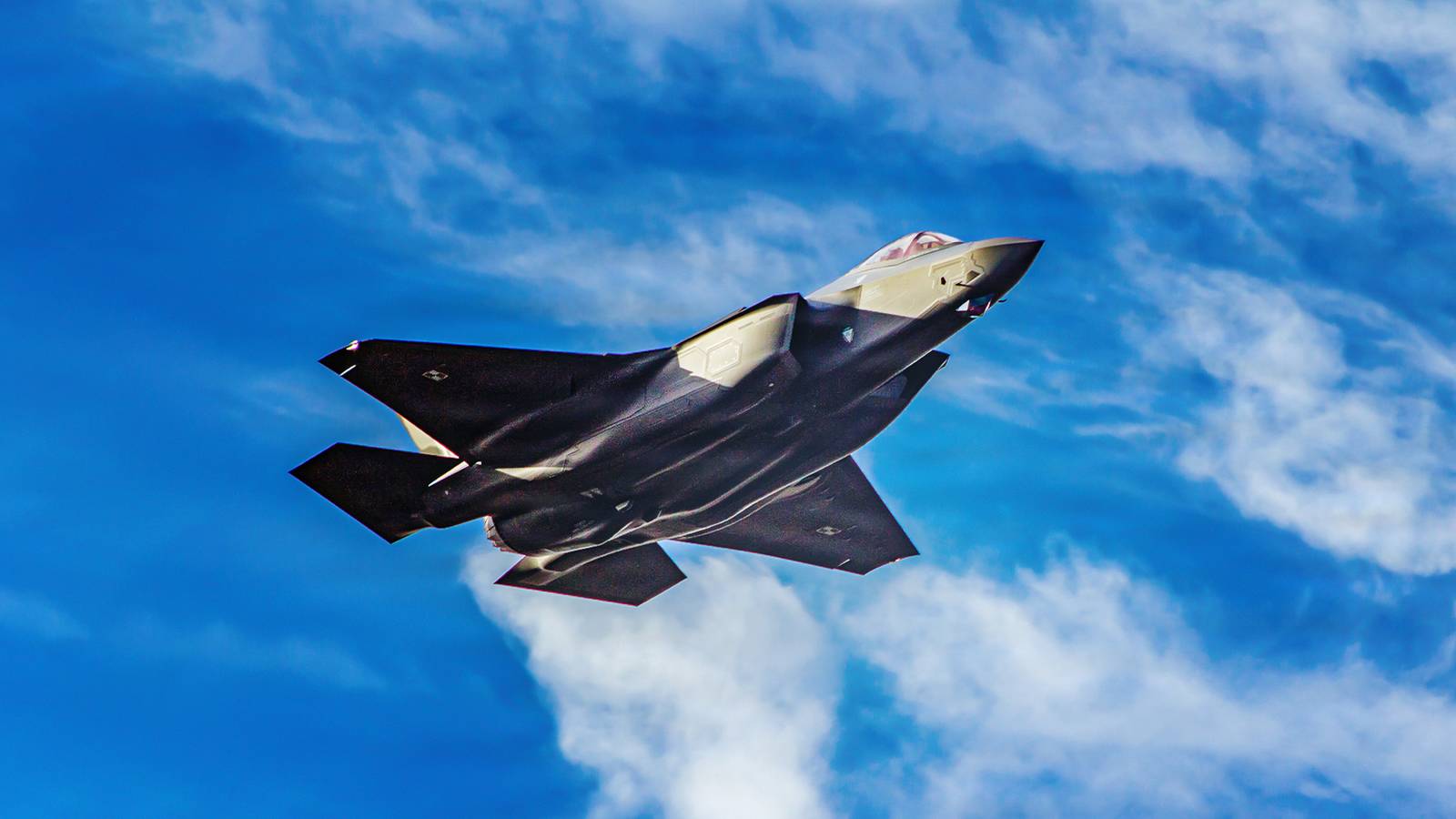
Published Jul 29, 2026, 12:00 PM EDT Luke Diaz is a freelance military writer with experience with active duty experience in the US Navy as well as defense and industrial engineering. He is a former Naval Flight Officer who performed tactical air control on the carrier-based E-2 Hawkeye. While the Lockheed Martin F-35 Joint Strike Fighter has always been a multinational program, the 19 international allies that fall under foreign military sales do not quite have all the same privileges as the United States. Even the United Kingdom, which is the only Tier One partner in the entire program, cannot perform maintenance on heavy radar-absorbing material due to the complexity of the technology, proprietary rights, and weapons export laws. Unlike earlier stealth aircraft, the F-35 Lightning II does not have a simple coating of RAM paint on top of its skin. Instead, the actual radar-deflecting qualities are 'baked in' to the composite materials that compose its exterior surfaces. LM essentially holds the only right to perform anything beyond superficial repairs to the complex radar absorbent structures. The federal government and LM also use classified diagnostic tools with exclusive software and limited access that are not shared with the other 19 member nations of the joint program. The Defensive Stance Against Industrial Espionage Credit: US Air Force The radar cross-section of the F-35 is essentially its most valuable attribute as a fifth generation fighter jet. Due to that fact, its RAM technology sits at the center of a fierce, high-stakes intellectual property dilemma that leaves global operators feeling sovereign control has been unfairly stripped away. The very breakthrough that makes the F-35's RAS so revolutionary is also why it has become an adversarial flashpoint over IP rights and technical autonomy. The JSF's RAS is a fibermat RAM baked directly into the multi-layer composite skin of the aircraft. Because the RAM is structural, the aircraft minimizes the use of distinct panels, seams, and steps that traditionally catch and reflect radio waves. These structures are meticulously tuned to match the wave impedance of a wide range of adversarial integrated air defense radar wavelengths. This drastically reduces the fighter's overall RCS. Ultimately, the US government's refusal to share RAS data is intensely driven by a history of security breaches. State-backed hackers of the People's Republic of China allegedly extracted up to 50 terabytes of data from the F-35 program, including classified information such as skin heating maps and radar cross-section profiles. Elements of this stolen IP are believed to have been mirrored in design updates on Chinese fifth-generation fighters like the Chengdu J-20 Mighty Dragon. As a result, even though international partners invested billions of dollars to co-develop the JSF, the US Joint Program Office and LM retained strict ownership of the core technical data. The Suffering Sales Of America's Stealth Fighter Credit: US Air Force Several major nations have backed out of, indefinitely delayed, or drastically scaled back their F-35 procurements specifically because they refused to surrender their national sovereignty to the United States' strict intellectual property locks over RAM, internal systems, and software. While some countries ultimately compromised due to a lack of other fifth-generation options, others chose to walk away entirely, including Spain, Turkey, and India. Meanwhile, other partners have drastically reduced their total orders, such as the United Kingdom, Switzerland, and Canada. The F-35 program has also faced consistent backlash for deficiencies since its debut. The technical roadblocks have persisted through last year with the infamous Technology Refresh 3 Block 4, which the Pentagon found to be so severely lacking that it added zero new combat capability to the global fleet. Problems with the aircraft over the years have seen readiness levels plummet to as low as 25% at times. The latest package of upgrades is now delayed by 6 years, with the full upgrades expected in 2025, now delayed until 2031. The Air Power Conundrum For US Allies Credit: US Air Force Since international operators pay strict premiums and carry no software sovereignty, these compounding delays have sparked bitter diplomatic friction and forced governments to rethink their deals. As a Tier-1 partner, the UK's frontline combat air strength is heavily dependent on the F-35. Originally anticipated to procure as many as 138 JSFs, it is unlikely that the UK will purchase any more after the next 12 F-35As are delivered, which, added to its existing fleet of 47 F-35B jump jets, puts its total at 59 - less than half of the original fleet number. Similarly, Switzerland found itself locked in a diplomatic dispute over the Patriot missile funding, which spilled over into its F-35 contract. After the political disagreement was resolved, the Swiss Air Force now finds itself paying a significantly inflated bill for a reduced number of aircraft. It is unlikely that funding will be raised in order to procure the full 36-strong fleet, and it will likely stop at purchasing just 30 F-35As. Meanwhile, Canada is still in limbo over how to proceed with its $19 billion contract for 88 jets. Canadian leaders have repeatedly threatened to scale back the purchase or go with alternative platforms like the Saab JAS-39 Gripen E. In response, the US government issued blunt diplomatic warnings that if the Royal Canadian Air Force backtracks on its order size, the US may alter the NORAD defense alliance and fly American F-35s over Canadian airspace, according to the CBC. Paying Premiums For Watered Down Fighter Jets Credit: US Air Force A major contributing factor that makes this situation highly volatile for international partners is the extreme asymmetric pricing structure applied to foreign buyers. FMS buyers must pay exorbitant, separate fees for the infrastructure required to host the aircraft. The first eight founding partner nations that helped fund the early development stage of the JSF pay a lower amount than direct FMS sales, but they still face the same restrictions as non-US operators and pay an inflated price for each F-35. Lockheed charges significantly higher margins for foreign integration. This includes paying hundreds of millions of dollars extra for customized secure hangars, US-approved diagnostic tooling, telemetry devices, and training simulators. Specifically, the aircraft is fundamentally tethered to a digital and mechanical leash. In the absence of constant replenishment, an F-35 fleet will be completely grounded within weeks due to the high maintenance toll of stealth operations. This arrangement ensures that an FMS partner can never legally or practically deploy the F-35 in a conflict that directly opposes Washington’s strategic goals. The current state of affairs has left many JSF customers in a frustrating paradox. They have purchased the most lethal fighter jet in human history, but they have done so by sacrificing their own independent defense sovereignty to the Pentagon. Locked Out: Sovereign Subservience Credit: US Air Force The F-35 program operates on a Global Support Solution. Under this, foreign nations do not directly own warehouse stockpiles of specialized RAM coatings, replacement parts, or proprietary components. If the US were to lock out a partner nation from the resupply network or software updates through the operational data integrated network, their 'exquisite' stealth fighter would be totally useless. For FMS operators, the inability to touch the stealth skin is compounded by the heavily restricted 'black box' avionics systems and persistent, credible fears of a remote US 'kill switch.' If an FMS nation acts against US foreign policy interests, Washington can instantly freeze their parts pipeline. Because the black boxes require continuous software authentication, cryptographic keys, and updated mission data files to function effectively in a modern conflict, the US can simply refuse to push critical software updates. This financial and strategic frustration is amplified by geopolitical double standards. Israel negotiated a highly unique exception for its F-35I 'Adir' variant. The US permitted Israel to install its own domestic electronic warfare architecture outside the standard black boxes and granted them a degree of independent depot-level maintenance autonomy. Other high-paying FMS allies look at the Israeli concessions and feel deeply slighted, as they are denied the same structural and digital sovereignty despite paying the same, or higher, per-unit costs. Israel's Unique Insider Access Credit: US Air Force Israel leveraged its historic defense-sharing agreements and a mandate from the US Congress to carve out specific exemptions that no other nation possesses. Israel’s 'special deal' with the United States regarding the F-35 is entirely unprecedented and stands as the only exception to the absolute control the US and LM maintain over the aircraft. While top-tier allies like the UK, Japan, and Australia are legally and digitally locked out of the jet's code, Israel secured a customized variant that grants them unrestricted freedom. The most highly guarded 'black box' in the standard F-35 is the BAE Systems electronic warfare suite. Israel was permitted to bypass this and install its own locally developed EW system created by Elbit Systems. While other countries must send their mission data and threat libraries to Eglin Air Force Base in Florida to be compiled and verified by the American military, Israel is uniquely permitted to write its own software additions. Lockheed Martin modified the central computer architecture to create an open-architecture layer. The Israeli Air Force is also not restricted to the tightly controlled maintenance and overhaul network with just three sites in the world. The US Air Force bomber plant is the core facility where the most sensitive work is done, but there is a final checkout assembly line at both Cameri, Italy, and Nagoya, Japan, where the partner nations around the world send the planes for heavy maintenance checks. Declining to use any of these facilities, the JPO conceded that the IAF is permitted to operate an independent D-level depot at Nevatim Airbase in Israel. This enabled the IAF to fully integrate the new stealth fighter into its domestic defense industrial base and modify it with plug-and-play interfaces that allow for the installation of Israeli-made weapons. The IAF was also permitted to develop its own conformal fuel tanks to enable its aircraft to perform penetrating deep strikes in contested airspace. No other member nation in the JF program has equivalent autonomy to the unique privileges granted to the IAF.
The Real Reason Why F-35 Operators Can't Restore Their Own Jets' Stealth Alone
Full Article
Original Source
Read the full article at Simpleflying →KhanList aggregates and links to publicly available news content. We do not host full articles from third-party sources. Always verify important information with original sources.