
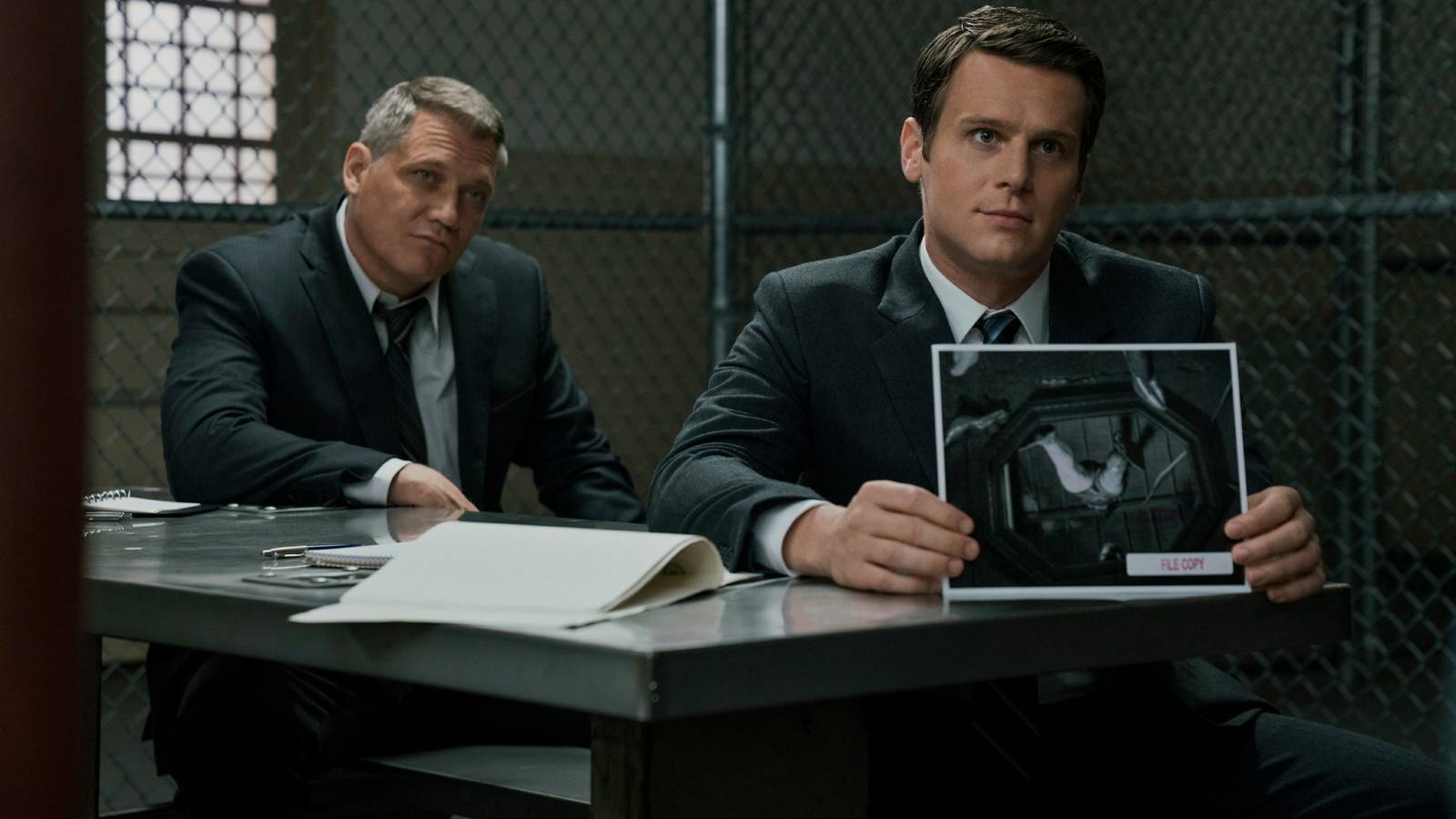
Published Nov 23, 2026, 1:06 PM EST Abdullah Al-Ghamdi joined Screen Rant in August 2019 and is now one of the leading contributors of the TV News team. Having written over 4000 news stories in that time , with his work cited in Buzzfeed and TV Insider, he's always bemoaning that there's too many shows and not enough time. You can contact him at: aalghamdi@hey.com. Sign in to your ScreenRant account David Fincher is finally opening up about why Mindhunter season 3 never happened. Fincher, the director behind classics like Fight Club and Se7en, made headlines late in September when it was revealed that he would not be renewing his overall deal with Netflix. The deal is set to expire next year, bringing an end to a run that has seen Fincher bring films such as Mank and The Killer to the streamer, as well as the upcoming Upon a Time in Hollywood sequel, The Further Mis-Adventures of Cliff Booth. Fincher has also had a major role in helping to shape Netflix's television output, beginning as the executive producer of House of Cards. The three-time Oscar nominee directed the first two episodes of the political thriller, helping to set the visual style for one of the streamer's earliest hits. He was also a major driving force behind the acclaimed anthology Love, Death & Robots. It could be argued, though, that Mindhunter has proven itself to be the enduring favorite out of Fincher's Netflix Originals. During an interview on the Happy Sad Confused podcast to promote The Further Mis-Adventures of Cliff Booth, which releases exclusively on IMAX on November 25, Fincher spoke in detail about why a third season of the crime thriller Mindhunter never happened. The director begins by looking back at Mindhunter season 1 and its difficulties. In the quote below, as well, Fincher is frank about the script challenges that occurred during season 2 and included throwing away much of what had already been written: "While we were doing the first season, we were going, 'Okay, we can't do this anymore. Dave, you can't be the showrunner, it's too much work.' That show was a 90-hour work week, [even] when I wasn't directing. That first season was a cluster—k. [For season 2], we were finding our way, we were trying to figure out the scripts and trying to get the stories and really make Pittsburgh work for us in the 1970s. While that was going on, we hired a showrunner that Netflix really liked, had a great reputation. I read a couple of his scripts and he went to work and he supervised a team of writers and they wrote eight or nine scripts for the second season. I was so up in it in Pittsburgh that I didn't get to read until I got back to LA and I was starting to cut the first season. I read these scripts and I threw them away. It was not our show. So then, it was a mad scramble of, 'Okay, we're starting over, we've got to get eight to ten.' I wanted to have 10 in my pocket before we started shooting. I think we got eight, and it was the same kind of cluster—k. Throwing those scripts out cost us almost a year." The candidness of the Gone Girl helmer's response continues, as he talks about how Netflix approached him about how to broaden the appeal of Mindhunter as a counterbalance to its budget of $100 million per season. Fincher mentions in particular that he was asked if he could bring the series closer to the style of CSI, the well-known CBS procedural franchise, and shares how he responded: "So now, we had a show that was not coming back in 18 or 19 months. By the time we were getting to season 3, it was pretty obvious it was going to be the same thing. It might have been longer, I think it was 24 months. That's when Netflix said, 'Look, we got to be honest with you, there are 2 million people who love the show. And the show costs $100 million a season, and it's basically guys with styrofoam cups in their hands sitting at stainless steel tables getting the rundown. Is there anything you can do so this audience can grow?' I said, 'What do you mean?' They said, 'I don't know, will they ever run after somebody with a gun in their hand?' I said, 'No, no, that's not what it is.' They were like, 'We get it, but we have to ask. Can you make concessions to get closer to CSI?' I said, 'No, I can't. I won't. And I don't think you really want me to.' And they said, 'We don't, but we don't know how else we are going to grow this.'" Fincher ends with the question of whether Mindhunter could ever be brought back, detailing why a revival would be unlikely. As an example, he turns to his experience working on House of Cards as a show that drew more of an audience than Mindhunter's bumpy two-season run: "So, every time somebody says to me, 'Can't we bring that back?' I said, 'Here's what I need you to do. You need to go out, you need to make 10 million friends, and you need each of them to send me $10, and then I'll do it.' Look, I love the fact that people finally love the show. Things have a time and a place, and the best-laid plans led to not an optimal delivery system or schedule. Getting off on that wrong foot put us on the wrong foot for the second season. We were very close to being quadriplegics by the third season. I just said 'I don't understand what those concessions would be that would grow an audience from two million to 10, 12? What does it need to be?' I think at our highest point, House of Cards had seven or eight million [viewers], and that begins to justify the cost." Some of the troubles regarding Mindhunter season 3 were known before these most recent remarks, including its high budget relative to viewership, but this new interview offers a rare window into why a beloved series, generally regarded as one of the best of its era and in its genre, was quietly put on hold several years ago. Now with Fincher formally making his Netflix exit, it seems unlikely to return. Mindhunter, which starred Jonathan Groff, Holt McCallany, and Anna Torv and spotlighted the beginning of criminal profiling, has nonetheless influenced a trove of other crime shows in the years since. New episodes may be out of the question at this point, but the project's outsized influence is hard to deny. Mindhunter is available to stream on Netflix. Release Date 2017 - 2019 Network Netflix Showrunner Joe Penhall Cast Holt McCallany Bill Tench Directors David Fincher, Carl Franklin, Andrew Dominik, Andrew Douglas, Asif Kapadia, Tobias Lindholm Writers Joe Penhall, Jennifer Haley, Joshua Donen, Courtenay Miles, Carly Wray, Pamela Cederquist Creator(s) Joe Penhall
The Real Reason Mindhunter Season 3 Never Happened Finally Revealed By David Fincher
Full Article
Original Source
Read the full article at Screenrant →KhanList aggregates and links to publicly available news content. We do not host full articles from third-party sources. Always verify important information with original sources.