
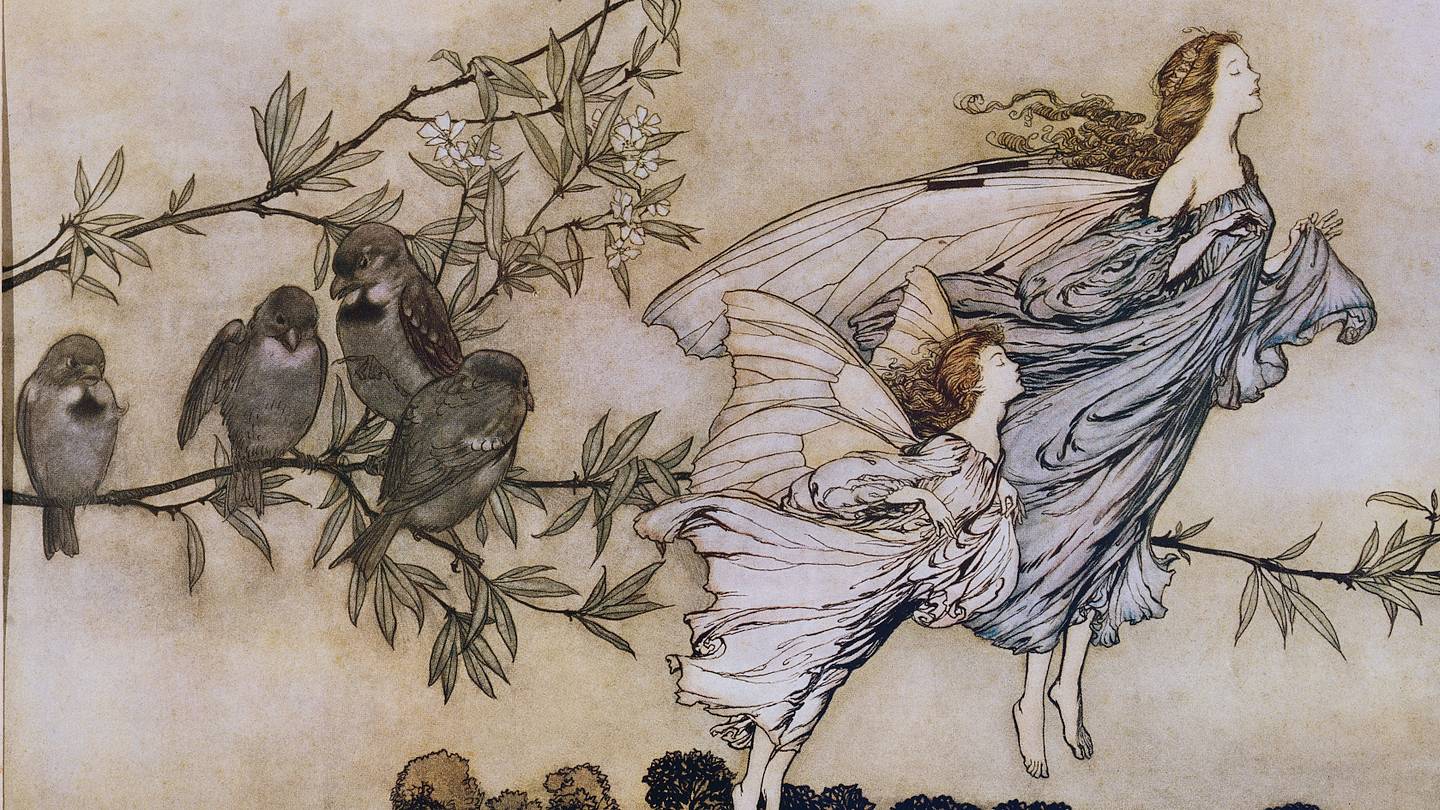
In 1915, a 23-year-old Oxford graduate named J.R.R. Tolkien published a poem called "Goblin Feet" in the annual anthology Oxford Poetry, and it's about as far from Legolas as you can get: it's full of "enchanted leprechauns" and "the padded feet of many gnomes," and he wrote it to please his future wife, Edith Bratt. Tolkien came to hate that kind of fairy so much that when he was asked to let the poem be reprinted in 1971, he reportedly said he wished "the unhappy little thing" could be "buried for ever." In his 1939 lecture "On Fairy-Stories," he called Michael Drayton's fairy poem Nymphidia "one of the worst ever written" and blamed it for the "flower-fairies and fluttering sprites with antennae that I so disliked as a child." Mental Floss has noted that Tolkien took elves from tiny to human-sized, and the material he used to do it was already on his own shelves.Light Elves and Dark ElvesA 1764 Icelandic manuscript depicting Norse mythology, one of Tolkien’s primary inspirations. | Pictures from History/GettyImagesTolkien read Old Norse, and the most famous description of elves in it comes from the Prose Edda, written by the Icelandic chieftain Snorri Sturluson in the 13th century. Snorri describes a heavenly place called Alfheim and splits the elves in two: "The light-elves are fairer than the sun to look upon, but the dark-elves are blacker than pitch," and the dark ones live down in the earth.Tolkien gave his own elves a split along the same line: in his mythology, the elves who made the journey west and saw the light of the Two Trees of Valinor became the Calaquendi, or Elves of the Light, and the ones who never got there were the Moriquendi, the Elves of Darkness. The Tolkien scholar Tom Shippey has argued that this division was Tolkien's way of making sense of Snorri's, with history doing the sorting instead of skin color. The same Norse tradition handed him his dwarves. A section of the poem Völuspá known as the Dvergatal lists dozens of dwarf names, including Þorinn, Fíli, Kíli, Dvalinn, Bömburr, Glóinn, Óinn, and Eikinskjaldi, a name that means the one with the oaken shield. Mental Floss has covered that borrowing, but the list has one more name on it: a dwarf called Gandalfr, which ends in álfr, the Old Norse word for elf.In Old English, Elves Were DangerousTolkien became a professor of Anglo-Saxon at Oxford in 1925, and the Old English he taught didn't treat elves as cute. In Beowulf, the descendants of Cain include "eotenas ond ylfe ond orcneas": giants and elves and a third kind of creature usually translated as something like demon-corpses. An Anglo-Saxon medical charm called Wið færstice, meant to cure a sudden stabbing pain, blames the injury on "ylfa gescot," the shot of elves, among other culprits: the pain could be something an elf had fired into you.They were also beautiful, in a way that made people nervous. Old English had the word ælfscīne, meaning "of elfin beauty" and poets used it for Abraham’s wife Sarah and for the biblical heroine Judith. The scholar Alaric Hall argues that the word meant beautiful in a dangerous, seductive way, and Tolkien seems to have read it that way too: in the 1920s, he wrote his own Old English poem, "Ides Ælfscýne," about someone seduced and carried off by an elf-woman.The Irish Connection He DeniedJ.R.R. Tolkien at work in his library. Though scholars noted strong ties to Irish myth, Tolkien maintained his Elvish lore was entirely original. | Haywood Magee/GettyImagesIn 1937, when Tolkien sent his elf mythology to the publisher Allen & Unwin, the firm's reader complained about its "eye-splitting Celtic names," a story Mental Floss has told before. Tolkien wrote to Stanley Unwin on December 16 with a correction: "Needless to say they are not Celtic! Neither are the tales."The folklorist Dimitra Fimi doesn't entirely buy it. In Irish myth, the Tuatha Dé Danann are a semi-divine people who arrive in Ireland by ship, burn their ships so there’s no going back, and win their first battle at a cost that includes their king Nuada's arm. In The Silmarillion, the rebel elves called the Noldor sail to Middle-earth, burn their ships on arrival, and win their first battle, and one of their leaders, Maedhros, is later hung from a cliff by his hand until it has to be cut off to free him. The Tuatha Dé Danann were finally said to retreat into ancient mounds or to lands across the sea, and Tolkien's elves end their story sailing west. In that same letter, Tolkien admitted he knew Irish and Welsh stories "in their original languages," said they were "mad," and added, "but I don’t believe I am."Read More:
The Real Mythology That Helped Inspire J.R.R. Tolkien's Elves
Full Article
Original Source
Read the full article at Mentalfloss →KhanList aggregates and links to publicly available news content. We do not host full articles from third-party sources. Always verify important information with original sources.