
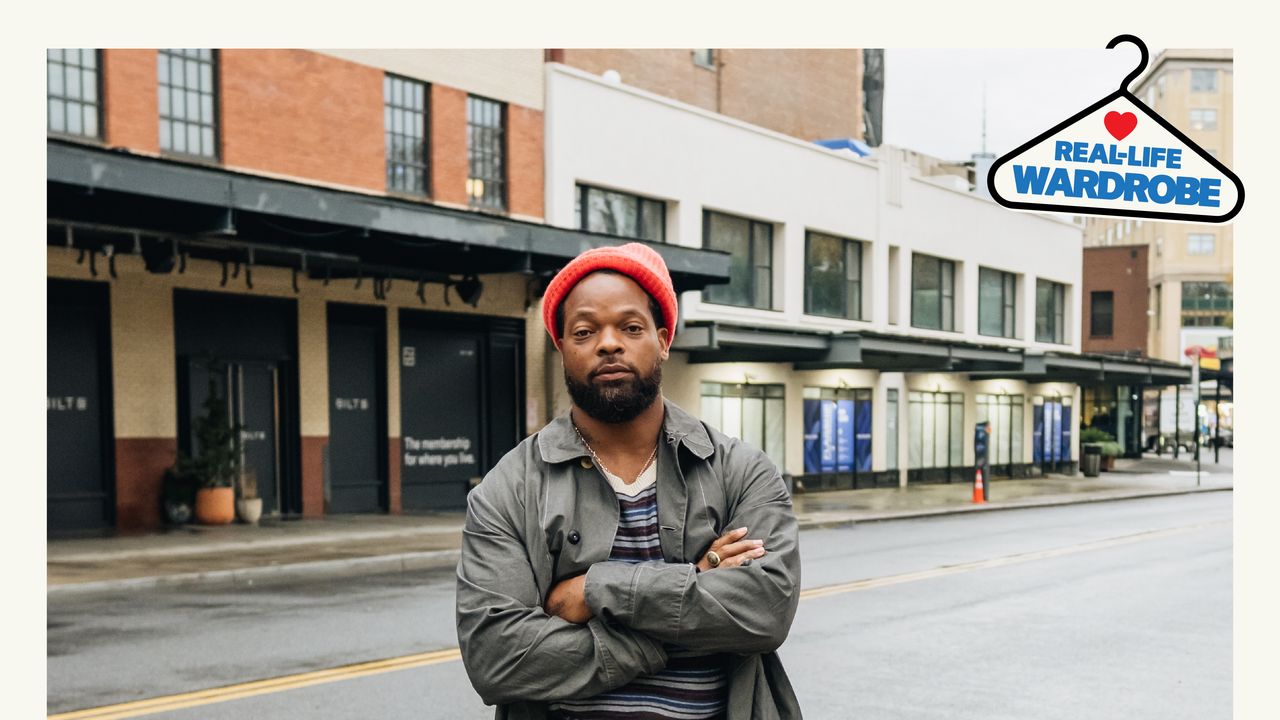
The former Legion of Boom member on going back to school after retiring, the politics of architecture, and why tunnel style is “terrible.”When you’ve won a Super Bowl ring, made three Pro Bowl appearances, and played a key role on one of the most dominant defensive squads ever—the Seattle Seahawks’ 2010s-era Legion of Boom—what do you do next? For Michael Bennett, the answer was to head back to school.After completing his 11-year NFL career in 2020, the 41-year-old enrolled at two institutions—the University of Hawaii and Seattle’s Heritage School of Interior Design—to study architecture and interior design, respectively. “I’m a student of whatever I do,” Bennett tells me. “My best quality—and probably my worst quality—is that the things I love to do, I try to become the best. I play tennis five days a week. I’m trying to go to Wimbledon. And design and architecture are like that.”All that effort is paying off. Through his design practice Studio Kër, Bennett debuted an 11-piece collection of avant-garde furniture inspired by the African diaspora in 2024, which was well received by critics. He’s now hard at work on his sophomore line, alongside a spoken-word album and the occasional bespoke garment.That last side quest should come as no surprise, because Bennett has some of the most distinctive personal style I’ve ever seen on a pro athlete–current or former—with a particularly clean headwear and accessories game. Here, Bennett tells me all about the skills he carried over from football into his new career, what fatherhood has taught him about masculinity, and the song he listens to every day.GQ: You played in the NFL for 11 seasons, most famously as a member of the dominant “Legion of Boom” Seattle Seahawks team that won the Super Bowl in 2014. Why did you choose to step away when you did?Michael Bennett: I’ve been playing football my whole life, man. After winning so much, I dug deep. I had already conquered the body. How do I conquer the mind? At what point am I being selfish? I’m missing so much of my kids’ lives. I’ve already been to the highest of the high. Am I going to leave my family with a broken man? That was really the question. Am I chasing ego or am I chasing something else? In reality, a lot of us are just chasing the ego, to be remembered, scared of the death of what [your life] was rather than [embracing] the growth that can be.You’re an author, you lead philanthropic efforts, you frequently speak publicly on a wide range of topics. You spoke to GQ in 2018 about wanting to be taken more seriously. I’m wondering if your public perception has changed enough for you, and in what ways you still have to subvert expectations to make your voice heard?People want to keep others in a certain box because that’s the way that they understand them. That’s in any relationship. If you started to date somebody when they’re 20 and you turn 40 and they start to change, you’d be like, “You used to like your eggs like that.” People don’t allow others to transition; won’t allow people to actually experience growth. Often you’re meeting people in a time where they’re just starting to learn who they are. Over time you start to really develop who you are.The truth is it doesn’t matter if people take you seriously, [as long as] you take yourself seriously. What are you doing to practice your craft? Artists are like, “Oh, my practice, my practice.” I never really understood what that meant until I started doing my own practice. I practiced on the field and I can practice the body. But really, if you want to be taken seriously intellectually, then you have to practice the mind. Sometimes practicing the mind is also connected to the body. In football, yeah, you are connected to the mind in a certain way. But it isn’t always like learning to be a lawyer or an architect or an artist—to be a thinker, you’re doing something completely different. And it’s just allowing yourself to transition. Man, truthfully, you got to say fuck everybody.Football is so complex, though. Obviously, people are literally smashing into each other physically, but it’s an intellectual pursuit. My mind is always blown when I’m watching how many people are coordinating on the field with detailed plays and calls.I think it’s one of the most intellectual sports in general. Tennis is one of those sports where it’s about the angle, the quick twitch. You’re by yourself. With football, it’s the amount of moving parts. People overlook the amount of detail that it takes to run a team—practicing and going through a play 3,000 times before you actually get it. The best players I ever met were the smartest when it came to the sport. They were the PhDs of their craft.You’re the father of three daughters. What has that experience taught you?It’s taught me vulnerability. It made me a better human. In some ways, my daughters have allowed me to mature. The sport of football requires so much masculinity. I’m not saying that all masculinity is toxic, [but] it’s more about, how do you hunt but still be gentle? The true samurai doesn’t strike, but knows he can.What my daughters have allowed me to do is develop my whole humanity. To have a daughter is so special—women are very special. As an athlete, people come back from injuries, but to see a woman come back from giving birth is a whole other level of love. My daughters have been my greatest accomplishments in my life. I never made a Super Bowl trophy. There’s always another winner. But there’s only one Peyton, there’s only one Blake, and there’s one Ollie. As a maker, those are the most special things that I could make.You went back to school and now have your own design studio. Why did you choose to pursue architecture and design? What sort of perspective are you hoping to bring to the practice?In 2019, I was really into Booker T. Washington and W.E.B. Du Bois and [their debate over] the “Talented Tenth.” [Booker T. Washington believed that] intellectualism should never get away from the idea of making. I got into design because I’ve always been involved in politics, and politically, I started to realize that everything came down to design.Shirt and pants by Studio Kër. Shoes by Collegium. What do you mean by that?Whenever I spoke out about police brutality or on critical issues in America, that was really where I started to think about design as this language—this form of resistance. How can I change the system? It starts with design. Where I grew up, a non-gentrified area that was low income, it’s like you could see that there was no empathetic way of thinking about design. The definition of architecture for me is empathy for space. That’s what led me to this idea of these African diaspora forms and languages that I will use as my form of resistance.Are you working on any new projects with Studio Kër right now?I’m working on a new collection of furniture. The first collection I did was called “We Gotta Get Back to the Crib,” which to me was really about getting back to the essence of Blackness. A lot of times we talk about Blackness and it’s always connected to traumatic experience. But to me, it was more about how can I connect to these true levels of love, these things really shaped my culture, my family, my mother, my grandmother, and everything that was beautiful about being Black? This next collection is about African brutalism. How can I bring these things that are seen in the ghetto in America and in West Africa and then turn those into ideas about furniture? A lot of times what I’m dealing with as a designer is this idea of abstraction. How can I pull and reference something in such a sweet way? Like how Virgil designed shoes with references, leaving crumbs to this unspoken past. As a designer, that’s what I’m trying to do.What’s inspiring you right now?Music inspires me—I know you have an album coming out. I love it. It’s great.Yeah, I got a spoken word project.Why not call it rap or hip-hop?As an athlete, if you talk about your cars or you talk about your jewelry, the way that you gained it doesn’t have that kind of Jay-Z effect—you didn’t hustle to get that. You played to get that, which is different from somebody hustling to get that. With spoken word, I think about Gil Scott-Heron or The Last Poets. They’re talking about critical issues. My perspective is really about humanizing the Black experience and the Black man. My stories and what I’m trying to tell with this music, E-Nigg-Ma, is so much about Black culture, Black design, Black features, this idea of what America is trying to suffocate about Blackness and not let it breathe.Cuff by Dries van Noten. Ring by Olithica. Watch by Patek Philippe. I cut you off, sorry. What’s inspiring you right now?Music. When I’m designing, beautiful sounds are really important to the way that I think. My number-one song that I always listen to is Miles Davis’s “Flamenco Sketches.” It’s my daily listen. Those are the sounds that I need to hear: the horn, the riffs, the in-between.My studio inspires me, just the way light hits. It’s the simplest things. Seeing my family movies. My wife inspires me with what she’s designing.Was there a seminal moment in which you became interested in clothing and style?My great-grandpa, Hall Mack, everybody talked about his fashion. People still talk about his style. He was the first person I saw dry cleaning everything. His style was impeccable. When I look back at a period of style that I liked, it’d be the years of the Birth of the Cool. People like Miles, Sidney Poitier, everybody was just fresh.I’ve always been connected to style. People always call me “Runway Mike.” They say, “Bro, you wear more Margiela than anybody I know.” I design my own clothes. [Style] is a part of who you are. I love the idea of fashion. I want to design a fashion show. Yo, Wales Bonner, let me design something for you! I want to be backstage.How have you honed your style over time? Because you wear high fashion and luxury brands in a way that is not obvious.Over time I just found me. That takes so much time. I feel like one of the most beautiful things is Instagram and this ability to share things, but one of the worst things is Instagram and the ability to share things. Because there’s a part of us that starts to mimic [what we see] in a way that isn’t true to us. We start to judge ourselves on other people’s experience.It’s cool to see things, but it’s also cool to experiment with what you feel good in. “Yo, this is what I look good in. I don’t care what nobody says, I feel good.” That’s what true fashion is. I buy Prada because I actually like it. That’s the development of who you are and your taste—when you buy things for the love of it. Like, “Man, I really love the shoulder on this.” I’m not buying anything to be seen in it. I’m buying it because I respect the process.Jumpsuit by Studio Kër. Shoes by Prada. Can you remember your first significant purchase?I think it was something from Acne, even though Acne was that middle kind of brand. Acne now has gotten too expensive.Do you remember how old you were?I think I was in my 20s.What’s your most recent purchase?Two things. I bought this striped Prada sweater. It was just a nice, beautiful brown. It was quiet, but it was super nice. And I just designed the blue shirt [from my second look]. Even making something like that is expensive.How do you make clothes?I just sketch it, and then I make it in LA.The last jumpsuit was you, too, right? So you just draw a sketch and bring it to a factory?Yeah, or show a picture of something and break it down like, “Cut this out. I need the arms to be like this.”But you just make one-offs? Stuff for yourself?I’m also going to do it for my studio. My goal is to have studio attire that I produce. This year I’m dropping four shirts. If you’re a designer and you want a beautiful shirt, here’s four of them. I’m only making a hundred of them. Keep it very simple.Do you have any favorite brands or designers?The thing that’s exciting about fashion now is getting away from logos and getting back to beautiful garments. I always loved Issey Miyake, because it’s just so uniform for me. It’s something I wear in the studio all the time—easy to put on, mix and match. It travels well. He was a genius when it came to innovation. A lot of people make clothes, but not a lot of people innovate. I like Wales Bonner. I always like her polo shirts. Margiela and Prada are two of my favorite brands of all time—Prada is just so detailed. Jil Sander is nice. I like Toteme.What do you think about tunnel style?Tunnel style is terrible. It’s manufactured. It’s not real. The clothes are wearing them. Half of the things aren’t really who they are. There are some people, like Laremy Tunsil, that are fresh—he’s a big guy from Washington who dresses fresh and it feels like it’s him. But a lot of times you see people that just look like they’re trying too hard to do fashion. Fashion should be quiet and it should be proportioned properly. There’s a geometry to it, and I think that’s what’s missing from tunnel style.Which sport has the most swag?It’s not the sport, it’s the individual. There are some fresh individuals from each sport that wear dope clothes, like Shai Gilgeous-Alexander. Stefon Diggs. My brother Martellus dresses fresh.Can you give me three non-negotiable albums that you think everybody should listen to?Jay-Z’s 4:44. Miles Davis’s Kind of Blue. And I’m in between Kanye West’s Late Registration and Mos Def & Talib Kweli Are Black Star.Sign up for Show Notes to get news on the latest runway shows, parties, and insider events on the international fashion circuit.Christopher Fenimore writes and photographs GQ’s Real-Life Wardrobe column. He currently splits time between Cutchogue and Brooklyn, NY. ... Read More
The Real-Life Wardrobe of Michael Bennett, Who Traded the NFL for Furniture Design
Full Article
Original Source
Read the full article at Gq →KhanList aggregates and links to publicly available news content. We do not host full articles from third-party sources. Always verify important information with original sources.