
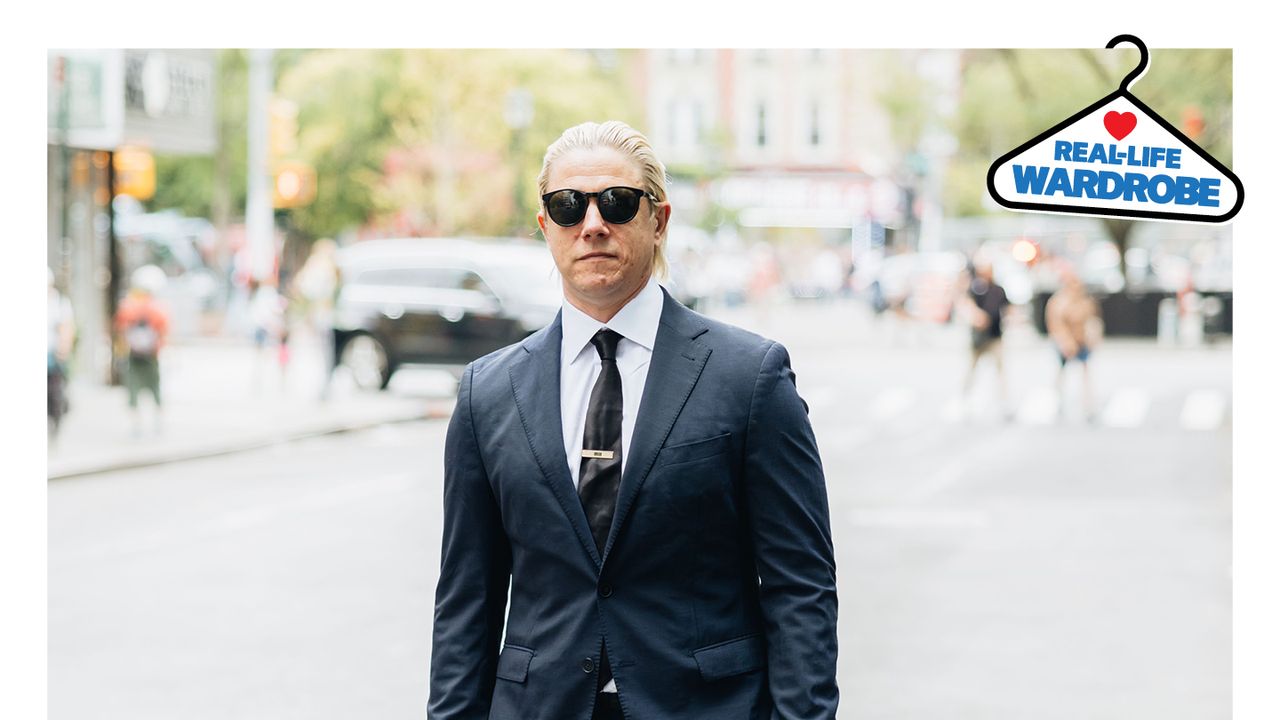
The ever-dapper frontman dishes on his band’s excellent new record, bleaching his hair for the first time ever, and what the “indie sleaze” era was actually like.Paul Banks has the vaguely Midwestern accent of a guy who grew up in a lot of places. He was born in England, but his dad’s job in the auto industry shuttled the family all over the globe—through Michigan, New Jersey, Spain, and Mexico—before he landed in New York City for college. Throughout his youth, Banks dabbled in a bunch of different art forms: painting, photography, furniture design, fashion. Then he discovered Nirvana, and a career in music became the only thing he wanted. “At the time it was like, ‘If somebody gets to have that job, then I want to be able to have that job,’” the 48-year-old recalls.For the last three decades, Banks has done that job at the highest possible level. Interpol, the band he co-founded in 1997, catapulted to fame in the early aughts alongside a wave of fellow NYC indie bands. They’ve remained remarkably consistent ever since, and their eighth studio album—This Mirror Weighs a Ton, which lands today—easily ranks among Interpol’s richest and most replayable records yet.Banks and I met up at producer Andrew Wyatt’s studio in New York, where the band recorded the new LP, to discuss Interpol’s secret to longevity, living through the “indie sleaze” era, his approach to dressing for the sage, and the tiny Japanese label he buys his staples from.All clothing and accessories, subject’s own. Coat by APC. Polo by Zara. Glasses by Vuarnet. GQ: Do you remember the first moment you fell in love with music?Paul Banks: I was really into music and very fascinated by it as a child. I remember seeing a Bruce Springsteen live show on TV and it didn’t sound like the radio. I was very underwhelmed. Before that, I thought that every time I heard a performance, there were little people in the stereo making sounds. I remember having very deep, embedded thought processes; this is probably tied in with some sort of neurodivergence. I had to stop being exposed to the radio in the afternoon because I would lie in bed at night and not be able to sleep, playing melodies over and over in my head. I developed a mnemonic technique, I guess you’d call it, where I picked a default song that I could go to where I knew all the words. There was no mystery. And if anything was keeping me up, I would just revert to singing this one in my head, which was “Land of 1,000 Dances” by the WWF wrestlers. It taught me, at an early age, a variation on meditation, because I was able to control my mind and lull myself to sleep by having a familiar melody and lyric. But my brain has just always been wired to be very sound oriented. When I was 12, it was “Dream On” by Aerosmith. I was into classic rock. I fell so deeply in love with the song that I had to learn how to play it on guitar. And that’s when I picked up a guitar.Bands often have trouble surviving as long as Interpol has. What are the keys to overcoming adversity and continuing on with the same project for almost 30 years?I think it comes down to personality types. It’s hard to talk about the early days before Sam [Fogarino], our current drummer, without sounding like I’m shitting on the original drummer. But when we finally had our final lineup, I felt like, “Okay, we’re lifers.” These weren’t people that were cultivating a serious plan B. We were all plan A. As I get older, I realize the amount of privilege that’s involved in that whole notion—that this is definitely what we want out of life and that we’re willing to make whatever sacrifices are necessary. I had my drug and alcohol problems in my 20s and I got past those. Daniel [Kessler] never had them. Sam kept that under control in his own life. I think the things that probably break up bands are drugs, ego, and lack of ideas. We’ve had the drugs and the ego issues. Ego’s probably still ongoing, but you get in therapy and deal with your ego issues with your bandmates. Get off drugs. If you still have ideas, that’s what keeps you going.Ever since Interpol hit the scene in the early 2000s, you guys have almost always performed and been photographed in shirts, ties, and tailoring. Why was that such an important aesthetic for the band from the get-go, and how have you evolved or shifted the look over the years?First things first, I had some okay jobs before the band became the main job. I worked at Interview magazine, which is pretty cool. I quit because they were keeping me on as a freelancer and I was offended that they weren’t hiring me. Then I worked at shitty magazines after. I used to go to work and have this idea that if I could literally give the universe whatever hours of a career is needed, like, almost surgically remove them from my life, I would give that time away so that I didn’t have to go and do some job that I fucking hated. I really disliked it a lot.When the band was doing shows, I remember feeling like, “This is what I care about. This is my job. I’m going to wear a tie and dress up for concerts because this is what matters to me.” Flipping that notion of being very presentable for your day job, I was schlubby for my day job within what I could get away with. But I wanted to be very formal and very composed with the concerts. Daniel was someone who dressed very formally regardless. He was always pretty put together. The original bass player, Carlos [Dengler], was a completely costume-y guy offstage as well. So, it was no stretch for him to lean into this. Sam was also someone who had an affinity for fashion. So within his wardrobe there were suits and dress shirts. It wasn’t like, “This is what we’re going to do, go buy clothes.” We did have conversations: “Let’s dress nicely for the show.” But it came about organically. We were four guys that it felt natural for, and we enjoyed doing it for our individual reasons.Pants by Uniqlo. Boots by Gucci. You guys came up during an era that people now refer to as “indie sleaze.” What do you think of that moniker? Does it bear any resemblance to what you guys were actually living through?Yeah, it’s actually very apropos. I had a friend who ran a couple bars on the Lower East Side. Max Fish was a very bright bar. It wasn’t shady or seedy. It was actually fun and nice and [full of] cool people. So that was the antidote to what else I was doing, which was the basement of the Dark Room, just fucking doing crazy shit. Or there was a back room at this place, Lit. There were a lot of places in the Lower East Side that were grimy, and then we’d go back to people’s apartments above the bars until 8 in the morning, just being fucking scuzzballs. But that mixed with great fashion and music culture.There definitely was a scene. In the early days, people would talk to us about the Strokes and the Yeah Yeah Yeahs and want there to be a scene. We used to interpret it as, “Oh, you want us to say that we’re all friends and knew each other,” but we didn’t really. But now you realize in a bigger picture that it is a scene, because we were all going to the same bars in the Lower East Side. I think they were going to Mars Bar, which was a bar I knew of, I just didn’t go to. Or Don Hill’s was a place in the West Village where I got a flyer to a Strokes show in 2000 from somebody. We were all on the same path in the world. We used to rehearse next to TV on the Radio in Brooklyn and buy coffee from Kyp [Malone] at Verb [Café] on Bedford Avenue on the way to rehearsal. So there was a lot of crossing paths with people. It was pretty sleazy at times.You signed to a new label and you’re about to release a new album, This Mirror Weighs a Ton. What inspired the title and the overall themes?I wrote that lyric in this room, actually. For me, the songs begin as instrumentals that we’re writing, and then I get ideas from melodies. Sometimes those ideas come with actual words. Mostly it’s just fake words and consonants and vowels. But I’ll know that I want an open vowel—an “O,” and not a closed one like an “E”—in any given moment. I’ll know really specifically how I want the vocal to flow and then I find words for it. Another artist I know called it Romulan, from Star Trek. You sing in Romulan before you figure out what the actual lyrics are—a fake language. I start with gibberish. Now I feel like maybe my subconscious does know what words they are. They’re just getting lost in translation on the way out. I just need to unearth what it was that my subconscious was trying to say. Sometimes I find those words more quickly now because that’s become my method or my understanding of where it’s all coming from, the well of ideas inside. I don’t know, man.The lyric came and then I lived with the lyrics, like, “Oh, I really like that. That feels really resonant.” It fits me to have lyrics that can feel very conversational, but then when you turn around in your mind, they start to gather weight or resonance or other meanings. That’s really important to me. I like conversational things that have weight. That to me was one of those examples.There are a lot of themes of self-reflection and the burden and the responsibility of being honest with yourself—as a person, as a band, as a country. We’re at a point where there are a lot of different ways that the individual is having to look at their role in the world. The country is having to look at what its role is in the world. There’s a lot of that going on in this record. That was on my mind while writing.Whose idea was it to have Andrew Wyatt produce? What did he bring to the album?He’s been friends with our bass player, Brad [Truax], for many years. I’ve been friends with him for 12 years. We worked together on a song for my record with the RZA, Banks & Steelz. He produced “Wild Season.” He’s a fucking musical genius and a super funny dude. I remember when we worked together back then, I laughed a lot with him, which really goes a long way in life. If you like somebody and they crack you up, that’s a very special thing. Daniel became good friends with Andrew, I don’t know how many years ago, five or six years ago. And now they’re really tight. So he was just close friends with three of us, and I knew the level of his talent from having worked with him previously.Daniel, being friends with him, hears other things he’s been working on with different artists and knew what he was capable of as well. We just talked about having somebody produce and help us, because we needed to do something new with this record. I’ve done a lot of things outside of Interpol. I’m pretty comfortable doing different things. But I think for Daniel, it was really important for him to be with someone that was familiar so he didn’t have to go through that process of getting to know a new person while in that vulnerable creative space. It just felt right.When we did the first writing sessions we ever did with Andrew, we came up with a ton of ideas, and his contributions on the song “Iron City” came out right from the beginning. He added a glockenspiel and countermelodies that informed what I did vocally. We all were like, “Holy shit, he just made everything better right away. He gets it and it’s helping this process.” What he brought to this record is incredible layers of arrangement and other instrumentation, from oboe to clarinet, to strings, to live strings, to slide guitar.There’s a lot going on. It’s cohesive, but expansive. It’s amazing.Thanks. He’s a genius, and his aesthetic really overlapped well with ours. He had a real vision of what he wanted to do with our band, while respecting the history of our band, while also doing something that felt new and timeless. It was a really good collaboration.When did you first become interested in clothing and style?I mean, dude, always. I remember when I was four having a fucking ’80s striped polo in my fucking nursery school that I would pop the collar on and feel so cool. I had a T-shirt that I guess was from Georgetown. I don’t even know about that school, but it had a big bulldog on it. It said, “How about them dogs?” on the back. And I remember as a five-year-old, I was like, “When I’m in this shirt, I’m the fucking man.” When I was 10, I got my first pair of blue jeans. I had my Simpsons T-shirt and my blue jeans, and I remember we took a family trip to New York City, and I was just like, “Ladies, what’s up?” I was just a little fat kid, but with the jeans on, I felt like the man.I’ve always found it to be a great form of self-expression. I’m somebody who just loves aesthetics. My whole life I’ve been a great admirer of the way people wear clothes. One thing is whether or not it’s just a really original idea. But another is someone who’s put together really well and the way that the clothes hang on them, man or woman. It kind of boils down to genetics a lot of the time. That’s one facet that I’ve been really into since I was a kid—the part that someone doesn’t really have a lot of control of, just natural God-given beauty. Then the reality is you can get some fat guy with a lot of confidence in a fucking blue suit killing it. I don’t think anybody that’s been on Earth long doesn’t understand that it’s really more about personality and flare and confidence. That really is what ultimately matters in fashion, and being attractive is not about being buff or thin or whatever. It’s just a wonderful way of self-expressing and of communicating to the world that you see the art in existence. I think that’s what is said when you put some effort and energy into your outfit.Suit by Baldessarini. Shirt by Eton. Tie by Altea. Who were the bands you looked up to style-wise growing up?Kurt Cobain and Nirvana was a really huge one. I was a very grungy kid. I used to dress so fucked up that my family got asked to leave a restaurant once, because my sweater had so many holes in it. I’ll tell you one thing: When Lenny Kravitz’s “Are You Gonna Go My Way” came out, in the video there’s just a who’s-who of badass hipsters. At one point, some skater kid jumps off of one ledge onto another ledge, and I remember that was a real awakening. Lenny looked really cool, but he was into flamboyant shit. The people that were in the room, that sense of caring about what’s cool, it hit me. I give a lot of credit to that one, to Lenny and his video casting.Are there any bands you feel are particularly stylish now these days?Cameron Winter wears clothes very well. I saw him in some black, really loose-fitting stuff, and I was like, “Yeah, that’s very of the moment. But he’s lucky because he’s very tall and lanky, and the fact is that clothes just hang really well on tall people. I remember RZA and I got matching suits when we were working together, and when someone’s taller, it just hangs differently. Idles, I like their fashion a lot.Can you remember your first significant clothing purchase?I got really into thrifting when I was a junior in high school. Maybe it was some cream patent leather loafers that I bought when I was living in New York City.What’s your most recent pickup?That APC raincoat [I wore in this shoot].Sweater and shirt by H&M. Pants by Uniqlo. Vintage shoes by Sacha Dandy. Glasses by Volcom. I read something in an interview you did in 2021 where you said you rock lower-end gear onstage when you sweat, and nicer stuff offstage. Is that stille true?All my style on- and offstage differs immensely. I fucking live in sweatpants and athleisure and streetwear. But I would never want to wear that onstage. I don’t want to confuse informal-casual with the stage. I want the stage to be a ceremonial, important ritual with formality to it. I think what I was saying is I would wear H&M dress pants because of the sweating and the wear and tear of being on tour. But now, I have a little bit of a middle ground of having some nicer tailored things. The suit I wore today, I wear onstage.What are some essentials you wear on- and offstage?I got some Celine boots that are fucking really, really tight that I would have worn today, but they’re in the wardrobe case. I have a number of leather jackets. I have a Dolce & Gabbana jacket and a Celine leather jacket that I used to wear a lot onstage. And these snakeskin shoes. There’s a Japanese company called Time Is On that I discovered last time I was in Tokyo, and I have a bunch of their dress shirts and stuff that I like onstage.What is touring like for you at this age versus your 20s?Now I’ve got to take care of myself, most importantly, physically for the mental. Getting enough rest on the road so that my voice doesn’t crack, and then also enough rest so that mentally you can put up with it, because the traveling gets really, really tiring. As I get older, I’m more mindful of the blessings and how fortunate it is to have a life where I ultimately do something I really care about and love doing. But the studio is the really fun part about being a musician. The live show is really fun as well, but everything between one show to the next is fucking work, man.How do you guys travel? A big bus?Depends. A big bus in the States is cool because at least you know wherever you go, there’ll be a Starbucks and you can get something that’s familiar to you. For me, the most important things are getting to a good gym, ideally a boxing gym. Obviously local cafes are better, but just something familiar, because it’s hard. Imagine if you move to a new town every day, and at the cafe that you first stumble into, the person’s a shithead. It matters when you live somewhere for a while and you get to go to your favorite coffee shop. And those little bits of familiarity go a long way. You don’t have any of that when you’re on tour. You have to really counteract that by finding other ways to ground yourself when everything’s changing.How are the crowds? Are you annoyed by seeing phones out all the time?It’s very different. In the very early days, you could do a show and then go to some fan’s house party. That was fun and wild and loose. Now I love and enjoy and appreciate the audiences as much as ever before. I sort of tune out the phones. With some things, you’re not really going to win that fight. I don’t want to get bent out of shape about something that I’m not going to be able to do anything about. I suppose you could have people check their phones at the door, but I don’t care enough to bother with anything like that.Talk to me about your hair. How has your styling or cut evolved? Has your routine changed?I’ve never really been too conscientious about changing the look from album campaign to album campaign. But this time I did, because around the time that we were getting into promoting this record, I was about to either cut all my hair off or bleach it for the first time. I said, “Fuck it, let’s bleach it and we’ll see how it goes.” We took some press photos with the bleached hair and I was like, “Yeah, I like it. This is new.” It feels like I’m doing it for my job, because otherwise I’d just shave my head. I do like having a new signature look. So if you see pictures of me with this hair, it means it’s this record, this campaign, this moment in time. I think that’s a good thing to promote the record and give it a unique branded moment. Jack White does this very well, where every album he’ll come out with a slightly different thing. Madonna is the god of knowing how to brand herself and differentiate from album to album. Luckily, the hairline’s not receding too much. I think I’m going to carry this until the launch of the record, and then I think it might all come off.Can you give me three non-negotiable albums you think everyone should listen to?Oh, that’s really tough. Here Come the Warm Jets, Brian Eno. Surfer Rosa, Pixies. And Deltron 3030.Sign up for Show Notes to get news on the latest runway shows, parties, and insider events on the international fashion circuit.Christopher Fenimore writes and photographs GQ’s Real-Life Wardrobe column. He currently splits time between Cutchogue and Brooklyn, NY. ... Read More
The Real-Life Wardrobe of Interpol’s Paul Banks, Who Wears a Suit Onstage to Remind Himself It’s His Job
Full Article
Original Source
Read the full article at Gq →KhanList aggregates and links to publicly available news content. We do not host full articles from third-party sources. Always verify important information with original sources.