
The conversation she claims would spark one of the longest-running – and potentially most expensive – divorce battles in British legal history occurred in November 2013, after what Natalia Potanina insists was an entirely ordinary family dinner at their home outside Moscow.'We were just sitting together at the dinner table, having tea. We were with our children,' she recalled in an interview given two years later.Nothing, in other words, to suggest that this was anything other than another unremarkable evening in the life of a couple who had been married for three decades.But when their three children had left the room, her husband had a startling suggestion: it was time for them to get a divorce.Such was the then 52-year-old's shock, Natalia later insisted, that she initially thought he must be joking.But Vladimir Potanin – a metals tycoon who had risen from relatively humble beginnings to become one of Russia's wealthiest oligarchs and an ally of President Vladimir Putin – was deadly serious.From that evening onwards, the couple would never again share a bed, or indeed a home. By Natalia's account, they have barely exchanged a word since.Yet even amid the anguish and recriminations of that November evening, neither could surely have envisaged the extraordinary longevity – or sheer financial scale – of the fallout that would follow. Natalia Potanina arrived at London's High Court on Thursday for her divorce proceedings with former partner Vladimir Potanin Natalia is pictured with Potanin, Russia's second richest man, while they were married Russian President Vladimir Putin meets with Potanin in his official residence on December 10, 2018For while their marriage formally ended in 2014, twelve years and several bitter court battles later, the former sweethearts remain locked in an acrimonious legal dispute which this week arrived in the rarefied surroundings of London's High Court.It is thousands of miles from the Moscow home where their marriage unravelled – but then, that is rather the point.Natalia this week told the court her husband's links to Putin made it impossible for her to get a fair hearing in Russia, and said she felt frightened in Moscow, and described an incident in which she was 'followed by black cars'.For while she was born and raised in the Russian capital, Natalia, now 65, has lived in London for the past decade, has acquired British citizenship and has fought successfully for the right to challenge her previous financial settlement in the English courts, in pursuit of a substantially larger share of her former husband's vast fortune.A staggering £2.1billion share, to be precise – a sum which, if awarded, would make this Britain's most expensive divorce settlement on record, comfortably eclipsing the £554million financial settlement ordered by the High Court in 2021 following the divorce of Dubai's ruler, Sheikh Mohammed bin Rashid Al Maktoum, and his former wife Princess Haya bint Al Hussein.The sums involved are so extraordinary – 'really quite breathtaking' in the words of Charles Howard KC, counsel for Mrs Potanina on the opening day of what is expected to be a 15-day hearing this week – and the battle so bitter, that the whole affair has the makings of a television drama.Certainly anyone currently gripped by the glossy television drama War, streaming on NOW TV, might be forgiven for thinking that the spectacle unfolding in London's High Court had been lifted straight from its script.Starring Dominic West as Morgan Henderson, a fabulously wealthy British tech tycoon, and Sienna Miller as his estranged actress wife Carla Duval, the series charts the increasingly poisonous disintegration of a marriage in which unimaginable wealth, wounded pride and the determination to emerge victorious combine to turn divorce into something approaching all-out warfare. Natalia and her ex-husband Potanin are locked in a feud of more than 10 years Natalia and Potanin are pictured on their wedding day in 1983Yet while the fictional Hendersons wage their battle across eight episodes of lavishly produced television, the real-life Potanins have been fighting theirs for more than a decade, the latter half of an extraordinary journey which took them from Communist-era Russia to a life of almost unimaginable wealth and privilege, characterised in court documents submitted by Natalia's legal team as a world of 'luxury yachts' and 'extraordinary holidays travelling in their private jets'.'Money', the document went on, 'was no object'.Behind this extraordinary catalogue of riches, however, lies a remarkable 'reds-to-riches' story, played out against the backdrop of the collapse of the Soviet Union and the emergence of a new class of Russian billionaires who would acquire fortunes of almost unimaginable proportions.The couple met as teenagers at the same school in Moscow, marrying in 1983 when both were just 22.In those early years, life was a far cry from the gilded existence that would eventually become theirs.Money was desperately tight, Natalia recalling in an interview 11 years ago how, for much of their early married life, they had lived in her parents' modest two-bedroom apartment, surviving on 'absolutely no money'.'They helped us to bring up our children,' she recalled. 'Then they let us have their apartment and moved out to live in a smaller flat not far away.'In those days, Vladimir worked as a senior engineer for an arm of the Ministry for Foreign Trade. But he was ambitious, and as the Soviet Union began to disintegrate, he was among those quick to recognise the extraordinary commercial opportunities emerging from its ruins. The divorce between Natalia and Potanin is one of the bitterest and most expensive divorce disputes in BritainIn 1990, he founded Interros, initially a foreign trade association specialising in economic consulting and the trading of non-ferrous metals.It was the beginning of a spectacular ascent. Over the next few years, using capital from Interros, Potanin established major private banks before taking advantage of Russia's now infamous 1995 'loans-for-shares' privatisation auctions.These controversial deals, which saw valuable state-owned assets transferred into private hands at knockdown prices, are now widely regarded as one of the defining moments in the creation of Russia's oligarch class.Among the industrial assets in which Potanin acquired controlling stakes was the mining giant Norilsk Nickel, a company that would become central to his extraordinary fortune.It was an era in which the old Soviet economic order was being dismantled at dizzying speed, and a handful of business leaders were amassing riches that would have been unthinkable only a few years earlier.Potanin was among the most successful of them.By 2004, Forbes was reporting that his business empire was worth $32billion, with his personal wealth estimated at $3billion, placing him at the very pinnacle of Russia's new moneyed elite.With the money came political influence. An ally of Boris Yeltsin, the first president of the Russian Federation, Potanin served for six months between 1996 and 1997 as Russia's Deputy Prime Minister, moving with apparent ease between the worlds of high finance and high politics. By 2004, Forbes was reporting that Pontanin's business empire was worth $32billion, with his personal wealth estimated at $3billion Natalia told the court her husband's links to Putin made it impossible for her to get a fair hearing in RussiaFor Natalia, meanwhile, the transformation in the family's fortunes was no less dramatic. The couple, who had three children together, now aged 42, 37 and 27, found themselves inhabiting a world almost entirely removed from the cramped Moscow apartment in which their marriage had begun.There were magnificent homes, including a property in one of Moscow's most exclusive residential enclaves, within a complex boasting its own ski slope.There were country estates, three yachts and the sort of international travel arrangements for which ordinary first-class flights would scarcely suffice.And there were parties on a scale that would have been unimaginable to the young couple who had once depended on Natalia's parents for a roof over their heads.Indeed, such were the sums at Potanin's disposal that, as the High Court heard this week, he once paid the late George Michael £1.7million to perform at a private New Year's Eve party in December 2006.Yet, according to Vladimir Potanin, just 16 days after that glittering celebration, his marriage was effectively over. He agreed to go on holidays with Mrs Potanina over the ensuing years for the sake of their three children.It is a version of events robustly disputed by his former wife, who maintains that they remained a couple until that fateful evening in November 2013, a contention she says is supported by family photographs from the intervening years.The January 2007 date is significant, she insists, but for an entirely different reason: according to Natalia, her husband suggested that they backdate their separation to that point, thereby fixing the value of his assets at an earlier date rather than at the time their marriage actually ended.Taking to the stand at the High Court on Thursday – clad in elegant black, with a Yves Saint Laurent bag – she described how she thought her husband's request was a 'bad joke' at first.'It was a shock to me, and I would have liked to have stayed (married),' she told the court.Only in the aftermath of this, the court was told this week, did she become aware that her husband had a mistress with whom he had a child in 2011.'You now know Mr Potanin was in another relationship. You may not have known then. In any event he was,' Lord Faulks KC, representing Vladimir Potanin, told her.'What I suggest he said to you for the children's sake was even though you were going to be divorced the family could still travel together but he would stay in separate accommodation.' Such an arrangement would, Natalia responded, have been 'insane'.In fact she says the pair continued to share a bed and had sex up to three times a week until November 2013.Whatever the truth of the competing contemporaneous accounts of their separation, the scene had been set for a divorce that would prove as bitterly contested as it was extraordinarily expensive.According to Natalia, after that final conversation her husband left their home, leaving the divorce papers he had produced that evening behind him, and effectively cut off all communication.'I even wrote letters to him asking for reconciliation,' she told the court this week, adding that she wanted 'in her soul' for the marriage to be saved.But if Natalia had been left reeling by the abrupt collapse of her marriage, she was equally determined not to walk away from the fortune she believed they had built together.By September 2015, the former couple were facing one another across a Moscow courtroom, where Natalia sought a 50 per cent share of Interros and her husband's alleged 30 per cent stake in Norilsk Nickel, of which Potanin is chief executive and which was then valued at an estimated $7billion.Her argument was straightforward: the companies, their shares and the assets they represented had been accumulated during the course of their 31-year marriage, a union which, she maintained, had played a crucial role in her husband's commercial success.On paper, at least, Russian divorce law appeared to offer her grounds for optimism.In the absence of a prenuptial agreement, the general principle is that marital assets should be divided equally between divorcing spouses.But therein lay the problem.For quite what those assets were – and, crucially, which of them could be regarded as belonging personally to Vladimir Potanin – would become the central and fiercely contested question.While Potanin declared his personal wealth to be limited to his monthly salary of $500,000, his former wife maintained that substantial assets had been placed beyond her reach through a complex network of offshore companies.Nonetheless, the resulting financial settlement was, by the standards of most divorces, an astonishing sum.Natalia says she was awarded £30.9million, although her former husband disputes that figure, maintaining that she has received an overall figure of £63million.Either way, to a woman who believed herself entitled to a substantial share of one of Russia's greatest fortunes, it represented a fraction of what she considered her due.It was tantamount, she later declared, to 'saying that Russia's richest man is worth nothing'.And it was this perceived 'grave injustice', as her barrister Charles Howard KC described it this week, which set Natalia on the long and tortuous legal path that has eventually brought her to the High Court in London. For as Mr Howard told Mr Justice McDonald this week, that sum was less than one per cent of the 'extraordinary' wealth amassed by Potanin during their 31-year marriage.'On any objective analysis, that is hugely unfair and a huge injustice, particularly when it entails her being deprived of billions of dollars,' he said.The figures presented to the court are enough to make even the wealthiest of observers blink.Court submissions put Potanin's total resources at approximately £5.2billion, with annual earnings of around £42.2million.And should Natalia's claim for £2.1billion fail, she is seeking an alternative award of £600million to meet what her legal team describes as her 'reasonable needs'.These include £150million for a new London home, £441million for 'maintenance' and a further £10million in other capital expenditure.Her claims, however, are being fiercely resisted by her former husband, now also 65, whose legal team also includes Baroness Shackleton, the formidable divorce lawyer who represented the then Prince Charles during his divorce from Diana, Princess of Wales, in 1996.They are expected to argue that Natalia's attachment to the lavish lifestyle the couple once enjoyed is not one shared by her former husband.There is, moreover, a striking geographical and political divide between the two former spouses.While Natalia has made her home in Britain and acquired British citizenship, Vladimir remains closely associated with the Russian establishment.Reportedly a close ally of President Putin, with whom he shares a passion for ice hockey – the pair have played against one another in a charity gala match – he is currently barred from entering Britain under sanctions imposed following Russia's invasion of Ukraine.Unlike his former wife, therefore, he will not be appearing in person in the London courtroom where the latest chapter of their long-running dispute is being played out.Instead, he is expected to give evidence by video link next week.Whatever the eventual outcome, there is little to suggest that Natalia, who is understood not to have returned to Russia for a decade, will abandon her pursuit lightly.Indeed, in an interview in 2018, she made clear that, for her, the legal struggle had become something more than a simple dispute about money but about a principle.'As for how long I am prepared to continue fighting, well life - or rather my former husband - has put me in a situation where I've got to continue,' she said.'I feel it is my duty to speak and protect not only my own self and our children, but to show a different route that other Russian women can take in protecting themselves in a similar situation.'Additional reporting by Will Stewart and Cameron Charters
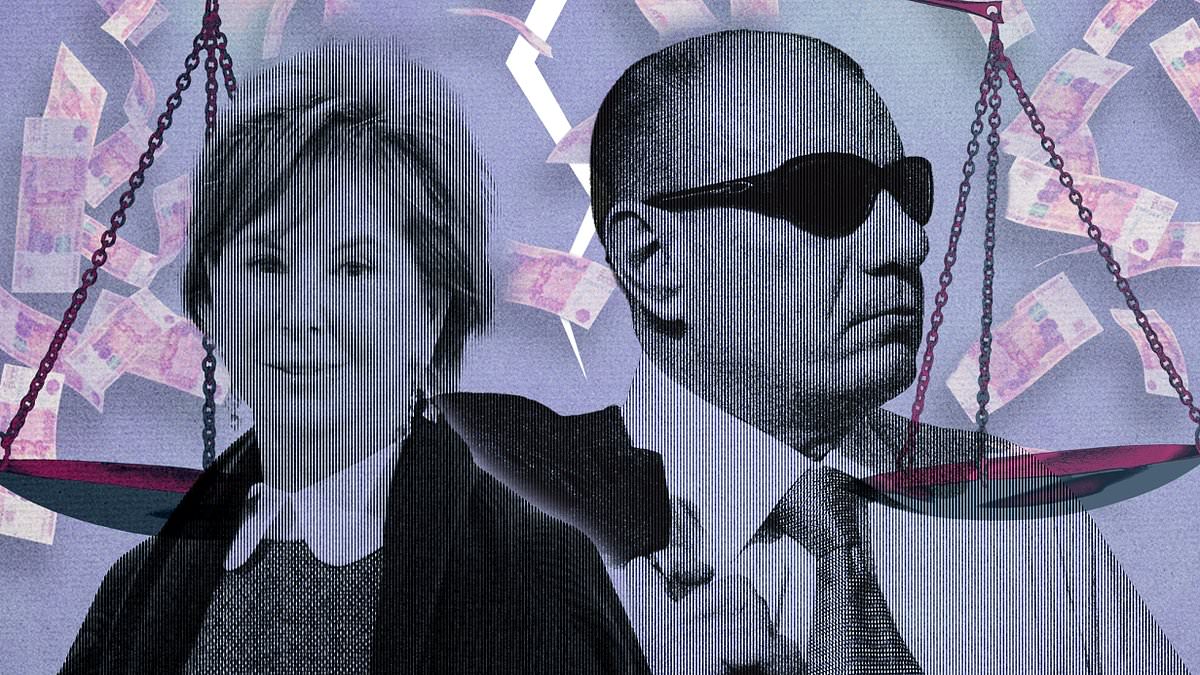
The real-life War divorce. Why the wife of a Russian oligarch - and Putin's ice hockey buddy - is fighting for £2billion in Britain's biggest ever divorce battle
Full Article
Original Source
Read the full article at Dailymail →KhanList aggregates and links to publicly available news content. We do not host full articles from third-party sources. Always verify important information with original sources.