
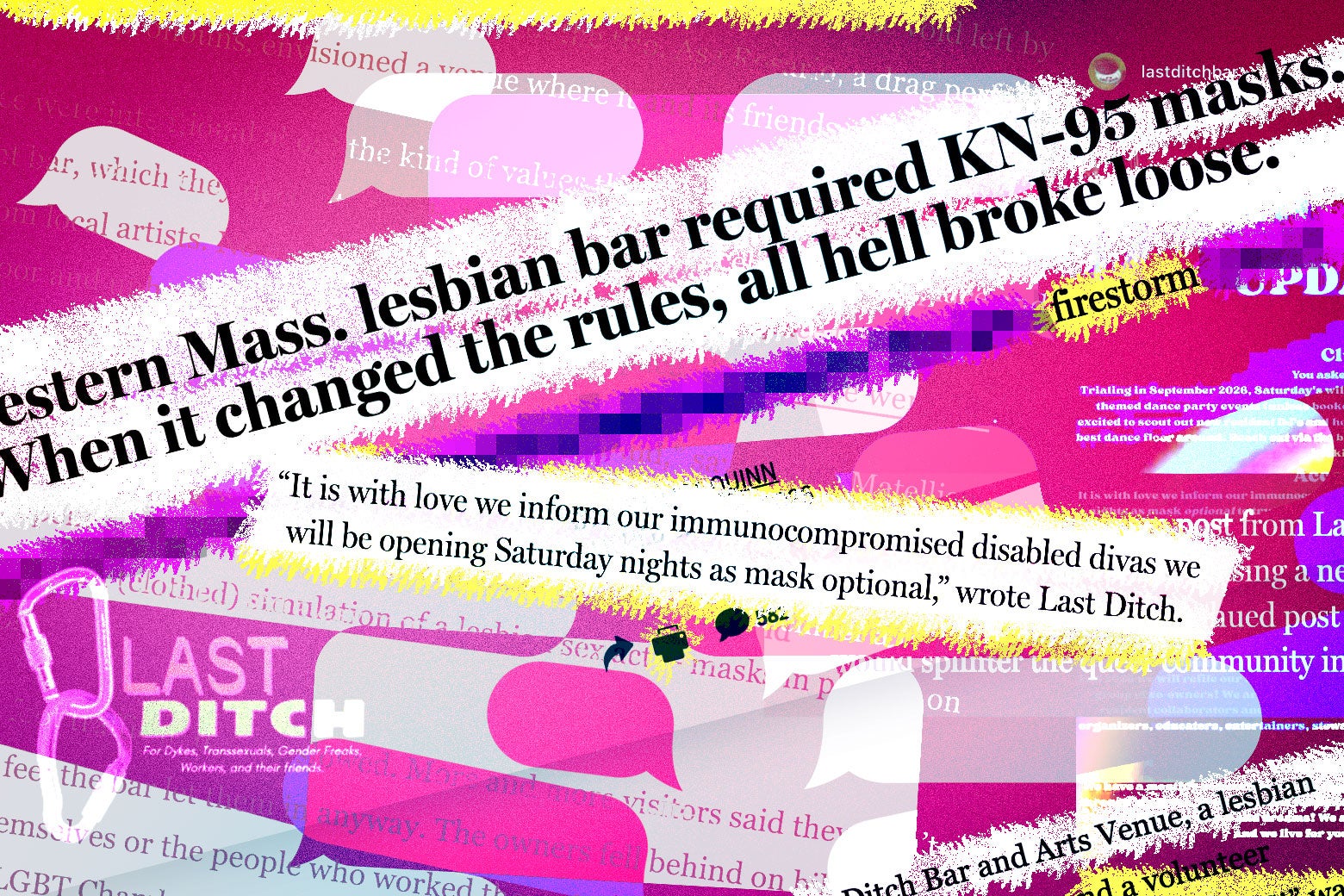
Life Last Ditch faced backlash for their new masking policy. Then the episode broke containment. By Enter your email to receive alerts for this author. Sign in or create an account to better manage your email preferences. Unsubscribe from email alerts Are you sure you want to unsubscribe from email alerts for Christina Cauterucci? Sept 25, 20261:52 PM Photo illustration by Slate. Photos by Getty Images Plus, Globe, and Last Ditch. Sign up for the Slatest to get the most insightful analysis, criticism, and advice out there, delivered to your inbox daily. At first, the rubbernecking at the Western Massachusetts lesbian bar seemed all in good fun. Everyone wanted to read the viral Boston Globe feature about the noxious backlash that had engulfed Last Ditch. On Aug. 31, 2026, the establishment, which typically has a policy that patrons must wear masks, announced that Saturday nights would be “masks optional.” “The new policy was not received with love,” Annalisa Quinn wrote, in an article that quickly rose to become the paper’s top story of the year. It was a carefully reported piece of local journalism, but there’s no doubt that its popularity was powered by the slew of easily mockable characters and tropes within: a person using it/its pronouns; a bar co-founder who left to attend clown school; leftists who accuse people of racism and ableism willy-nilly; a bartender who won’t play Lady Gaga because the singer is a “Zionist.” Multiple queer friends of mine sent the link around for a laugh and a bit of good-natured commiseration at how self-defeating our LGBTQ+ comrades can be in pursuit of an unreachable ideal of inclusivity. By demanding fully-masked perfection—and that the bar provide free drinks for anyone who claims they can’t pay—queers clamoring for a safe space may force one of the few in existence to close. Amused and dismayed by the depiction of gays fatally overdosing on their own self-righteousness, the general consensus in my circles was something along the lines of “this is why we can’t have nice things.” But soon, inevitably, the story broke containment. No longer was it mostly fellow queers and left-leaning Globe readers cringing at our own values contorted to the point of absurdity. On X, Sen. Ted Cruz reposted screenshots of the piece, writing, “Leftism is a mental disease.” Right-wing provocateur Andy Ngo and conservative commentator Michael Knowles chimed in. Robby Starbuck dug up old photos of the bar’s founders to publicly insult their looks: “Leftism destroys someone inside and out.” Instead of viewing the Last Ditch feature as a glimpse into a fringe community struggling to reconcile its own norms, a rising internet consensus seems to see it as a cautionary tale that should discredit the left as a whole. I’m writing this mere days after the story published, and already it has become a weapon for anti-gay and anti-trans ideologues invested in painting all LGBTQ+ people as identity-obsessed, antisocial freaks. It’s a shame, because there are a few worthy takeaways to be gleaned from the case of Last Ditch. One is that people are often harshest to those who care about them. The Heritage Foundation won’t give us the time of day—so we rag on the Human Rights Campaign. The random dive bar down the street hasn’t been requiring masks since 2020—so we expect mandatory masking every single night from the queer bar. The most powerful man in America is boldly, unabashedly racist, so we focus our anti-racist protests on people who are trying the hardest not to be racist. Some of these critiques are valid and important—you can care, and still mess up!—while others are raised as a way to claim some small sliver of power over anyone willing to cede it. The shrieking demand for absolute perfection becomes a weapon. For Last Ditch, this meant hundreds of online messages accusing the bar operator of killing people (via allowing infection to spread), and a multi-hour livestreamed meeting at which they were called racist for sharing how hard it’s been to keep the place afloat. Attendees also said the owner had jeopardized their safety by inviting a licensed therapist to moderate the conversation. This impulse isn’t unique to activists, or to queers: Kids are better behaved for babysitters than they are for their parents, in part because they feel safe in the knowledge that their parents will forgive and love them no matter what. But the Last Ditch story speaks to the thick skin required to run any event or institution in a community with radical expectations of accommodation. It also points to the value of having humbler ambitions—ones suited to a bar, not a utopian experiment—instead of making big promises to people with out-there demands and then absorbing their rage when you can’t fulfill them. When that fails, instead of capitulating to the loudest and wackiest among us, it is better to just say no. But there’s a deeper context to the Last Ditch controversy that’s getting lost in the mean-spirited commentary. The bar’s struggle to survive is part of a broader pattern in the Western Massachusetts queer scene. In 2024, the Majestic Saloon in Northampton, the only LGBTQ+ bar in “Lesbianville, USA,” closed. Within days, queer-centered Greenfield venue 10 Forward shuttered. Last Ditch opened in the property vacated by 10 Forward, with a name that literally described its purpose: It was intended as a last-ditch effort to create a viable space that cared for people in all the ways that previous venues had failed to. Unfavorable economic headwinds surely contributed to the closure of Last Ditch’s predecessors. Running a small-town gay bar in the post-pandemic, high-inflation, sober-curious 2020s is no easy feat. But according to community members, both spaces also shut down after weathering a wave of criticism that resembles what Last Ditch is facing now: In an Instagram post, a local resident launched accusations of ableism and racism and called for a boycott. The Majestic Saloon even held a community mediation session akin to the one Last Ditch hosted. Rene Pellissier, who co-hosts a monthly comedy and poetry open-mic showcase at Last Ditch, admires the ethos of the venue, which she describes as an idealistic project “run by several well-meaning queer people in their early- to mid-20s.” The Last Ditch co-founders stepped up to fill the void left by the bars that closed. In turn, the one remaining operator of Last Ditch has been vilified by a vocal subgroup in town that is unwilling to accept the compromises that maintaining a sustainable community gathering space entails. “This isn’t about the masks—this is about perfectionism. We are expecting too much from our local community,” Pellissier told me. “If we turn our backs any time we disagree, we will lose everything.” At a time when LGBTQ+ people, disabled people, and people of color are suffering systemic neglect and targeted attacks from the state, some are demanding that the few institutions catering to their needs agree to fulfill all their needs. Others, wanting to be good allies and feeling helpless in the face of the hostile political landscape, believe their only choice is to “amplify,” in the preferred jargon, the voices of the most aggrieved. But every bar-slash-arts-venue must operate within the strictures of the society in which it opens. No bar-slash-arts-venue is capable of mending the structural shortcomings of the wider world. This is a difficult reality to face, and it’s a conversation more queer communities could stand to have—even in places with less extreme ideals than Greenfield. But it’s impossible to have it with the compassion and clearheadedness it requires in an online cesspool of bad-faith commentary. It’s actually kind of ironic that in a discourse about the management practices of a Massachusetts lesbian bar being denounced by a handful of entitled people, a senator from Texas thinks he is entitled to weigh in and scold. Even before the Globe published its piece, the discourse around Last Ditch had already fallen into this internet pit. Some of the most impassioned online pushback to the relaxed mask mandate didn’t actually come from bar patrons or community members, but from far-off keyboard warriors. The person whose Instagram comment read “I hope your venue gets firebombed for robbing my fellow immunocompromised people of their Saturday plans,” as quoted by the Globe, clarified that “I don’t even live in your town.” To the extent that they are a real, sincere person, they are also a deeply unwell conspiracy theorist, not an emblematic member of the Greenfield scene. This story has never been just about a queer bar setting itself aflame to placate a militant few. It’s about how digital distance distorts everyone’s perspective, endangering the physical spaces where lasting connections—the things that make a collection of people a true, resilient community—are built. As a result, the people who are desperately clamoring for a safer space to gather risk creating conditions that make it impossible to sustain one. Look past the laughable excesses, and there is clearly much to cherish about queer life in Greenfield. A spin through Last Ditch’s Instagram page reveals a vibrant schedule of themed parties, drag shows, DJ nights, movie screenings, karaoke, music showcases, line dancing, and co-working opportunities. In Washington, D.C., the 700,000-person city where I live, we can barely keep two lesbian-centric spaces open, and one is in the basement of a gay bar. For now, at least, this tiny town of 17,700 has one of its own, run by a 26-year-old who is struggling to keep the business afloat while balancing the competing interests of its patrons. No matter how misguided or incomprehensible some of their decisions look from outside this insular community, they have clearly been made with the admirable intention of making people who have been snubbed by much of the outside world feel welcomed, safe, and rich in opportunities for creativity and delight. They deserve better than what they’re getting: an internet-enabled pile-on that has made them a villain to unreasonable purists on the left and culture-war fodder to bigots on the right. Internet Culture Politics Massachusetts LGBTQ+ Restaurants
The Real Lesson to Take From the Viral Lesbian-Bar-Meltdown Story
Full Article
Original Source
Read the full article at Slate →KhanList aggregates and links to publicly available news content. We do not host full articles from third-party sources. Always verify important information with original sources.