
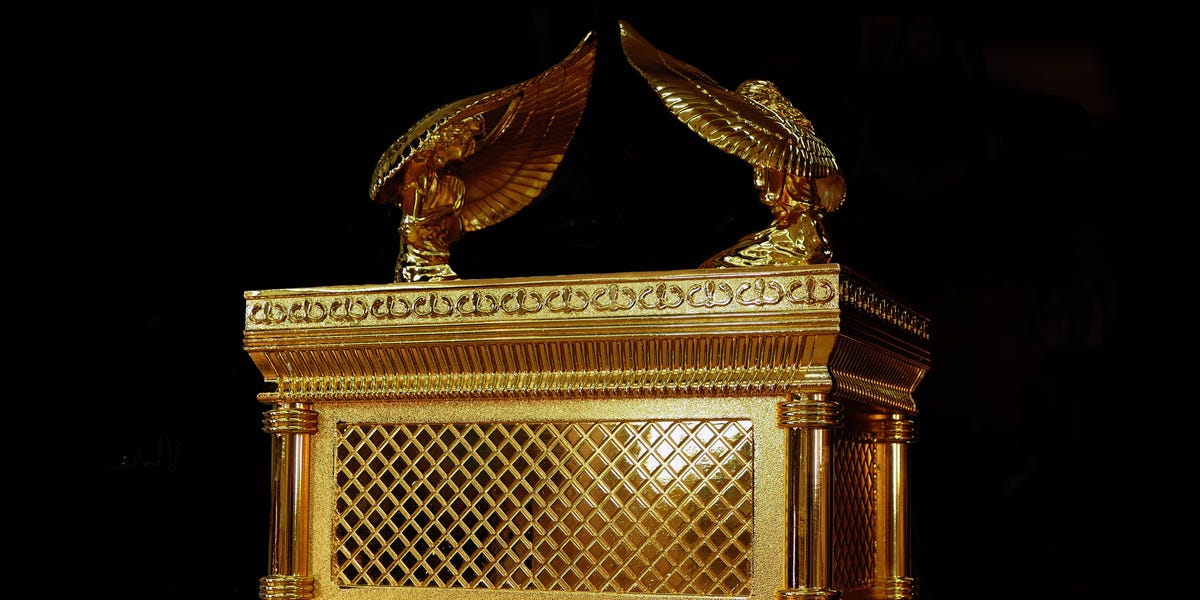
Next to the Church of Our Lady Mary of Zion in the ancient city of Axum, Ethiopia, stands a small, fenced-off sanctuary called the Chapel of the Tablet. Entry is forbidden to everyone on Earth except one man: a lone monk appointed for life to watch over its contents.According to believers, he’s guarding one of history’s most sacred and sought-after relics: the Ark of the Covenant.In the Hebrew Bible, the Ark is described in precise detail: a rectangular chest of acacia wood overlaid inside and out with gold, measuring roughly four feet long by two feet wide and high, and crowned with two golden cherubim with outstretched wings. Forged at Mount Sinai to house the Ten Commandments and serve as God’s literal throne on Earth, the Ark guided the Israelites through the wilderness, toppled enemy armies, and eventually became the sacred centerpiece of King Solomon’s Temple in Jerusalem. Then, during the Babylonian destruction of Jerusalem in 586 B.C.E., this ultimate seat of divine power vanished from the biblical record without a trace.For millennia, its disappearance has fueled endless archaeological quests, conspiracy theories, and pop-culture touchstones like 1981’s Raiders of the Lost Ark. Yet according to the Kebra Nagast (“The Glory of the Kings”), a revered 14th-century Ethiopian national epic, the Ark was never lost at all. Instead, it was smuggled out of Jerusalem nearly 3,000 years ago by Menelik I, the son of King Solomon and Makeda—better known outside Ethiopia as the Queen of Sheba.According to the epic, Menelik grew up in Ethiopia before traveling to Jerusalem in his early twenties to meet his father, carrying a royal ring Solomon had left with his mother as proof of his lineage. Solomon recognized the young man immediately—he was the spitting image of his grandfather, King David—and begged his favored son to stay and inherit the throne of Israel.Menelik insisted on returning home to rule his mother’s kingdom. Reluctantly, Solomon agreed, but on one condition. The firstborn sons of Jerusalem’s highest-ranking nobles, priests, and military commanders were ordered to accompany Menelik as his new royal court to establish a “second Israel” in Ethiopia.That decree sealed the Ark’s fate. Devastated at the thought of leaving the presence of God behind, the young elites conspired to pull off an ancient inside job. The heist was masterminded by Azariah, son of the High Priest Zadok. Prompted by an angel in a vision, Azariah commissioned an exact wooden replica of the Ark. Under cover of night, he and his co-conspirators slipped into the Temple, swapped the genuine Ark for the decoy, and hid the real relic in their luggage.API//Getty ImagesEthiopian miniature of Menelik I transporting the ArkWhen Menelik’s caravan departed the next day, the Kebra Nagast claims the Ark’s power lifted their wagons and animals off the ground, propelling them toward Ethiopia at supernatural speed. By the time Zadok discovered the counterfeit and Solomon’s army gave frantic chase, the Ethiopians were long gone.Christianity was still centuries away, so as tradition has it, the relic was first kept on Tana Qirqos, a remote island on Ethiopia’s Lake Tana, where priests guarded it for 800 years. Then around 340 C.E., when King Ezana of the Aksumite Empire converted to Christianity, the Ark was ceremoniously moved to the newly built Church of Our Lady Mary of Zion in Axum, permanently linking the ancient Israelite covenant with Ethiopian Christianity.Over the centuries, whenever invaders threatened Axum—including Queen Gudit’s forces in the 10th century and the devastating Adal War in the 16th century—monks spirited the Ark away to mountain strongholds and island refuges until the cathedral could be rebuilt. In the 1960s, Empress Menen Asfaw, wife of Emperor Haile Selassie, funded the dedicated Chapel of the Tablet next door. According to local monastic lore, the move was necessary because a divine “heat” radiating from the Ark was cracking the ancient stone walls of its previous sanctum.A. Davies//Wikimedia CommonsThe Chapel of the Tablet in Axum, Ethiopa. Photo: A. Davies.Because the Ethiopian Orthodox Church forbids anyone—including scholars, archaeologists, and even the church’s own patriarch—from laying eyes on the relic, its authenticity remains impossible to verify scientifically. Only one outsider in modern history has claimed to get a look. In 1941, British army officer Edward Ullendorff—later a prominent professor of Ethiopian studies—allegedly used his military clout and fluency in classical Ge’ez to talk his way inside the sanctuary. In a 1992 interview, Ullendorff claimed the chest he saw was merely a “middle- to late-medieval construction.”However, Ethiopian officials and historians quickly pointed out a flaw in Ullendorff’s scoop: every church in Ethiopia keeps a replica of the Ark, known as a tabot, for ceremonial use. If Ullendorff saw a medieval wooden box, believers argue, he was simply fooled by a decoy—the exact same trick Azariah used on King Solomon 3,000 years ago.And so, while treasure hunters continue to scour subterranean tunnels in Jerusalem and desert caves across the Middle East, millions of Ethiopians believe the search is already over. The world’s most famous lost treasure isn’t buried in a secret vault—it’s sitting right on a street corner in Axum, hiding in plain sight.Shawn Gorman is Deputy Editor of News for Popular Mechanics. Before joining Pop Mech, he specialized in academic reading for educational testing. His diverse academic background also includes time spent as a lecturer and librarian at institutions such as the University of Kentucky, SUNY, and Harvard University. Shawn holds a Ph.D. in Modern Foreign Languages and Literatures from Boston University, an M.A. from The Ohio State University, and a B.A. in History from the University of Oregon. His favorite subjects to explore include computer science, physics, math, and biology. He lives on a medium-sized cat ranch in Easton, Pennsylvania, with his wife and two daughters.
The Real Ark of the Covenant May Be Hiding in Ethiopia—and Only One Man Alive Is Allowed to See It
Full Article
Original Source
Read the full article at Popularmechanics →KhanList aggregates and links to publicly available news content. We do not host full articles from third-party sources. Always verify important information with original sources.