
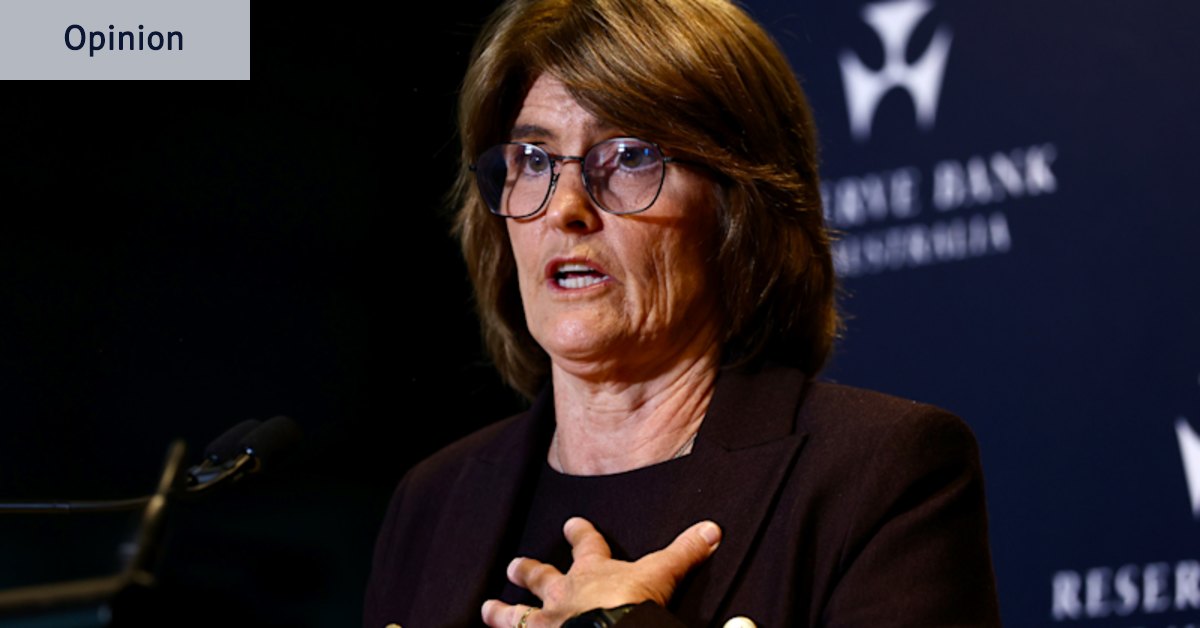
OpinionNovember 27, 2026 — 11:45amMonetary policy is not easy. With the imperfect information it has available, the RBA has just one blunt instrument – the cash rate – which has long and variable lags in its uncertain impact. It also has the legal duty to pursue price stability and full employment at the same time.At its November meeting the board decided, six votes to three, to increase interest rates. The statement expressing the majority view said the labour market remained “a little tight”, without presenting any convincing evidence on this. And subsequent information indicates to the contrary. If the additional information had been available at the time, it would be surprising if the board pulled the lever it has now pulled five times this year.RBA governor Michele Bullock. Louise KennerleyJust over two weeks later, the October ABS Labour Force Survey showed employment had fallen by 43,500 in the month before that November meeting, and the unemployment rate had increased from 4.7 per cent to 4.9 per cent. The interest rate hikes the RBA had already implemented had taken unemployment from 4.1 per cent to 4.9 per cent — with the earlier rate increases yet to have most of their effects.At their forthcoming meeting on December 8, in light of this new information, and cognisant of their dual mandate, board members should not be embarrassed to reduce interest rates at least to where they were before the latest hike. The risk of continued large increases in unemployment and reduction in activity greatly exceeds the risk of excess demand triggering acceleration of inflation. It is hard for Australia, with the highest labour force growth in the developed world, to actually have a recession. It would require a huge decline in output per person. But we might get there — with the immense costs that entails.Treasurer Jim Chalmers is putting together the mid-year economic financial outlook (MYEFO). It is always good to cut any genuinely wasteful or unnecessary public expenditure, but there is no reason to cut the budget to reduce aggregate demand. In particular, there is no evidence of excess demand generating pressures in the labour market for accelerating inflation. We favour moderately tightening fiscal policy and easing monetary policy in current circumstances. That combination yields better outcomes for productivity growth and intergenerational equity.The RBA, with the rest of us, has been told the MYEFO will be mildly contractionary. That information, with the October labour force survey, make an interest rate cut the logical decision on December 8.The near-consensus in the financial press is that there is excessive aggregate demand. But if there is excessive demand we would expect it to show up in the labour market. Growth in the Wage Price Index (WPI), the best measure for assessing the impact of wage growth on businesses’ costs, has stayed between 3 and 4 per cent per annum for the past two years. The most recent quarterly WPI numbers suggest much of that growth is coming as catch-up to high price inflation, both current in the case of award wages, and from several years ago for EBAs. So underlying wage inflation attributable to demand conditions is much lower than the headline number.Careful observation provides no evidence of market wage settlements causing accelerating inflation at any time during the above-target inflation of recent years — even over the extended period when measured unemployment was at or below 4 per cent.In this context, we question the wisdom of using quarter-by-quarter variations in productivity and therefore unit labour costs as an indicator of labour market pressures for accelerating inflation. Economist Paul Krugman’s much-quoted dictum that productivity is almost all that matters over the long run has to be read in the whole – and on this matter the long run can be very long.Underemployment is now much larger relative to employment than it used to be, reducing the NAIRU – the unemployment rate at which inflation accelerates. The NAIRU is properly measured by observation of contemporary labour market dynamics and not by output from macro-econometric models calibrated from historical labour market behaviour. This suggests that unemployment is well above the NAIRU because wage inflation has not been driving up price inflation at unemployment rates significantly below the current level.Current unemployment of 4.9 per cent, which is expected to rise, is just below the RBA’s model-based estimate of the NAIRU but above some other Australian estimates. It is also above the RBA’s view of the full-employment level of unemployment, which considers a dashboard of labour market indicators.There may sometimes be a case for interest rates to be raised even if unemployment is at or higher than the NAIRU. It’s pleasing that the RBA recently has given more emphasis to the effects of monetary policy on imported inflation through the exchange rate. And the RBA does have to be concerned about the possibility of entrenched high inflationary expectations leading to prolonged high inflation.Australia has recently been through three large external price shocks — the COVID disruption of supply chains and the Ukraine and Iran War effects in oil, gas and coal markets. The Iran War shock was still having a large direct effect on prices in the recent CPI data. In extreme conditions, there may be a case for insulating the economy from excessive price shocks of these kinds with pre-emptive tightening of monetary policy to raise the exchange rate — perhaps accompanied by an easing of fiscal policy to maintain full employment. But once the shock has hit the domestic economy, momentum in price increases is only broken quickly by deep recession. Moderate monetary policy accompanied by other measures to reduce inflation will allow gradual reductions of inflation without deep economic downturns.RBA officers have recently put much more emphasis on inflationary expectations. The transparent statistical measures of inflationary expectations do not support the view that expectations have risen dangerously. The Melbourne Institute surveys cited by the RBA do not point to high inflationary expectations. We have one objective, a market-based measure of inflationary expectations: the gap between yields on standard and indexed 10-year bonds. That gap is lower now than six months or a year ago. It has recently suggested average expectations of 2.25 per cent over the next 10 years – below the middle of the target range.The labour market institutions we have today make any idea of a wage-price spiral far-fetched, as RBA Board member Iain Ross argued convincingly in a recent speech. And the data on wage and price inflation show that prices have put upward pressure on wages and not vice versa.The law requires the RBA to pursue full employment as well as moderate inflation because it matters. Full employment means a higher standard of living for people who would otherwise not be in work. Those most likely to become unemployed when we depart from the objective include the young, people with a disability and First Nations people. Full employment brings a lower budget deficit, with important implications for intergenerational equity. Full employment favours higher levels of business investment and productivity growth. Confidence in rising employment increases community support for productivity-raising reform – as in the Australian reform eras of the mid- and late twentieth century. In addition, many families are relying on additional hours of work to maintain their living standards and often to meet rising mortgage payments.When the economy is operating below its potential, everyone pays, through lower earnings growth and less capacity for government to provide services and income support.Co-written with Jeff Borland, Redmond Barry Distinguished Professor of Economics at the University of Melbourne.Ross Garnaut is the emeritus professor of economics at the University of Melbourne and the Australian National University. He is a director of The Superpower Institute and ZEN Energy. He is also a former Australian ambassador to China.Peter Dawkins is chair of the West of Melbourne Economic Development Alliance and an emeritus professor of economics at Victoria University.Get a weekly wrap of views that will challenge, champion and inform your own. Sign up for our Opinion newsletter.Ross Garnaut is the emeritus professor of economics at The University of Melbourne and The Australian National University. He is a director of The Superpower Institute and ZEN Energy.Peter Dawkins is chair of the West of Melbourne Economic Development Alliance and an emeritus professor of economics at Victoria University.From our partners
The RBA has forgotten its job description and must cut rates ASAP
Full Article
Original Source
Read the full article at Smh →KhanList aggregates and links to publicly available news content. We do not host full articles from third-party sources. Always verify important information with original sources.