
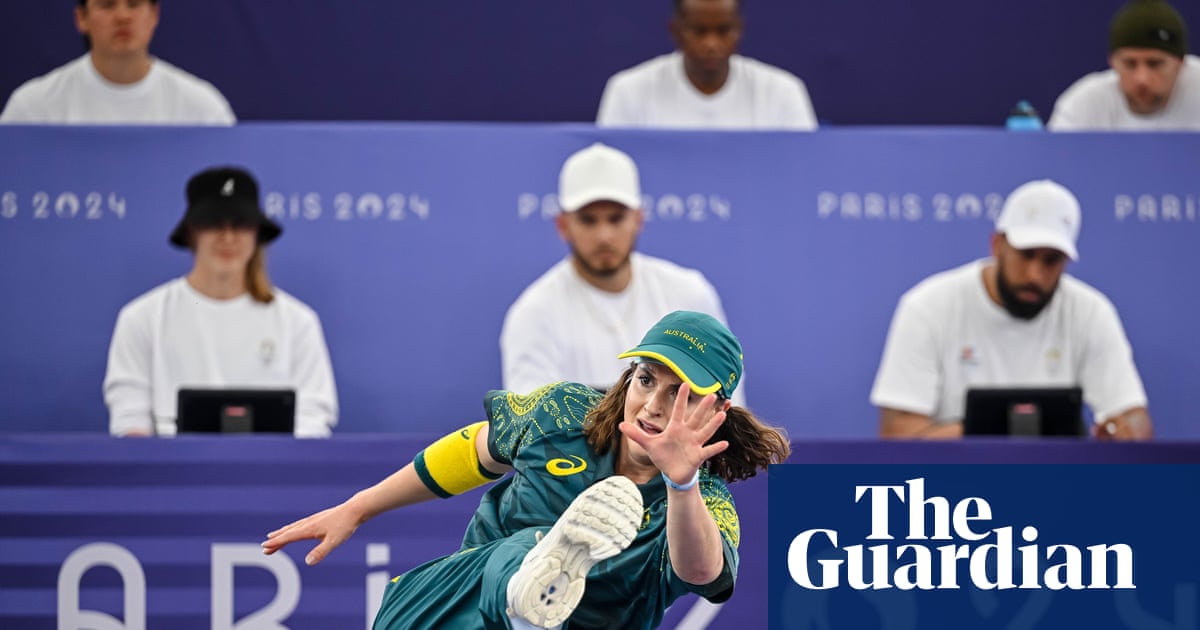
Early in Netflix’s new documentary, Untold Raygun: Breaking Badly, Australian B-girl Rachael Gunn, recounts a session she had with her sports psychologist prior to the 2024 Paris Olympics.“Right before the Olympics, I went to my therapist, panicked,” she says. Her therapist asked her what was the worst thing that could happen. And she said, “The whole world could laugh at me.” Her therapist responded: “Do you think that’s reasonable?” Cue Gunn’s hysterical laughter.Anyone who has ever gone to a therapist will be amused at this anecdote. Nine and a half times out 10, the therapist would have been right. No, they’d say, the worst outcome you can imagine probably won’t come to pass. But in Gunn’s case, what she feared the most did, in fact, happen. Her shenanigans – the sprinkler, the kangaroo hops – in the cypher made her go viral almost as soon as she was done with her sets. (Perhaps if Gunn had been explicit about what she was planning to do in her sets, her therapist would have reacted differently.) Gunn’s performance launched a thousand memes, more than a couple of late-night TV segments, several conspiracy theories, and even a musical at the Edinburgh Fringe Festival.“She became the most famous breaker on planet Earth overnight,” Flix, a fellow Australian B-girl, says in the documentary. All without winning a single vote from any of the nine judges across her six rounds.Untold Raygun, which premieres globally on Netflix on Tuesday, really doesn’t dwell on what it means for breaking, an art form created by Black and Brown youth in the South Bronx, that its first Olympic foray will be primarily – if not exclusively – remembered for a white woman from Australia doing the sprinkler instead of the dynamic performances of the rest of the contenders. It’s mostly focused on Gunn herself with little time spent on the greater context of the art form and how it ended up in the Olympics. The documentary features interviews with Gunn, her parents, her husband who introduced her to breaking, and a few dancers who know her from the Aussie scene. Through them, we get a coming of almost middle-age story about an academic who meets a B-boy working at a call center, falls in love with him and the art form he’s passionate about, and somehow ends up centerstage at the Olympics.Australia’s Rachael ‘Raygun’ Gunn competes during the women’s breaking round-robin at the Paris Olympics in August 2024. Photograph: Angelika Warmuth/ReutersGunn is likeable in the documentary. She comes across as (mostly) self-aware and self-deprecating. Her parents are charming, laughing heartily when asked if they had ever previously associated “Olympian” with their quirky daughter. Sammy Free seems like a sweet fellow who is completely besotted with his wife. (We should all be so lucky to find someone who loves us the way that Free clearly loves Gunn.) But the most useful voices in Untold Raygun are the two Australian B-girls who offer some critical perspective on the place of women in the breaking scene and Gunn’s performances at the Games. They’re harsh, at times, but also fair.Tinylocks, one of Gunn’s contemporaries, repeatedly invokes “No easy props,” a term that’s something of a hip-hop ethos about having to prove your skill to earn respect. (The phrase is often associated with American B-girl Asia One, who founded a crew called No Easy Props in 1997.) “It was such a male dominated space and B-girls were really fighting to be seen but as more women started entering breaking, it was felt that some girls were getting accolades too early in their careers. The crowd would cheer just for participating,” she says.It is within the context of “no easy props” that Tinylocks offers her assessment of Raygun’s pre-Olympic performances, as she was coming up in the small Australian scene. “There were one or two times when I was like, ‘Oh yeah, that was fresh.’ Maybe not so much the other times.”Tinylocks decided to pass on trying to earn the Oceania qualifying spot. “I’m interested in breaking as an art form,” she says, which is a sentiment I heard from other dancers in the scene after the Olympic trajectory was announced by the IOC and the World DanceSport Federation (WDSF). Flix gave it a go at the Oceania qualifier, but said that, at 41, she didn’t expect much. Gunn was surprised that she kept advancing through the bracket until she was in the final battle against B-girl Molly. If you go back and watch the Oceania qualifier, you won’t see any of Gunn’s “iconic” moves from the Paris Olympics in that final. What she threw down against Molly doesn’t stand out in any way – either for good or for bad. Yes, her movements were slow and lacked sharpness, her sets not particularly intricate. But she showed fairly standard breaking foundation movements. If she had done those sets in Paris, Gunn wouldn’t have advanced out of the preliminary rounds but she also wouldn’t have become a global sensation.Gunn competes during the women’s breaking competition at the Paris Olympics, where she failed to win a single vote from the nine judges across her six rounds. Photograph: Héctor Vivas/Getty ImagesThe documentary explains the change in her set composition: she realized how far behind she was the top B-girls she was going to be battling at the Olympics. She went to a couple of European battles in the months before the Games and performed poorly in all of them. Gunn and her husband decided to change their approach. Instead of trying to up the difficulty content of her sets through power moves – the acrobatics like headspins and windmills that laypeople associate with breaking – they would go all in on originality, one of the five categories breaking judges evaluate at the Games. (The other four were technique, vocabulary, execution and musicality.) They had gone from hoping to win one battle or even one round to trying to win a single vote from one of the nine judges. Gunn and Free said they looked to Australia for movement inspiration from its famous wildlife (kangaroo) to its dance moves (the sprinkler). They even added a nod to swimming, an Olympic sport at which Australia excels. Despite this strategy, Gunn didn’t get a single vote in Paris.There’s a world in which this approach could have worked for Gunn but it’s a world where she is much better at breaking fundamentals, where her footwork is sharp and clean, her movements swift but also unhurried. The breaking scene has had its share of well-respected dancers who bring humor and personality to the cypher. B-boys and B-girls often call this “character.” (In fact, one of them, Jeffro, was competing on the men’s side in Paris.) The issue with Gunn’s attempts at character is that those gimmicks were basically all she had. The bunny hop or the kangaroo weren’t simply moments in an otherwise proficient set that ticked other boxes, like technique, execution or musicality. The gimmicks were the main event.As a point of contrast, let’s consider another athlete who became a meme during the Paris Games: Stephen Nedoroscik. The pommel horse specialist doffed his glasses, Clark Kent style, before he saluted the judges. There the tenor of the online discourse had none of the mockery that suffused the Raygun tweets because Nedoroscik was actually world class in his event. He was the 2021 world champion on pommel horse and won bronze in the event at the Olympics. Something similar took place in the sport shooting event where Turkey’s Yusuf Dikec became a meme due to his nonchalant stance and lack of gear. But because he was actually good at his sport – he won silver – the online hijinks never turned mean.“People have a lot of opinions about what women do, what women should do, sometimes from women,” Gunn says of the reaction online to her performance. Generally speaking, there is truth to this assertion. Women do get singled out for criticism in a way that often feels disproportionate to the offense. Gunn didn’t commit a crime. She didn’t murder anyone on live TV. And she didn’t cheat her way to the Olympics as many people falsely claimed after Paris. (This is one of the conspiracy theories that Untold Raygun takes pains to dispel.) But it still felt disingenuous for Gunn to invoke this defense as a response to her Olympic performance. The response was not simply about her creative choices but also about the gap between herself and her competitors. She put herself on an Olympic stage where spectators expect elite performance, not a professor who is simply doing her best. The Olympics aren’t really a vehicle for self-expression. They’re supposed to be a vehicle for excellence.Gunn poses for a portrait in Sydney in April 2024, four months before making her Olympic debut in Paris. Photograph: Cameron Spencer/Getty ImagesGunn isn’t the first person to compete at the Olympics whose skills are decidedly subpar. There was Eddie the Eagle, the British ski jumper who competed at the 1988 Olympics in Calgary, who definitely did not fly through the air with the greatest of ease. Eric Moussambani competed in swimming at the 2000 Games though he could barely swim the entire length of an Olympic pool. And in 2018, Elizabeth Swaney, representing Hungary, did nothing of substance in the halfpipe competition, putting together the most basic of runs. What distinguishes Gunn from the other Olympians is that they competed in sports that were already well-established. Though they became well-known, they didn’t become the face of their respective sports. But breaking was new to the Games in 2024 and most viewers weren’t familiar with it except from pop-culture products of the 80s. Gunn left Paris as the most famous breaker in the world. The average person on the street couldn’t tell you who won the breaking competition in Paris but they can probably remember Raygun, if not by name, then at least by description of what she did on the floor.There was no way for Gunn to have predicted this outcome, even if she, on some level, feared it before she got on the plane for France. But it would have been welcome to see her reckon with it and what it means for the culture and breaking’s chances of getting on the program of a future Games. (The documentary doesn’t mention this so I’ll do it: that breaking won’t appear at LA2028 has nothing to do with Gunn. The decision was made months before she hopped across the cypher.)Ultimately, Untold Raygun seeks to reassure the viewer that Gunn has survived her very public bout with global humiliation with her spirit and sense of whimsy intact. “I’m a dorky white woman who is an academic,” she said. “And I’m OK with that.”Last week WDSF submitted breaking for consideration for the 2032 Olympics, which will be hosted by Brisbane. If the local organizing committee decides to give breaking another shot at Olympic glory then perhaps we’ll see Gunn again, but hopefully not at the center of the cypher.
The Raygun documentary ducks a big question about the Olympic fame of a ‘dorky white academic’
Full Article
Original Source
Read the full article at Theguardian →KhanList aggregates and links to publicly available news content. We do not host full articles from third-party sources. Always verify important information with original sources.