
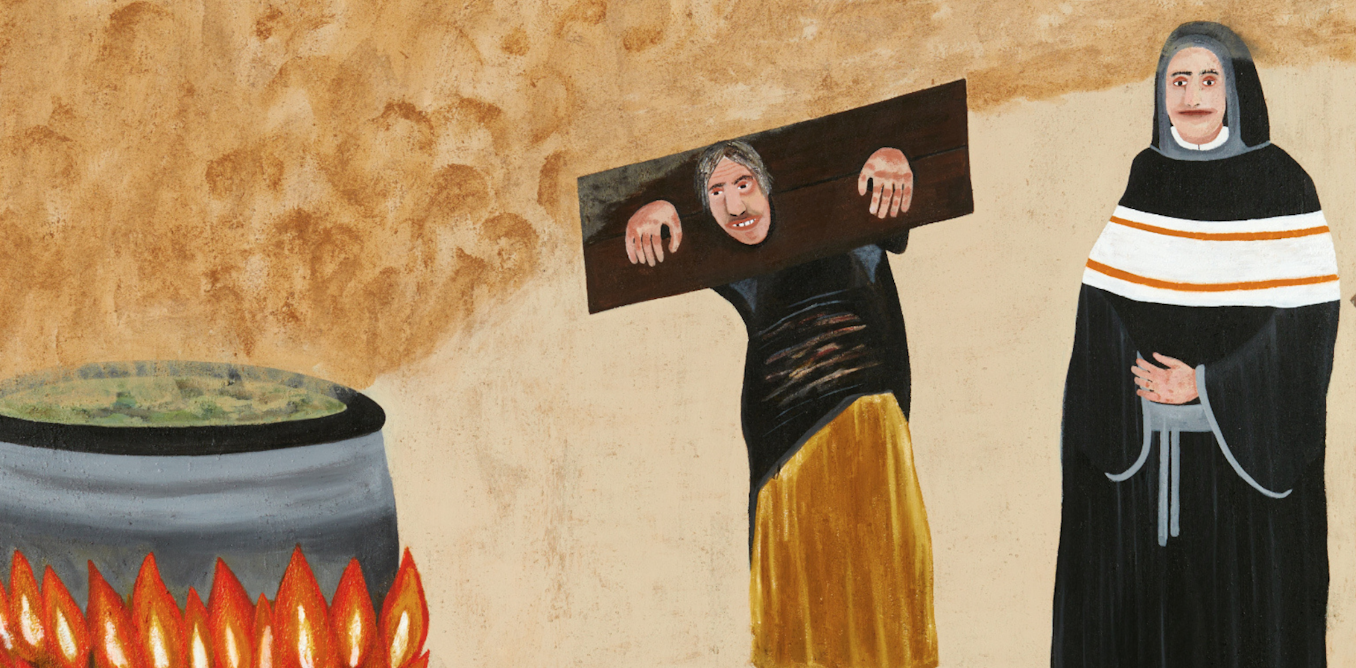
Entering The Raw and the Cooked at the Saatchi Gallery in London, you are faced with a single enormous painting that occupies the whole of the opposite wall. The Punishment of Richard Roose (2026) is a magnificently anachronistic project: a museum-scale picture of a fairly obscure episode of English history. Stiff, stylised, life-sized figures stand against a plain background in this painting by Harry Jones London, curator of the exhibition. At its centre, a boiling cauldron emitting a toxic cloud of steam is the imminent destination for the unfortunate figure standing beside it with his head and hands trapped in stocks. There are monks, men-at-arms, heraldic banners, sinister dogs – everything needed to get medieval with this punitive spectacle. But the punishment of who, and when? In 1532, Richard Roose, a cook convicted of poisoning, became the first person in England to be executed by being boiled alive. He was sentenced under a novel poisoning act passed specifically for his case. The appalling spectacle of the cooked cook – an irreplaceable human consciousness reduced to mere meat – appears to exemplify what the medievalist Umberto Eco called the “barbaric” medieval in every way. Except that this event did not actually happen in the middle ages (500 to 1500). This is a picture of a Tudor-era atrocity that medieval English law would never have permitted. Although the middle ages of the exhibition’s title sometimes anchors to the historic period, it primarily lays claim to a collection of tropes that have come to be seen as medieval. For instance, the exhibition’s statement of intent cites the idea of an artisanal medieval age. This is “the physical world of the handmade – that of leatherwork, metalwork, woodwork, painting, ceramics and even baking”. It summons up medieval with a special claim on spirituality via the “human impulse to find meaning and community”. The exhibition’s modern artistic interpretations raise further notions of the medieval. Jessica Luostarinen’s paintings, Fitting (2024) and Fitting – 2 (2025), combine the chivalric medieval of knightly adventure with the contemporary and futuristic. Here we see images of an androgynous figure being encased in plate armour that could be interpreted as cyborg-like. Where are they now? The commonplace medieval sentiment of nostalgia and lament for the transience of worldly things proves remarkably durable, and is explored at length in this exhibition. Many pieces ask “Where ben they bifore us were” (Where are they who lived before us?), in the words of a 13th-century English lyric. Jakob Rowlinson’s sculpture, The Apogee of Foolishness (2024), includes shoes transformed into grotesque masks. The Prada shoe used to create a death mask sees a medieval moral take modern form. This is a witty reimagining of the memento mori, an object that reminds viewers of the transience of worldly goods and of their own, inevitable mortality. The Apogee of Foolishness by Jakob Rowlinson (2024) Huxley Parlour/Jakob Rowlinson In metal artist Caitlin Hazell’s Pilgrim Badge Replicas (2024), sharp and detailed initial castings – imitations of the mass-produced badges that medieval pilgrims bought at shrines – deteriorate into indistinct and fragmentary forms. These tiny objects are a meditation on fragility and the passing of time. But some of the most successful works do not explicitly cite the medieval. Hazell’s Unknown Individual (2024, rebaked 2026) is a life-sized skeleton which, on further inspection, turns out to be made of bread. It is laid out in a vitrine framed by an assortment of pebbles, shells and driftwood – a relic of an imaginary past. Emmanuel Awuni also arouses the sympathetic frisson triggered by coming face to face with apparent human remains. His work Sankofa (2022) – a word from the Ghanaian Akan language “evoking the idea of reflecting on the past” – is a sculpted head broken open to reveal a golden leaf and a cowrie shell. Despite the implicit violence, its expression is serene. This profoundly emotive object is vulnerable, tender and precious. As the exhibition thesis says: “There is an undeniable resurgence of the medieval in contemporary art and culture” – and especially in contemporary visual art. Other such artworks have been shown at the National Gallery’s 2023 St Francis of Assisi exhibition, 2025’s Medieval Relics at Green and Stone, and the current Living by the Rule: Contemporary Meets Medieval at the Sainsbury Centre in Norwich. Academic medievalists have, on the whole, accepted that it is ungracious to complain if creative engagements of the medieval do not quite match our understandings of the period. Imagination can know things that scholarship misses. Mapping the contours of what people do with the medieval is more productive than policing it. This exhibition shows that the medieval, however it is understood, is still able to act in the present day. The Raw and the Cooked is on at The Saatchi Gallery in London until September 11
The Raw and the Cooked exhibition: art goes medieval in search of the aesthetic of the middle ages
Full Article
Original Source
Read the full article at Theconversation →KhanList aggregates and links to publicly available news content. We do not host full articles from third-party sources. Always verify important information with original sources.