
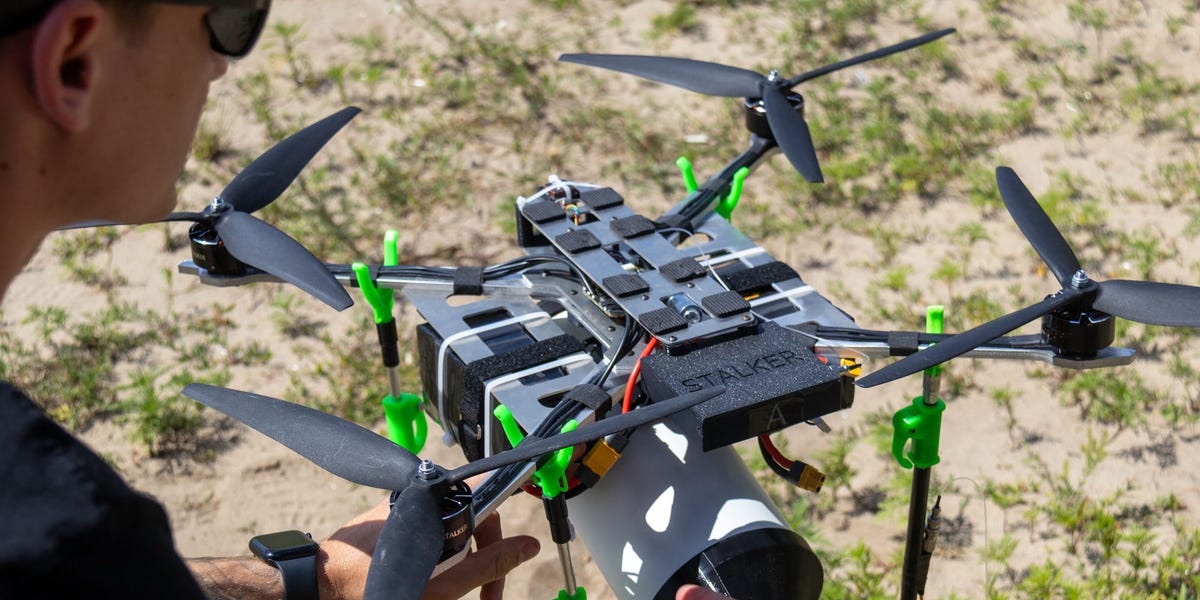
TechEx gathers constant battlefield feedback about its drones' performance and makes regular changes based on soldiers' requests. Ukrinform/Ukrinform/Sipa USA The fast-moving arms development race amid Russia's war against Ukraine means that the defense companies can't ever really consider a product finished or stop making regular updates, a leading Ukrainian drone maker told Business Insider.Ukraine's defense companies gather constant feedback from soldiers using their products in combat and make frequent updates, sometimes daily. Many companies and soldiers say that without these updates, their gear could become irrelevant on the battlefield within weeks.Oleg, an executive at major Ukrainian fiber-optic and interceptor drone maker TechEx, told Business Insider that "the most important thing is that you want this product to evolve over time. There will never be a moment when you just build a product, and it's just good."If a defense company "just stays with one single product, I think within three months, it will be outdated, and nobody will use it," he said, speaking on the condition that only his first name be used for safety purposes.TechEx's drones, he said, are updated weekly, sometimes with major modifications and other times with adjustments of just a few millimeters or grams.In this war, he said, "when you build a good product, the enemy builds the countermeasure." To stay in the fight, weapons makers must keep adapting. "You need to work constantly."Ukraine's Frontline Robotics, for example, told Business Insider that it gets feedback from soldiers 24/7 and makes small changes to its products up to 20 times a month, with major updates coming roughly every six months. Ukrainian soldiers assemble and repair drones close to the front lines, make upgrades, and give constant feedback and requests to their manufacturers. Carlo Bravo/Anadolu via Getty Images Ark Robotics, another Ukrainian company, said it may make about half a dozen different changes to a product over a few weeks.Companies are baking the ability for fast and regular updates into their design from the very beginning, making them modular and software-first so changes can be made remotely, quickly, and without needing to redesign or rebuild the entire product from scratch. The traditional model for Western weapons development is slower. A design is typically matured and tested before production, then is built in relatively stable batches for years, with changes made around scheduled upgrades rather than thinking about constant redesign.An analysis published by RUSI in December wrote that Western weapons systems "are treated as indivisible wholes, with procurement cycles often stretching over 10 to 20 years and upgrades requiring entire programme restructurings. This legacy approach treats innovation as a rare event rather than a continuous process."In Ukraine, companies and soldiers are allowed to directly communicate and innovate. Companies text, Whatsapp, and video call soldiers even when they are in the field to exchange constant feedback and requests. Ukraine's model is bottom-up and decentralized.Oleg said that TechEx's technical support department works with over 100 units to constantly support them and get battlefield feedback. Ukrainian companies often have employees who visit soldiers near the front lines, gather feedback, and help them make repairs or upgrades that can then be integrated back into the products. Soldiers often surprise Ukrainian companies with how they use or modify their gear, which in turn influences what they build and what features they add. TechEx updates its drones weekly, sometimes with small adjustments and sometimes with major changes. Pavlo Bahmut/Ukrinform/Sipa USA via Reuters Connect Western companies have long operated differently. Feedback from typically comes through a slower, formal chain rather than straight from the soldier who is using it. But many Western companies are starting to change their processes, particularly those with products in use in Ukraine.Earlier this year, US Air Force Gen. Alexus Grynkewich, who oversees NATO military operations as the Supreme Allied Commander Europe, told Business Insider that NATO wants to establish the same kind of battlefield feedback loop that Ukraine has, and that's something allies are working on.The drawback to constantly changing or redesigning weapons is that it makes it much harder to produce at scale.Achi, the CEO of the Ukrainian-Estonian robot, drone, and software company Ark Robotics, previously told Business Insider that when "talking about scale manufacturing, any change comes at a very high price," slowing down or even halting production.But change is essential. "You cannot afford not to be able to make changes," he said. That forces manufacturers to anticipate changing battlefield needs while trying to maintain production.Oleg said that European partners need to prepare for the reality of constant adaptation in weapons development, a warning echoed by other Ukrainian companies and officials. He cautioned that Russia is "really good at technology" and at developing countermeasures to even Ukraine's best weapons. "They're being underestimated by a lot of people."For Ukrainian weapons makers, that means there may never be a point when a product is truly finished. Read next Business Insider tells the innovative stories you want to know Business Insider tells the innovative stories you want to know Business Insider tells the innovative stories you want to know Business Insider tells the innovative stories you want to know Sinéad Baker is a Military and Defense Correspondent based in Business Insider's London bureau, writing about Russia's invasion of Ukraine and NATO actions.Sinéad most often covers soldiers' experiences, military strategy, battlefield developments, weapons systems, the defense industry's response, and the impact on NATO and European security, and geopolitical decisions that surround the Ukraine war. She has reported from NATO’s frontlines and around Europe, has interviewed multiple prime ministers and defense ministers, has appeared on BBC News and The Guardian's politics podcast, and has been cited by Congressional hearings.Sinéad has also extensively covered US politics and previously led Business Insider's breaking news coverage from London.Sinéad previously completed a master's degree in investigative journalism at City, University of London, and has written for The Guardian, The Observer, and TheJournal.ie. Sinéad is the former editor of the multi-award-winning The University Times in Dublin.ExpertiseExperiences of soldiers in Ukraine, including battlefield developments and tacticsWestern military responses to the war, and lessons they should learnNew weaponry built for and in response to the war Email Sinéad at sbaker@businessinsider.com or find her on X. Ukraine Russia
The rapid Ukraine war arms race means weapons makers can never truly consider a product finished
Full Article
Original Source
Read the full article at Businessinsider →KhanList aggregates and links to publicly available news content. We do not host full articles from third-party sources. Always verify important information with original sources.